

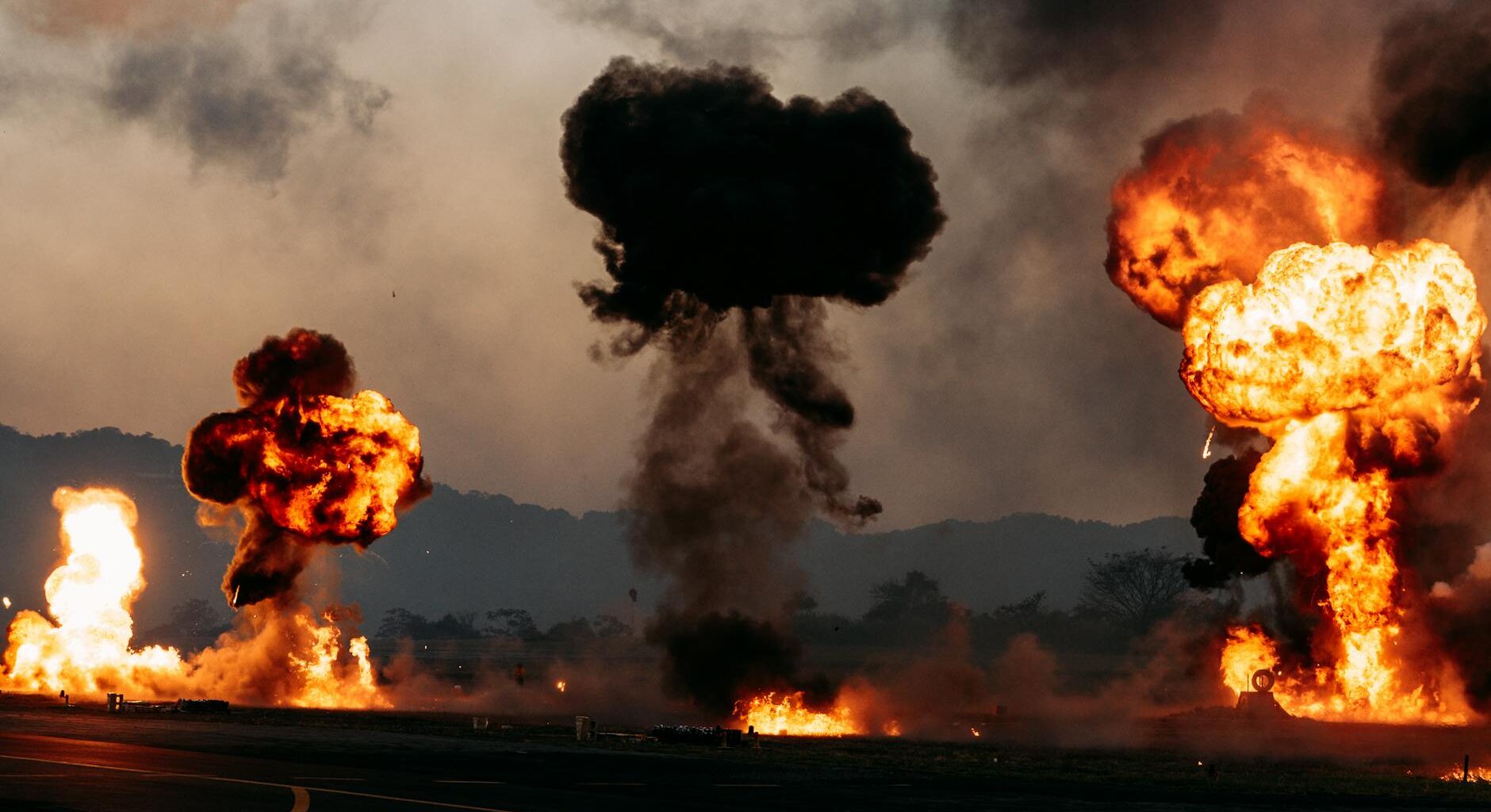
In a Pentagon press briefing this month, amid the ongoing war with Iran, US Defense Secretary Pete Hegseth quoted Psalm 144: ‘Blessed be the lord, my rock, who trains my hands for war and my fingers for battle.’ Hegseth, who has a habit of invoking crusades, and has written a book envisioning one, was eulogising American soldiers fighting in the Middle East, where a part of the Donald Trump administration’s narrative is the ‘liberation’ of the local populations subjugated by the Iranian regime. Hundreds of soldiers have complained to the US Military Religious Freedom Foundation (MRFF) that Christian religionist rhetoric, including prophesies surrounding ‘end times’, is being used to send troops to war as part of ‘God’s plan’. Trump, who has been described as being ‘anointed by Jesus’, according to some complaints received by the MRFF, has even hosted Christian faith leaders praying over him in the Oval Office.
Israeli Prime Minister Benjamin Netanyahu, meanwhile, has dubbed Iran the modern-day ‘Amalek’, the evil foes described in the Torah. ‘We read in this week’s Torah portion, “Remember what Amalek did to you.” We remember, and we act,’ he said, citing Deuteronomy 25:17, in Beit Shemesh earlier this month, at the site of an Iranian ballistic missile strike. Netanyahu has also frequently referred to Hamas as ‘Amalek’ since the 7 October 2023 massacre. This is all part of the growing influence of religious Zionism and Haredi factions on the Israeli government and the ruling Likud party, which is also encouraging radical Jewish violence in the West Bank.
Last month, US ambassador to Israel Mike Huckabee said, ‘It would be fine if [Israel] took it all’, referring to the Middle East. He has also frequently referred to a ‘biblical worldview’ that the US and Israel ostensibly share. Israel’s expansion in the region has gone beyond securing the territorial integrity of the Jewish state, with Netanyahu upholding the Torah’s description of Eretz Yisrael HaShlema, or Greater Israel, which is interpreted as the land between the Nile and the Euphrates.
In addition to shared biblical scriptures, Christian religionists, of both the Zionist and/or nationalist variety, now occupying key roles in the Trump administration, endorse Israeli policymaking owing to their belief in the second coming of Jesus in Jerusalem to signal the ‘end of times’. Ironically, while this Christian Zionist rationale for the war is being pushed to motivate American troops fighting Iran, it also inadvertently fulfils a similar Islamic prophecy about Armageddon. Islamic eschatology also prognosticates the return of Jesus to aid the Mahdi, a messianic figure who will defeat al-Dajjāl, the Islamic antichrist, before the supposed day of judgement. Sunnis believe that the Mahdi will be an Islamic leader yet to arise from the lineage of the Prophet Muhammad, while Shia doctrine claims that the Mahdi is the ‘twelfth imam’, who will return after being in hiding for over 1,000 years. The US and Israel have long been seen to represent al-Dajjāl in Islamist propaganda against the West, especially by the Iranian regime. Earlier this month, apparently noticing no irony, Hegseth also said that ‘Crazy regimes like Iran, hell-bent on prophetic Islamic delusions, cannot have nuclear weapons’.
The eerie similarities in the theological rationales used to fuel the war on both sides stem from the fact that the Abrahamic religions borrowed heavily from their predecessors and other faiths, especially Zoroastrianism, the ancient indigenous religion of modern-day Iran. The scriptural hostility against other, especially preceding, faiths, despite the multitude of commonalities between them, was necessitated by a need for the latter versions to differentiate themselves from the competing antecedents and contemporaries. This is why Judaism is especially wary of paganism and why Christianity, despite the emergence of a ‘Judeo-Christian’ alliance, has historically sought to erase its Jewish roots. Meanwhile, Islam carries that forward and has more tangibly targeted Jewish and Christian communities. So the idea that the local populations, which are today bearing the brunt of the wars in the Middle East, and which have long been subjugated by Islam, will be emancipated by Judeo-Christian religionists is, at best, conveniently disingenuous, and more likely deliberately malicious.
After centuries of Islamic totalitarianism, punctuated by the gory jihadism of recent decades, the Middle East has seen a surge in secularism and irreligion. This is best demonstrated by protesting Iranians, who have risked their lives to not only chant for the death of the ayatollahs and the Islamic Republic, but have also torched mosques and Islamic symbols in dissent. Even on the subject of peace with Israel, long held hostage to Islamic Judeophobia in the Muslim world, a growing number of voices in the Middle East have begun advocating the recognition of the Jewish state and supporting the Abraham Accords and their expansion.
But the wars in Gaza and Iran, along with the extreme, dehumanising, and inflammatory language of the radical Jews and Christians who dominate the corridors of power in Israel and the US, have also inspired a return to Islamic identitarianism on the part of many erstwhile secularist Muslims in the region. Many Muslims, who didn’t subscribe to Islamist or leftist absolutism, nor the correlated anti-Americanism and anti-Israelism, are returning to the brand of religionism that they are familiar with, one that might still safeguard them, as being ‘one of its own’, in an existential conflict. Better that, they must think, than being bombed by religionists of other communities that are looking increasingly likely to lump entire populations together in their war-mongering, scripturally-driven hysteria.
Indeed, one can argue with reason that the sheer lack of introspection among Muslim countries and communities, and the failure to acknowledge, let alone uproot, the violent bigotry against other religious groups and beliefs mandated in Islamic scripture and codified in dozens of Muslim-majority states, has been a significant factor in fostering mutual hostilities. But that doesn’t change the fact that the consolidation of anti-Muslim narratives, especially when they come in overtly religious packaging, whether as war cries in regional conflicts or political sloganeering for domestic audiences, is only hardening Muslim antagonism.
Far from liberating Muslims, hardline Judeo-Christian religionism is likelier to bolster the next wave of Muslim radicalism. Regardless of how the Iran war ends, the Iranian regime has already succeeded in laying the blueprint for a Shia jihad built on victimhood narratives and the glorification of martyrdom that will aim at the West. This will come in addition to the predominantly Sunni jihad that the West has witnessed in recent decades. Already, in fact, an Iran-aligned group has claimed responsibility for a recent attack on a London Jewish community.
In fact, many Muslims cheerleading for Iran around the globe are doing so across sectarian divides, with many deeming the Sunni Gulf states, with their seeming modernisation, as complicit in US and Israeli crimes. By taking a religionist approach, instead of a staunchly secularist one, in the conflict with the Islamic regime that they aim to topple in Iran, the US and Israel have inadvertently created pockets of ayatollah loyalists across the world. Those in the West who are cheerleading for crusades might soon have to wage them much closer to home than anticipated.
Related reading
Iran: Between Bombs and Theocracy, by Maryam Namazie
Image of the week: ‘The Iranian Genie’, by Polyp, by Paul Fitzgerald
Iran: On Power, Inheritance, and the Disciplining of Women’s Bodies, by Maryam Namazie
The Ayatollah, Theocratic Fragility, and the Rebellion of Iranian Women, by Yamin Mohammad
Iran-Israel, and beyond: the religious perspective, by Nicholas E. Meyer
Verses of Life: A Review of ‘Woman Life Freedom: Poems for the Iranian Revolution’, edited by Bänoo Zan and Cy Strom, by Daniel James Sharp
The Silent Revolution Against Religious Oppression in Iran, by Siavash Shahabi
The ‘Women’s Revolution’: from two activists in Iran, by Rastine Mortad and Sadaf Sepiddasht
Women’s Blasphemy and the State, by Maryam Namazie
On Israel, Hamas, and Refusing the Binary, by Maryam Namazie
Feminism and religion are incompatible, by Maryam Namazie
The Iran-Israel war is not a war of liberation or a pursuit of justice, by Fariborz Pooya
Israel’s war on Gaza is a war on the Palestinian people, by Zwan Mahmod
Israel in Gaza: Humanity’s Canary in a Coal Mine? by Brian Victoria
Is the Israel-Palestine conflict fundamentally a nationalist, not a religious, war? by Ralph Leonard
An Islamic (mis)education about Israel, by Hina Husain
The Anatomy of Zionism: Interview with Shlomo Sand, by Akash Srinivas
Christian nationalism threatens democracy. Secularism protects it. By Stephen Evans
White Christian Nationalism is rising in America. Separation of church and state is the antidote. By Rachel Laser
The Fourth of July and the Battle for America’s Soul, by Daniel James Sharp
American democracy will soon turn 250. Freethought can reinvigorate it. By Patrick Seamus McGhee
‘Project 2025 is about accelerating the demise of a functioning democracy’: interview with US Representative Jared Huffman, by Daniel James Sharp
Donald Trump is an existential threat to American democracy, by Jonathan Church
The radical atheism of the American revolutions: interview with Matthew Stewart, by Daniel James Sharp
The need for a new Enlightenment, by Christopher Hitchens






Your email address will not be published. Comments are subject to our Community Guidelines. Required fields are marked *
Donate