

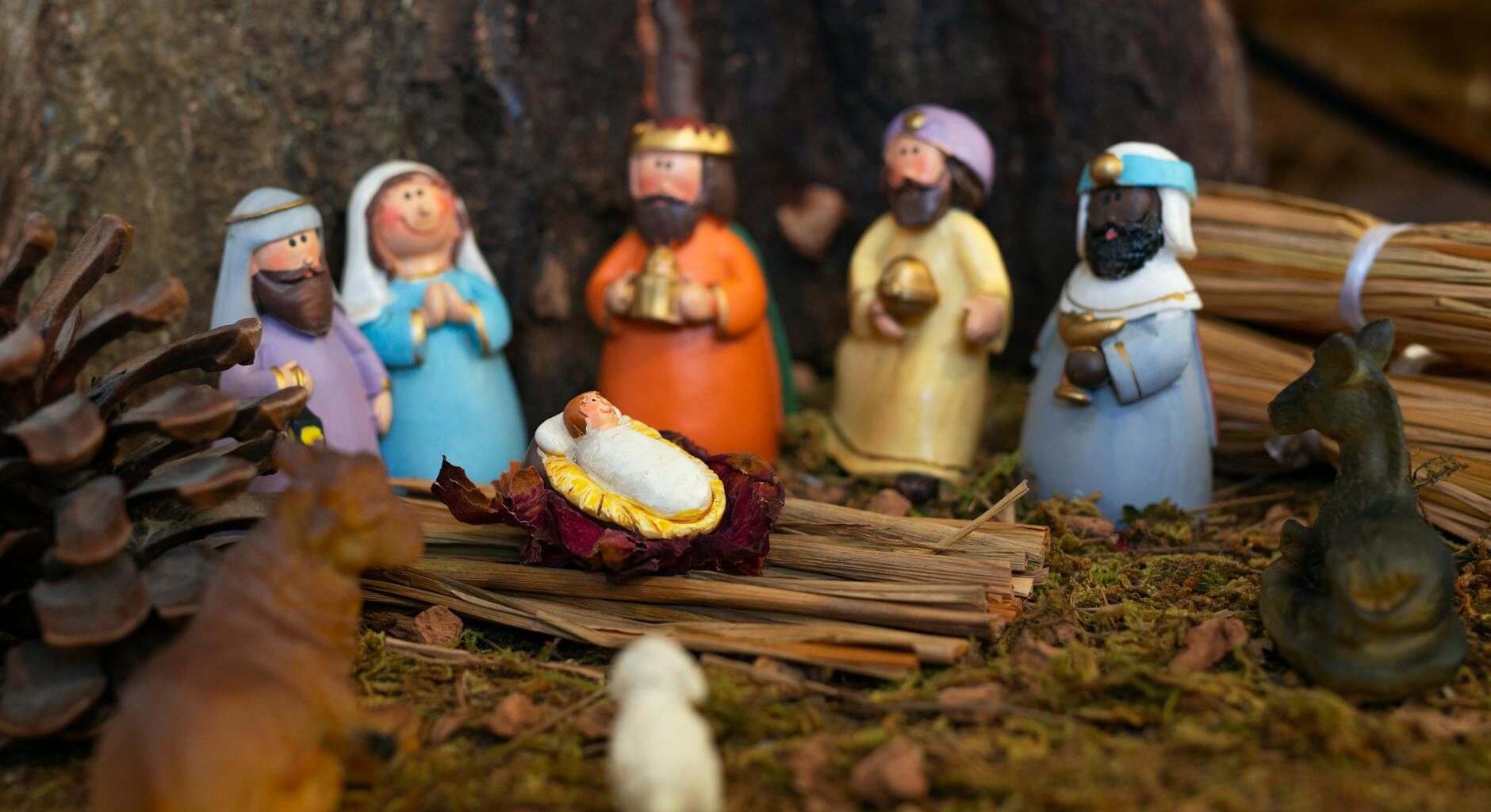
Many well-known ancient characters, both real and fictional, were alleged to be the products of miraculous births, usually fathered by a god and an earthly mother. Perseus and Heracles’ dad was Zeus, and Romulus’ was Mars. Helen of Troy was the daughter of Zeus, and the first Roman emperor, Augustus, was the son of Apollo. (Apollo and Zeus did quite a bit of this fathering with earthly women, apparently.) There were many others who claimed divine descent, including Alexander the Great.
It is against this background that two unknown Greek writers wrote a story of Jesus’ birth around 50 years after he had died. These writers are known as Matthew and Luke, although these names were only attached to the anonymous texts long after they were first in circulation. (There is no mention of the Nativity in Mark or John.) Our familiar Christmas story is a conflation of the two contradictory accounts. It is unlikely that the writers had any verifiable evidence from the event, which was distant—linguistically, geographically, and by 80 years or so—from their place and time of writing. Perhaps they used oral traditions or just made it up. They had to work around the tradition that Jesus came from Nazareth, while the Hebrew Scriptures ‘prophesied’ that the Messiah would be born in Bethlehem.
Our years are measured from the birth of Jesus, who we might suppose to have been born on 25 December of Year Zero CE. In orthodox Christian theology, he had always existed (even before the creation according to the later writer, John), but he was born (again?) to a virgin during the reign of King Herod while Quirinius was governor of Syria. Historical records, from the Roman historian Tacitus and the Jewish historian Josephus, tell us that Quirinius was first appointed in the year 6 CE and that Herod had died more than ten years before that. The exact date of Jesus’ birth remains uncertain but is estimated at 4 BCE.
Mary and Joseph were betrothed, not yet married, and Mary remained a virgin. But it turned out that she was pregnant. How could this be? A completely virgin birth would be a clone and hence female, so it would have been necessary to introduce genetic material to produce a male heterozygous embryo. Of course, it is possible to think of a quite non-miraculous explanation. But, per Matthew, Joseph himself had grave doubts until he had a dream in which an angel told him that it was all okay, so never mind those nagging doubts.
Matthew’s account implies that Mary and Joseph were in Bethlehem because that was probably where they lived, but Luke tells us that they lived in Nazareth and made the journey of 150 kilometres to Bethlehem to be recorded in a census decreed by Caesar Augustus for the whole Roman Empire. They had to make this journey because Joseph’s ancestor, King David, had resided there 1,000 years before. Can you imagine what such a census would have meant? Mass migrations would have been happening simultaneously all over the empire as everyone travelled to their ancestral homes (if they even knew where these were). Curiously, no other mention of this remarkable census has been found in any ancient record, nor is there any trace of its results, which would have been most interesting.
In any event, Jesus was said to be born in Bethlehem, presumably at his parents’ home (according to Matthew) or in a stable because there was no room at the inn (Luke). Both gospel writers must have been aware that his birthplace had to be contrived as Bethlehem, even though everyone knew that Jesus came from Nazareth, because Isaiah and Micah had predicted in the Old Testament that Bethlehem was where the Messiah would be born.
Only Matthew tells us that wise men had travelled from afar (he does not say how many). They followed a star. The idea that they were kings, or three in number, did not occur until the second century; they were given names in the sixth century and became venerated as saints. Cologne Cathedral preserves, even today, some bits of bone which were purchased from traders who assured them that they were true relics of the Magi’s remains. They still attract a constant stream of pilgrims.
It seems that the star guiding the wise men was not up to the standard of a modern GPS satnav. They lost track of it at Jerusalem, where, after they asked directions, it was leaked to King Herod that they were there to honour a new king. Herod wanted to stop that, so he ordered that all males in Bethlehem under two years old should be slaughtered. (Shouldn’t this mean that this must have been some months after Jesus’ birth, otherwise Herod would only have needed to take out the newborns?) The wise men, after this indiscretion, resumed their journey, and the star eventually took them to the very spot.
Joseph and Mary (in Matthew) fled to Egypt to avoid Herod’s cull of the male infants. After King Herod died, Joseph had another dream indicating that it was safe to return to Bethlehem, so they did. But Herod’s son was just as bad, so they relocated to Nazareth.
In Luke, they ended up in Nazareth, too, but they just went back home as soon as the census was done. There was no trip to Egypt. There were no wise men, only shepherds, and no slaughter of the innocents. There was no star.
Both Matthew and Luke have given us a genealogy of Jesus, tracing his male ancestors from Joseph all the way back to King David and then even further back to Abraham. Luke goes all the way back to Adam! Since Adam was created directly by God, this (kind of) makes Jesus a son of God by another route (or at least a grandson with a lot of greats). But this sort of reasoning would mean that we are all sons (or daughters) of God. Surprisingly, the two lists of ancestors give different names. Of course, the fact that Joseph was not Jesus’ father anyway is a complication.
There was no celebration of Jesus’ birthday for the first few centuries CE, and no date for it is mentioned in the Bible, but after Christianity gained power in the fourth century, a problem arose. Every 25 December, the pagans held extravagant celebrations for the rebirth of Sol Invictus, the Unconquered Sun. The Saturnalia celebrations involved exchanging gifts, eating and drinking too much, and having a great time (Christopher Hitchens once defended Christmas as at least being ‘a good old Norse booze up’). Even Christian converts were joining in. Since it wasn’t feasible to stop these celebrations, the Christian authorities relabelled it as Jesus’ birthday to make it a Christian festival.
We know that writers in those days were often just making things up; it was an age before the discipline of historical accuracy. Certainly, the apocrypha contain some very imaginative and obviously made-up stories, and the nativity stories show that such an approach made it into the canon, too. The writers of the nativities of Matthew and Luke were weaving two different tales around a core of a few shared beliefs. Stories were embellished very liberally at this time, so no one knows what, if anything, really happened when Jesus was born.
Is it not wonderful that our children are made to act out a conflation of these two contradictory tales each December?
Have a Merry Christmas and a Happy New Year!
Related reading
The Freethinker Christmas Specials (Or, Happy Solstice!), by Bob Forder
Jesus and Mo: Christmas cartoon 2022, by Mohammed Jones
Image of the week: ‘Moses Getting a Back View’ (1882), by Daniel James Sharp



Your email address will not be published. Comments are subject to our Community Guidelines. Required fields are marked *
Donate