

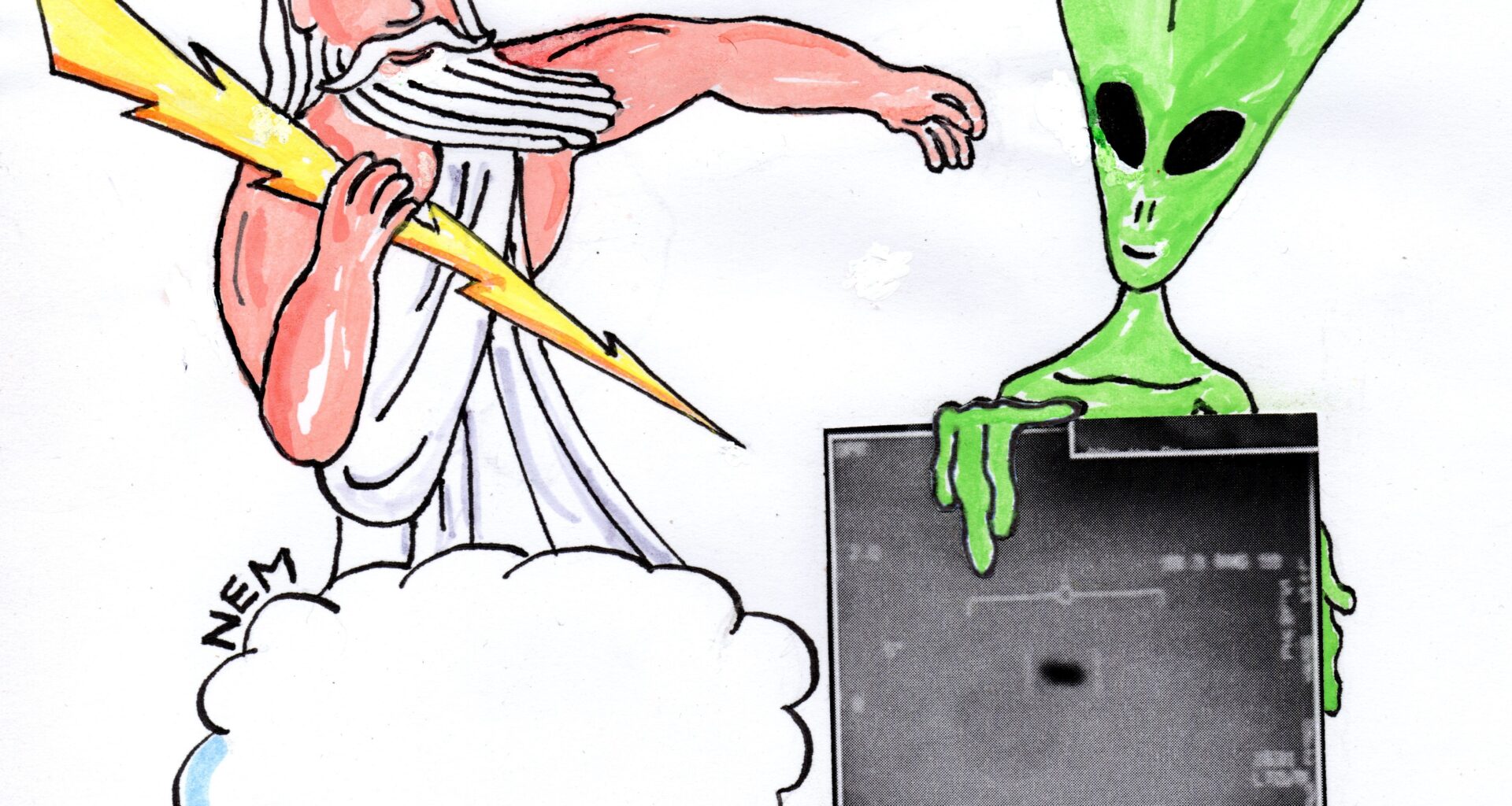
The origin, among our species, of belief in gods and other supernatural beings is so ancient—it seems that no matter how far back we go in human prehistory, we find hints of it—that we really ought to wonder whether chimpanzees believe in gods too. More precisely, not chimps but our common ancestor with them.
On the other hand, the process by which a belief in visiting or hovering aliens is acquired by people who had no such belief previously (and were not surrounded by relatives and communities already having such a belief), is often a perfectly contemporary phenomenon. And here is why it is of no little interest for studies into religion: it is a kind of time machine. Seeing it unfold is like being there at the dawn of otherworldly beliefs. Both operations so transparently satisfy the same psychological need, the impatient craving to replace uncertainty with understanding, however rushed its determinations and tenuous its grounding. (And further parallels with religious faith will be found below.)
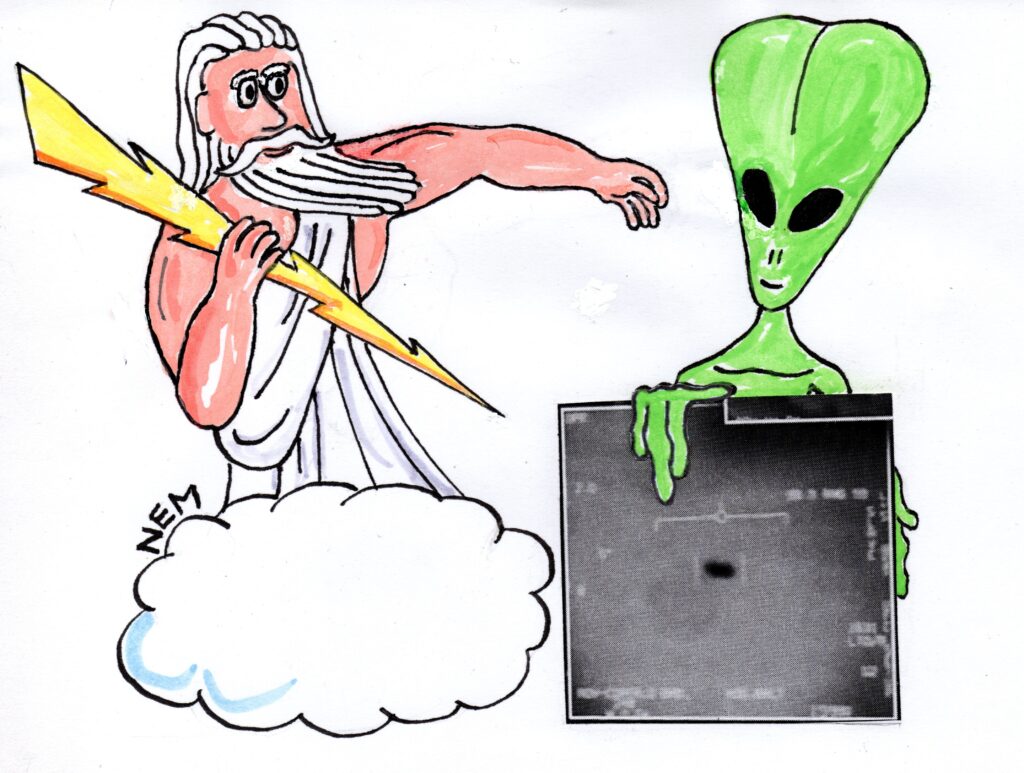
In other words: many people in our own times see something, often but not always in the sky, that they cannot understand, much less control, and jump to a definite conclusion: it is aliens. Before, if there was thunder, that meant there had to be gods of thunder. Now, if there is a bright light or a black smudge in the sky that current knowledge cannot account for, that means that extraterrestrials are poking around.
Here it is necessary to hurriedly emphasise that this in no way denies the enormous likelihood that life has also arisen in other parts of the universe than our own minuscule backwater. But the chasm between making that justifiable assumption, and holding that alien spaceships have crashed our borders—without even any attempts to obtain visas—is, well, sidereal.
The reason the chasm is so wide has to do with the Fermi paradox.
Enrico Fermi was as bright as can be demandingly asked for (he variously was the first to achieve a nuclear chain reaction, was the discoverer that slow neutrons were better for bombarding atomic nuclei than fast ones, and so on and on. He was the person who named the neutrino—no wonder the word ending sounds Italian.) But when, moving beyond his main field of nuclear physics, he made a celebrated remark about extraterrestrial life, he seemingly had not had the time to think it through. This was in 1950, during a casual lunchtime conversation in which UFO sightings came up. Considering the number of places in our huge universe in which advanced forms of life could have developed, he demanded, ‘But where is everybody?’ So many potential alien civilisations, yet not a single confirmedly authentic sign of any of them: few major scientific paradoxes have been worded so colloquially.
The paradox has been explained away, even though a large number of those explanations—and there are plenty to be found—do not even mention a very important last step in the reasoning.
What all the explanations do stress properly is that if life appears somewhere, there is an exceedingly good chance that it will remain at a very low level of development—single-celled or not much beyond that. Here on Earth, life consisted exclusively of single-celled and, much later, simple multi-celled organisms, for thousands of millions of years overall. That is by far the longest part of the planet’s history. Only 600 million years ago did complex multicellular life forms appear.
The short answer to Fermi is, ‘Everybody? Everybody may well be existing as something akin to bacteria or to pond scum—not as beings that can dabble with radio frequencies or build spacecraft.’
There are also more extended answers to Fermi. Next—they continue—life may also have to survive an obstacle race of mass extinctions, such as, on Earth, those ranging from the über-noxious Great Oxidation Event to murderous asteroid impacts. Then, suppose it dodges all such mega-bullets, as happened here by coincidence, lucky but certainly not preordained. There is no reason to expect that if complex life appears, some of it will necessarily go on to develop at least human-level intelligence. Plants and animals (or their counterparts in alien worlds) may very well find life niches in which they function optimally according to their needs, and settle in them indefinitely.
Sea sponges have remained sea sponges for 600 million years. Jellyfish, 500 million. The shark lineage has been around for 450 million years, meaning it has been content to remain as sharks since before there were trees, or Saturn had rings. Its current shapes have continued for 200 million years, with only some internal evolutionary changes. The crocodilians… but the point has been made.
And here comes the final argument in the dispelling of the Fermi paradox, one which, as mentioned earlier, often is not brought up. Yet it is as crucial as any. Even if and when intelligent beings develop (as we self-indulgently define intelligence), and form advanced societies (similar comment here), that does not ensure that the societies in question will in time become highly technological. That it eventually happened here is just one more in the quite improbable series of flukes that got us to where we are, for good or ill. Societies can become very complex and sophisticated and at some stage decide that this is as far as they will go, technologically; or they may have that decision imposed on them by events. Chinese civilisation is the best example of the former case, and the Maya may be of the latter.
In fact it happened to every single civilisation on our planet, save the European, and then only—as the Lord High Executioner sings in The Mikado—by a set of curious chances. Hi-tech was no foregone conclusion on Earth; there is no real reason to assume it is so in the universe at large. Alien societies may swoon over the beauty of their moons, without entertaining any earnest thoughts about actually going there.
When a culture voluntarily reaches a plateau in technological development, it may be because it loses interest or because of social self-complacency, as notably in the case of China, where it was felt that things under the incumbent emperors were as perfect as they could be—and people should not pursue change but only seek to emulate ancient sages. At this juncture it is hard to resist noting that religion could well play a part too. Here is a demonstration:
A second parallel between belief in celestial beings and in extraterrestrial visitors (after the shared fact of being adopted to patch over gaps in knowledge) refers to the figments’ imagined shape. Humans, with truly cosmic-scale conceit, conceive that gods—gods!—largely have the same shape as themselves. With aliens, while some writers may bother to devise other shapes for them, in general they are thought of as humanoid as well, with some touches as regards size and colour. Now let us take the case that they really are to some extent akin to humans. Humans, historically, cook up religions; it should then not be surprising if alien minds have similar bents. One thing that religions can be relied on to be is reactionary. Their natural tendency, once established, is to fight change tooth and nail (preferably their opponents’ teeth and nails).
Under the above assumptions, then, if any aliens take it into their bulbous heads to pursue tech progress, their clerics will likely torture and set them on fire to put a halt to such rot. Q.E.D. (If the beings are silicon-based, applying heat may not be quite as immediately satisfying a spectacle as with humans, but rest assured that they will come up with something equivalently painful.) Though religion’s obscurantism ultimately failed on Earth (in that field), it could succeed elsewhere.
It should be pointed out that belief in flying saucers can emerge among people who are otherwise sceptical-minded. Out-and-out atheists are not immune.
Here is a third parallel between the two alluded kinds of belief: humans flatter themselves that if their gods occasionally reveal themselves (personally, that is, or through a family member like a son, and not merely in their manifestations like lightning or floods, although a burning bush may serve the purpose), they will do so in the particular corner of the woods of the humans in question. And in their own general timeframes, not aeons before or later. Thus the Jews’ God and the Christians’ Son of God were active in the Middle East, and the Mormons’ Jesus visited the Americas. Ditto with extraterrestrials. They show the fuzzy shapes of their spacecraft in these very times of ours, and most frequently in what is still the leading power of the day, the United States.
Assuming some extraterrestrial civilisation did manage to avoid every one of the pitfalls in development listed earlier, and reached the stage of probing the universe, it is colossal hubris to assume it would be happening just now. It is said that infinite monkeys tapping away at keyboards for infinite time would eventually write all of Shakespeare’s plays. Admitting that, nothing justifies the idea that we would be there to watch when it happened.
There is also the matter of the Earth’s ‘radio bubble’. Earthlings have been emitting radio signals since circa 1900, i.e. for roughly 130 years. The signals’ expansion in space, proceeding at the speed of light, forms the bubble. It is consequently 130 light-years in radius now. Any extraterrestrials with the proper listening equipment and finding themselves inside that bubble’s 260 light-year diameter can detect our signals. None beyond it. The reciprocal situation, naturally, would apply to any alien emitter. Every emitter is restricted to its own bubble.
So much for the Earth bubble’s contemporary size; how about its potential far reach? Signals decrease in potency as distance increases (by a power of 2; the decrease can be even faster if there is interfering space dust and such). It has been estimated that the Earth’s emissions will, in this sense, be detectable up to a distance of about 12,000 light-years. That is miserable by universal standards but, all right, it is something. It means some aliens could detect us even that far. Of course, they will detect us in 12,000 years’ time. And if they answer, and do so right away, without endless debate in their academies and parliaments about the wisdom of doing so, their reply will reach Earth 24,000 years from now.
UFO fans—sorry, today the acceptable term is UAP, for Unidentified Anomalous Phenomenon—make much of the fact that many of the reported sightings have been near nuclear or missile facilities (which, needless to say, are more closely monitored than many other places). And especially that some of the sightings have coincided, so it is stated, with breakdowns at those sites, from which the enthusiasts conclude that the extraterrestrials are intervening to protect us from our technology.
This points to a fourth correspondence between the two sets of beliefs: in this case, it is the appearance of gods/aliens not only in order to fill in blanks in human knowledge, as in the first parallel drawn, but to assuage deep and very comprehensible human fears.
In any case, the rational thing to do, before scrambling to conclusions, should be the same as with religion’s alleged miraculous cures and the like. It needs to be determined, firstly, how many upsurges in UAP sightings around such sites have taken place with no technical breakdowns then taking place. And secondly, and conversely, how many times such breakdowns have taken place but without UAPs in the offing. In the absence of those data, and their analysis, the wise course would be to hold off on affirming that the aliens are here.
But—fifth parallel—belief in extraterrestrial beings is like belief in supernatural ones in that it is less about logic than about taking a leap of faith. Note that the size of the leap can be extensive. Some people hold that aliens have already set up a base on Earth. Hidden on the ocean floor.
New converts also consider it ‘proof’ of alien visitations when inexplicable sightings (at least, ones that are inexplicable at this time) are reported not by wild and ignorant hillbillies, but by NASA scientists and airline and Air Force pilots—and those people, people with serious haircuts, waver in their baseline disbelief that a darting light or dark blur perforce equals an extraterrestrial presence.
Such ‘proof’ involves not just one but two fallacies, although their effect here is interrelated. One is the venerable argumentum ad verecundiam, the appeal to authority figures. In this case, if respected figures like aviators go for it, it must be true. The second, less widely noted fallacy is that educated and bright people are immune from questionable beliefs; or, more generally, that people are of one piece, and therefore, for example, those who are wise and not gullible in one aspect of their lives are equally so in all of them. Yet one can hardly ask for greater intelligence than Newton’s, and his mystical convictions have always been an embarrassment even to many religious believers.
So yes, NASA and Air Force types are perfectly prone to leaps of faith too.
Yet a sixth coincidence can be pinpointed between beliefs in extraterrestrials and in otherworldlies. Once people acquire such ideas, they may tend (often rather quickly) to regard those who do not share them as worse than just unenlightened. ‘Having seen the light’ about space visitors, they may find there is something wrong with the disbelievers as persons—something sinister. Namely, they are conspiring to hold back or even combat ‘the truth’ that should be revealed to all. This is as fanciful as the diverse films that feed on the legitimate fascination of the subject. However, there can be a real danger if and when ‘other beings’ believers, whether paranoid like these ones or not, someday get to coalesce into cults that feel that only they are the righteous ones. And that statement is not itself paranoiac; it is history.
There is a bright side. At least, the mindset debated in this article—the hasty attitude towards something that should be left open until science catches up—generally concentrates on extraterrestrials. In modern thinking, it does not extend to other pending scientific matters. (This side of the Big Bang. For most people, the creation of the world in which the Big Bang appeared is still by godly fiat.) Before Einstein precisely accounted for it, the anomaly in the precession of Mercury’s perihelion was not held, by those who had heard of it, to be the work of a genie—or of aliens from that planet. Of the many theories today about dark matter and dark energy, none hold that they are the doings of gods or monsters or demons.
That hopefully disposes of the dispute. Anyway, this writing has to end here—it may sound strange, but there is a green homunculus at the window, apparently trying to get i–







Your email address will not be published. Comments are subject to our Community Guidelines. Required fields are marked *
Donate