
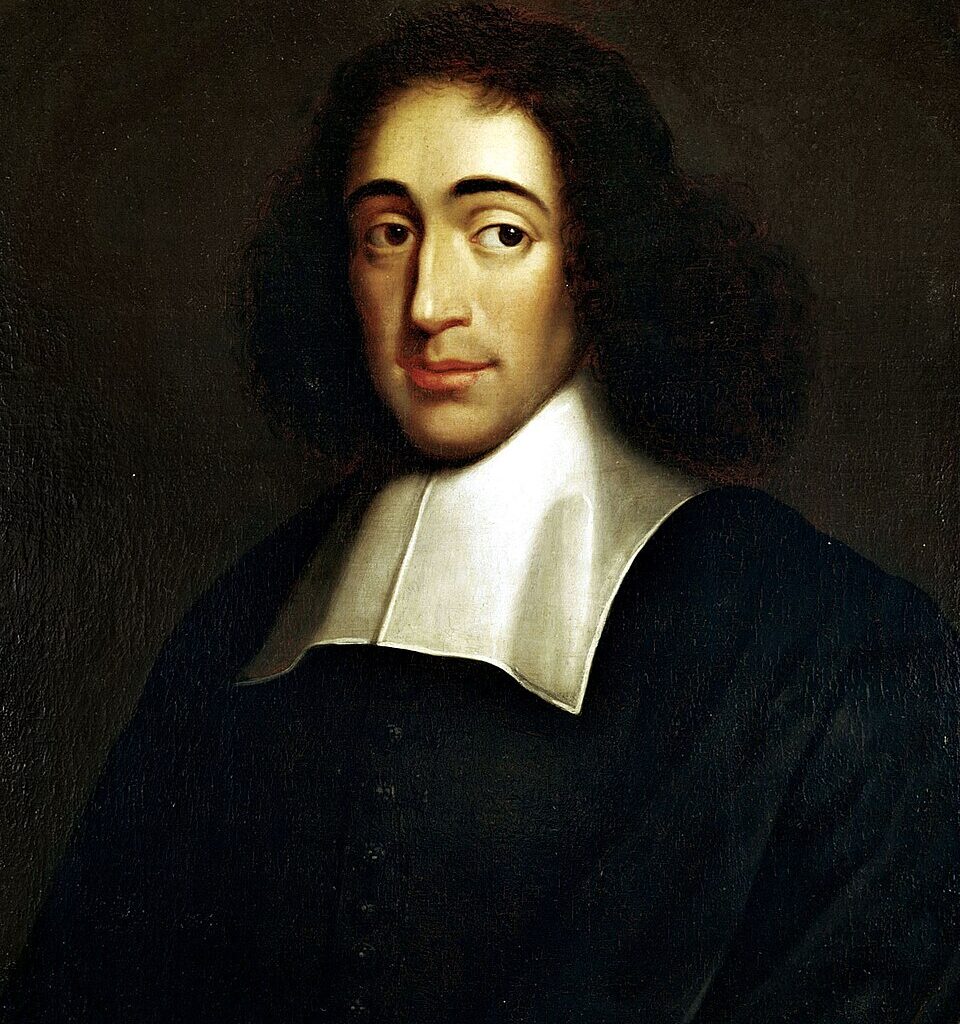
Benedict de Spinoza (1632-1677) was an atheist. He was a systematic atheist. His atheism was fundamental to his ethical and political project. Spinoza’s contemporaries in the seventeenth-century republic of letters were in little doubt on these points. Gottfried Wilhelm Leibniz (1646-1716), who knew Spinoza personally and must count as one of the most perceptive observers of the age, wrote that he ‘was truly an atheist’. Pierre Bayle (1647-1706), the first and arguably the greatest of the modern historians of philosophy, called Spinoza ‘the greatest atheist that ever was’.
In subsequent centuries, some of Spinoza’s interpreters pushed alternative, religious, or even theistic understandings of his work. Most famously, the German polymath Novalis (1772-1801) branded him ‘that God-intoxicated man’. The more informed critics over the centuries, however, have reliably seen through these anachronistic re-interpretations.
Much more colour and nuance may be added to the story. There are the varying definitions of atheism to consider, the historical setting within which Spinoza worked, his own efforts to evade charges of atheism, the multiple agendas in play among subsequent interpreters, and so on. But the core facts won’t change. Spinoza was an atheist—a systematic, deeply motivated atheist.
Steven Nadler gets it.
In his succinct and elegant new book, Spinoza, Atheist (Princeton University Press), Nadler fills in the historical and biographical context, parses the relevant definitions, and performs the necessary philosophical analysis. Along the way—precisely because atheism is so central to Spinoza’s project—he supplies an admirable introduction to the philosopher’s work. This is a book that should be of interest even to readers who don’t know much about Spinoza, never mind whether he was an atheist.
I could end this note here, but I will unpack just a little more, if only to underscore why the debate in this seemingly remote corner of the history of philosophy matters.
***
Definitions of atheism are a bit like definitions of pornography. They vary significantly across time and place. And they often reveal more about the eye of the beholder than the matter at hand. Still, most people, not unreasonably, are pretty sure that they know it when they see it.
Leibniz said simply that to believe in God is to believe in a supremely powerful being that structures our world in an intentional way, is deserving of our worship, and cares about us. Either you believe that such a being exists, or you are an atheist. If you ask the person in the street (or in the pews) today, you are most likely to get a similar, straightforward understanding of atheism.
To be sure, theologians, academics, and philosophers since ancient times have offered up a variety of counterintuitive ideas of God and religion, along with correspondingly diverse ideas about atheism. Maybe God is just the beingness of beings, or the Breath of the Universe, or a way of doing things, like gardening just so, or a certain kind of experience, like the sublime vision of a reddened sun through a thunderstorm or the feeling you get from a well-wrought cappuccino in the morning. Religious authorities since ancient times have generally condemned these exotic creeds of the philosophers as disguised forms of atheism. Today, on the other hand, a healthy spirit of toleration on the subject prevails. We like to think that everybody is entitled to the God of their choice, which means that the label of atheism is equally generous—and vacuous. Who is to say whether the sunset lovers and coffee-bar worshippers are atheists or not? And what does it matter?
Spinoza, in case you didn’t know, devotes the first part of his most important work, the Ethics, to a proof of the existence of what he calls ‘God, or Nature’ (also ‘Substance’). So, the suggestion that he is not an atheist does at least have a leg to stand on, though that leg is obviously planted in the alt-God territory of the philosophers. The real trouble, however, starts with the nature of the God/Nature/Substance whose existence he proves.
Spinoza’s Nature is a far more interesting concept than the nature invoked in today’s dinosaur and polar bear documentaries. But it isn’t God in any sense that the man on the street for the past several centuries would recognise. Leibniz, Bayle, and now Nadler are clear on this point. Spinoza’s ‘God or Nature’ has no will and no intellect; it can’t choose to make things turn out any differently than they do; it won’t do anything for you that you don’t do for yourself; you can love it, in a very intellectual way, but it has zero interest in your rituals, and it won’t love you back.
The crucial point—and the reason why we can’t just let Spinoza ride off into the stormy sunset with his own private deity—is that these rather un-God-like features of Spinoza’s God aren’t there by accident. They arise in a systematic way from all the other elements of his philosophy. More to the point, these deeper, philosophical roots don’t merely permit atheism. They positively exclude the very possibility of theism in essentially all the many varieties that populate the history of religion.
For example: Most forms of theism (and all that can survive on the street) take for granted that belief in God is an act of faith. We exercise our free will by choosing to believe in God. Or not. But Spinoza denies that we have any absolute faculty of free will, and he further denies that the will has any power over belief. A supposed act of faith, in his view, posits no understanding of the world; it is merely a vow not to think about certain things. So ‘theism’, as most people understand it, never gets out of Spinoza’s epistemological gates, as it were.
Another example: Most theisms are predicated on the intuition that morality is incapable of standing on its own feet. Without a deity to issue moral commands, the thinking goes, we can’t know what is right. Without divinely ordained rewards and punishments, humans can be counted on to do the wrong thing. Spinoza, on the other hand, argues that morality is very much self-supporting. Virtue is its own reward, he says. There is no room for a belief in God in Spinoza’s moral economy (at least among philosophers). Indeed, he further maintains that such beliefs, insofar as they involve favouring an imaginary deity in hopes of receiving favours in return, are just an invitation to vice.
Another example: Most theisms suppose that it is possible to derive some immensely valuable truths from that which we cannot understand. God may be inscrutable, mysterious, forever beyond the reach of our frail cognitive faculties, according to many traditions, but the mere fact of his existence is enough to require our obedience. More than that, God can always send us a sign from the other side of our comprehension, maybe a holy book, a prophecy, or just warm up our morning coffee in a revealing way, which will tell us everything we need to know to save ourselves. Spinoza, however, insists that to understand something—anything—is to understand its causes. From that which we do not understand, he concludes, we learn precisely nothing.
In short, Spinoza isn’t an atheist in the way that some other philosopher might just have a fondness for chocolate ice cream or Broadway musicals. Even when he is talking ethics, epistemology, metaphysics, and logic, he is also talking atheism.
Why is he so obsessed with an entity that, by his own reckoning, cannot possibly exist? Here Nadler’s interpretation is at its most insightful. Unlike many of our present-day atheists, Spinoza does not take a zero-sum approach to the old theologies. There is something worth keeping in the misguided ideas about God, he suggests, even if we need to kill off the God delusion to locate it.
There is a power greater than us, whose extent and workings, though always intelligible in principle, can never be fully comprehended, a being within which we live and move as finite, dependent beings. We can find happiness and virtue, even achieve a state of ‘blessedness’, by worshipping this power. Only, this supremely powerful being isn’t God; it’s Nature. And the way to worship it is not to build altars, offer ritual sacrifices, or scrutinise Bronze Age texts but to collaborate with our fellow philosophers in pursuit of greater understanding of ourselves and our world. What Spinoza offers isn’t a theology but an anti-theology—a deconstruction of ‘God’ that maps everything of value in the idea onto purely rational, secular foundations and discards the allegedly divine or sacred remainder.
There is a positive project in this variety of atheism. Spinoza’s work is, most fundamentally, an effort to elucidate an ethics for those who have embraced a philosophical way of life. But there is a negative project, too. The message that speaks most loudly through most forms of theism (and is often covertly expressed even in the exotic alt-theologies) is this: Obey. Submit to the commands of your lord—or there will be hell to pay. This is a message that has reliably warmed the hearts of dictators, kings, and oligarchs through the ages. To paraphrase Spinoza: the key to establishing a tyranny over one’s fellow humans is to cloak the fear with which they must be held in check under the specious garb of religion, so that they will fight for their servitude as if for salvation.
Spinoza, in other words, was a political revolutionary, and he was calling for a revolution against God, in a manner of speaking. His philosophy is a philosophy of freedom—most especially, a freedom from God. If that doesn’t make him an atheist—and not just an atheist, but a deeply motivated one—what would?
***
Given the inescapably atheistic thrust of Spinoza’s philosophy, one might further ask, how did the alternative interpretations of Spinoza as ‘that God-intoxicated man’ come about? In the most interesting cases, the short answer is that his work was, for strategic reasons, creatively misrepresented, often by his own supporters.
John Toland (1670-1722), whom Nadler discusses, is a case in point. According to his most perceptive contemporaries, Toland was a paid-up Spinozist and atheist. The word on the street was that he was ‘a genuine Spinoza chick’. Yet, as Nadler points out, Toland advocates in some of his writings for a lyrical form of ‘pantheism’ that is too spiritually infused to count as genuine Spinozism. Elsewhere he offers severe criticisms of positions commonly attributed to Spinoza. Why would an alleged Spinozist deviate so much from Spinozism? Why would he say such mean things about his supposed hero?
Here I will quibble with Nadler, who wants to take Toland at his word (at least where his word contradicts Spinoza). Toland engages in a wide range of philosophical exercises; his public-facing works on pantheism are just one aspect of his oeuvre and not the most representative. The pantheism was meant for the brothers at the lodge. It was to be part of a liturgy of sorts for the Masons. It was a halfway house, a family-friendly form of atheism for philosophical novices that would get across some of Spinoza’s ideas without scaring the neighbours. As for Toland’s criticisms of Spinoza—on close inspection, they turn out to be criticisms of positions falsely attributed to Spinoza. Their real and intended effect is to defend Spinoza against certain misinterpretations.
You don’t need to postulate access to Toland’s inner thoughts or some secret code in his texts to see this, by the way. You can just track his influence on his successors. Lord Bolingbroke, Alexander Pope, and the Baron d’Holbach, among others, got most of their Spinoza from Toland and went on to make the same atheistic moves on their way to shaping the thought-world of revolutionaries like Thomas Jefferson and Thomas Paine. Atheism is as atheism does.
An equally pivotal case is that of Spinoza’s reception in Germany in the late eighteenth century, which Nadler also covers. When philosopher-playwright Gotthold Ephraim Lessing (1729-1781) was out as a Spinozist, the meaning of the charge was unambiguous. He was an atheist, fit for the lash, or at least for instant cancellation. Johann Gottlieb Fichte (1762-1814) and others came in for the same treatment in what came to be known as ‘the Pantheism Controversy’, ‘the Spinoza Controversy’, and ‘the Atheism Controversy’—which, tellingly, were universally regarded as three labels for exactly the same thing.
What were the philosophers to do in response? The short answer: re-invent Spinoza as that God-intoxicated man. Pantheism again figured as a halfway house. Those charged with theological crimes could wave the pantheism flag to say that they believed in a one-and-only everything-everywhere God after all, and not in the horrible, no-good, materialistic nature of Spinoza. The orthodox, for the most part, didn’t buy it. It was lipstick on a diabolical pig, as far as they were concerned. Among later philosophers and the general public, however, the image of Spinoza as a hermit saint, worshipping his own private deity, was perhaps too intuitively appealing not to stick.
In modern times, the reasons for the misinterpretation of Spinoza are less illuminating. Having absorbed a Counter-Enlightenment caricature of the Enlightenment as a hyper-individualist, reductively materialistic, profit-maximising creed that disenchants the world and gleefully paves the way to nihilism, some modern readers are wont to find in Spinoza’s subtle and sophisticated deconstruction of religion lots of things that don’t match the expected Enlightenment stereotype. From this they infer that he must have been religious after all. In fact, they mostly succeed in compounding a misreading of the Enlightenment with a misreading of Spinoza. Clare Carlisle’s recent book, Spinoza’s Religion, which Nadler discusses, is a case in point.
***
So, Spinoza was an atheist. Who cares? Getting the history right is always a good thing, of course, but on the seemingly arcane topic that Nadler addresses in his new book it matters much more than most people think. Through Toland and his merry band of followers, through Bayle and all those who saw through his strange, love-hate obsession with Spinoza, and through the many German philosophers who pretended not to like the naughty bits of his work, Spinoza’s atheistic philosophy spread widely and exerted a direct influence on the democratic revolutionaries of the early modern world. It rose again to great influence on those who took up the revolution anew in the struggle against slavery. If you want to gauge the impact of the radical tradition that begins with Spinoza, you just need to read the Declaration of Independence aright. And maybe a couple of Abraham Lincoln’s speeches.
The challenges that we face today are different, of course. But not all that different. I’m sure we can all name a corrupt authoritarian or two who promises to rule over us in the name of God. If freedom and democracy are to survive the assaults that threaten them today, we would do well to take a second look at the work of ‘the greatest atheist that ever was’.
Related reading
The radical atheism of the American revolutions: interview with Matthew Stewart, by Daniel James Sharp
Against the ‘New Theism’, by Daniel James Sharp
The rhythm of Tom Paine’s bones, by Eoin Carter





1 comment
Daniel, I haven’t paid you close attention since I perceived you repeating Hamas propaganda, but the headline of this piece did catch my eye. Years ago you challenged readers to debate you on a topic of their choice, and I responded with “Spinoza is the greatest atheist who ever lived” and you declined – I believe because you agreed with the proposition.
Here we are now with two of my favorite present day Spinozists – Stewart who wrote my favorite book of all time (Nature’s God – I’ve read it 10 times, The Courtier and the Heretic is also high up on my list) reviewing Steven Nadler’s new book, following on my favorite biography of Spinoza written by him. Thanks for publishing this.
Your email address will not be published. Comments are subject to our Community Guidelines. Required fields are marked *
Donate