This essay was originally published on Robert F. Lynch’s Substack, The Laughing Ape, on 26 September 2026.
Author’s note: This is the third in a series on taboos, following “Naked in America” and “The Ape in the Basement.” It is adapted from a chapter of a book I’m writing called, “That’s Not Funny: How America Lost Its Sense of Humor”, about humor, forbidden language, and the power we give to words.
I was ordering my seven-year-old daughter a banana split at the Ritz-Carlton in Puerto Rico on Christmas Day, 2022. Then, my phone rang. It was my wife calling from the pool in a panic. She was there with our four-year-old, William.
It started the way it always did. She told him to get out of the pool. He called her stupid. “We don’t talk to Mommy that way,” she said. He called her an idiot. She knew what was coming. “I’m going to count to three,” she said. “One. Two—” He called her a motherfucker. “Last warning.”
Then he used the word.
I was still holding the banana split when she tried to tell me. She couldn’t get it out— just “You have to come.” I put the banana split down and ran.
***
In 1934, the linguist Allen Read wrote about a word he couldn’t bring himself to print. The word, he explained, held “the deepest stigma of any in the language.” The word was “fuck”. The paper was called “An Obscenity Symbol” and Read never printed the word once in all fourteen pages. The Comstock Act had made distributing obscene material a federal crime. His related study of American bathroom graffiti was too filthy for U.S. publishers and had to be privately printed in Paris.
Less than 40 years later, by 1972—‘shit’, ‘piss’, ‘fuck’, ‘cunt’, ‘cocksucker’, ‘motherfucker’, and ‘tits’— were the stars in George Carlin’s “Seven Words You Can Never Say on Television” bit. Asked why he focused on those words, Carlin explained: “It’s superstition. These words have no power. We give them power by refusing to be free and easy with them.” Today, those words barely raise an eyebrow. Because of comedians like Carlin, what once shocked the nation is now background noise. And in some ways this is a good thing. Because when comedians normalize what is forbidden, they demystify it. They pop the balloon—and once the fear is gone, we can talk about things more honestly, without euphemism or shame.
Another way to gain perspective on taboos is to step outside your own culture. I trained as a biological anthropologist under Napoleon Chagnon, who spent more than a decade living with the Yanomamö, an indigenous tribe in the Amazon. One of their strongest cultural prescriptions is against naming people who have died — the taboo is so strong that even the slightest, unintentional utterance can lead to violence or even death. This might seem like a curious fact about a remote tribe — until you realize we do the same thing. Our own taboos feel so rational from the inside, but from the outside, they’re just as strange and magical as anything the Yanomamö hold sacred.
But prohibitions don’t just vary across cultures—they change across time too. Today’s taboos feel self-evident only because they’re the air we breathe—unnoticed because they’re everywhere. What we hold sacrosanct now was invisible to us a decade ago. What we will hold sacrosanct a decade from now is invisible to us today. It’s hard to imagine now, but for most of American history, a man seen in public without a hat would have been like walking around with your cock out. Although most of the old American taboos around profanity, sex and violence have vanished, new ones have popped up to replace them, and one word has risen above all the others.
That word is nigger.
It’s so toxic we can’t even say it — we’ve had to build a euphemism just to talk about it — “the N-word.” No other word in the English language has this kind of power. It’s been elevated to a sacred status, becoming our culture’s Voldemort. Even words that sound like it spark panic. In 2015 at the Comedy Cellar in New York, I saw Aziz Ansari perform a bit on the word “niggardly,” which means stingy, that I can no longer find. The N-word has become so unutterable that we may soon need a euphemism for the euphemism. Maybe something like “the letter-after-M-word.” If you think this is far-fetched: in 2017, after the Charlottesville protests, ESPN barred Asian reporter Robert Lee from covering a football game because his name resembled a Confederate general’s.
The word wasn’t always this radioactive. Lenny Bruce, in the early 1960s, opened one of his most famous routines with “Are there any niggers here tonight?” He went on to use the word twenty-two times in less than a minute, believing that its unsayability gave it its power and that exposing the taboo to sunlight would drain it of that power. That same year Bruce was arrested for talking about sex — not for using the word “nigger.”
By the 1990s, talking about sex was fine, but the N-word was now a moral tripwire with real consequences. Although it had become America’s biggest taboo, the word was still allowed, within reason— usable to make a point, or as dialogue in Huckleberry Finn or Pulp Fiction.
In other words, context still mattered. Words, after all, are just noises we make, and we give them all their power. In a New York Times piece titled “How the N-Word Became Unsayable,” linguist John McWhorter wrote:
“What a society considers profane reveals what it believes to be sacrosanct. The emerging taboo on slurs shows the value our culture places — inconsistently or not — on respect for marginalized groups.”
He calls slurs “magic words”—and every culture has them.
***
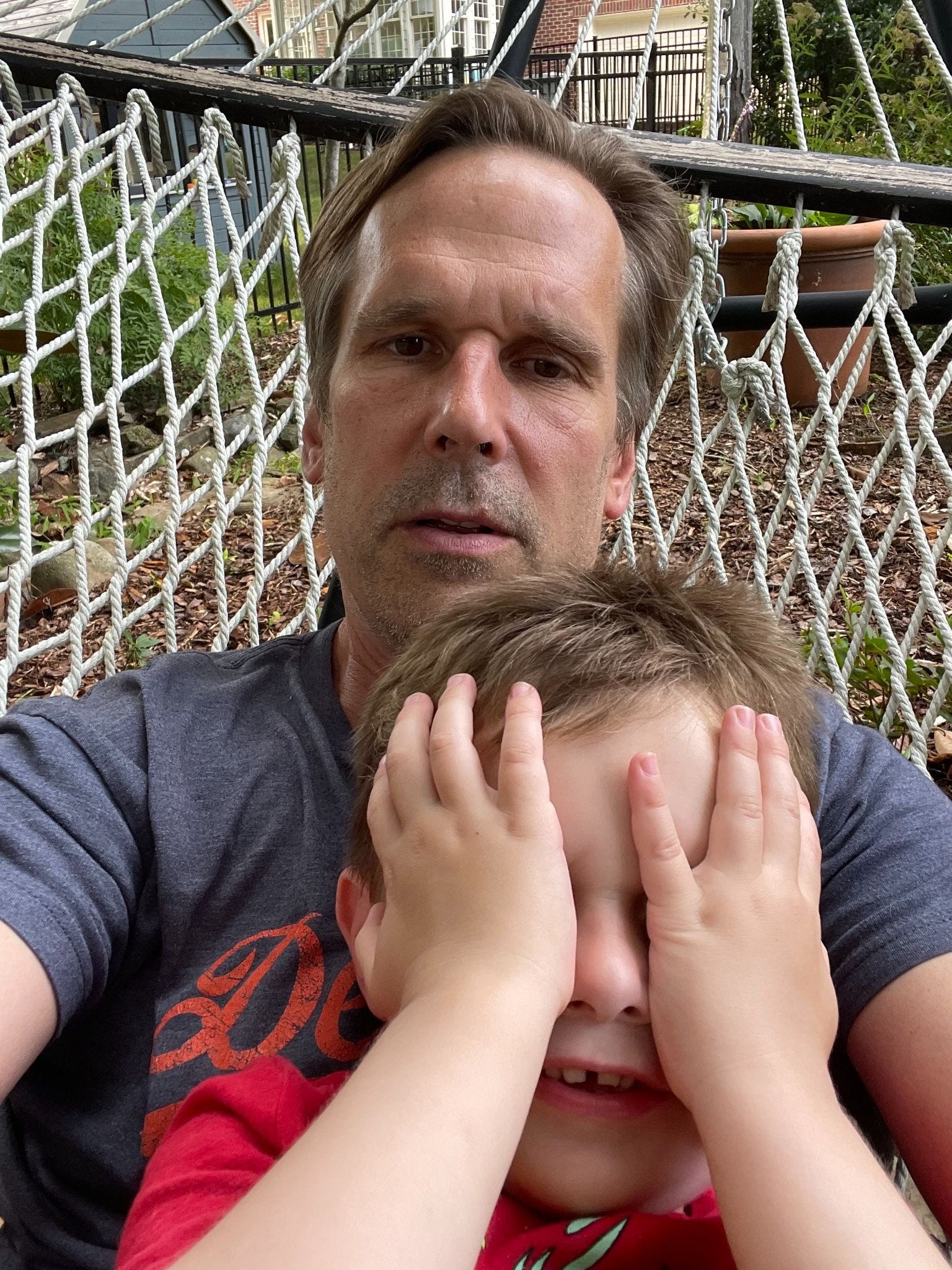
The banana split was still melting back at the counter when I got to the pool. We were at DEFCON 1 and I knew the drill. I rushed into the pool in my clothes and put my son, who was now calling me a ‘nigger’, in a football hold as a dozen or so guests, some of whom were black, watched in horror. I was afraid that someone was going to beat me up.
How did this all start? I should take some of the blame. I never really cared if my kids swore and actually thought it was kind of funny when my three-year-old said “motherfucker.” That was probably a mistake. At some point, though, he picked up the word. His preschool was half black, so I think he learned it there. My wife, however, thinks it’s because I yell “nigger!” every time I stub my toe. Anyways, let’s not blame anyone. Then one day, William casually called his sister a “nigger,” and my wife and I both freaked out. Of course it was our reaction that was the problem. We had handed the word and all of its power over to a four-year-old. If we’d stayed calm, it might have simply passed—a meaningless sound, no different from “motherfucker.” But we didn’t. We panicked, yelled, gave him time outs, and turned the whole thing into a hostage negotiation. And William, being a smart four-year-old, realized he’d found something that could freeze adults in their tracks.
Eventually, my wife and I managed to stop him from saying the word. But the whole ordeal left me wondering what we were really reacting to. On one level, this is just a story about learning a hard parenting lesson. But on another, it reveals our culture’s obsession with language stripped of context. A word, out of context, is just a sound. And coming from a four-year-old, that’s all it was — a noise that triggered a reaction. William had no idea what the word meant, no knowledge of slavery or racism. He didn’t even know that the word referred to black people. All he knew, and all he needed to know, was that it made adults lose their minds. McWhorter distinguishes between an obscenity and a slur. An obscenity is profane because of what it describes, while a slur is profane because of who it demeans. You can shout an obscenity at nothing; a slur needs a target. William was using the word as an obscenity, not a slur.
Our culture has turned the syllables themselves, rather than the intent or meaning behind them, into the problem. On January 30, 2022, the Twitter account @patriottakes posted a video showing Joe Rogan saying “nigger” again and again — no sentence, no context, nothing, just the word: nigger, nigger, nigger, nigger. Bruce had said the word twenty-two times in under a minute to strip it of power. Patriottakes said it twenty-four times in twenty-nine seconds to restore it. Singer India Arie started a boycott by announcing she was pulling her music from Spotify. One of those twenty-four instances, however, was taken from a segment in which Rogan had made the exact argument the video would inadvertently prove:
“The problem is when words get hyper-powered — like ‘cunt,’ or ‘nigger,’ or ‘faggot.’ ‘Faggot’ is the new one. Even ‘love.’ ‘Love’ is a hyper-powered word too. The word itself becomes more important than its meaning.”
They turned his own words about the dangers of taking words out of context and stripping them of their meaning down to a single word, and used it as evidence against him. Still, he was forced to apologize.
By getting too caught up in labels, we mistake the map for the terrain and blur the line between attacking someone for merely vocalizing a taboo word and using it to actually demean other human beings. In some cases, you have to bowdlerize history just to steer clear of these prohibitions. Joe Biden, for example, was criticized for quoting another legislator who said “We already have a nigger mayor; we don’t need another nigger big-shot” in order to condemn racism. But it didn’t matter. The word alone was enough to trigger outrage. Bernie Sanders was attacked for doing the same thing in one of his books — using the slur to illustrate the ugliness of racism. The syllables now matter more than intent or context, and uttering them is treated no differently than committing the offense itself. We’ve moved from judging meaning to policing phonemes— back to the days when people said “the F-word” to avoid saying “fuck.” Regulation itself isn’t the problem, and some lines are worth holding. We’ve just become better at policing the sound of a word than the intent behind it.
Good comedy can remind us how absurd it is to forget that distinction. The height of race relations in America may have come in a 2011 interview with Patrice O’Neal and Louis CK on ‘The Opie and Anthony Show’. O’Neal, who is black, was explaining the origin of the word ‘kike’ when Louis, whose father is Jewish, responded by explaining the origin of ‘nigger’. Louis asked,
“Do you know where the word nigger came from?… Originally? It was some black guy who was being a nigger. So they called him a nigger. He was being a real nigger. And he said, what a nigger. And that’s where it started.”
O’Neal, laughing uncontrollably, then interjected with “So nigger was a feeling!” Louis doesn’t back off from the joke or try to protect himself by saying he was just joking or by pretending that the word could apply to anyone. He acknowledges the obvious association of the word with black people — ‘some black guy who was being a nigger.’ And we all kind of know what he’s talking about too. The word (or concept really) is more likely to evoke the image of some pimp in Oakland than it is Barack Obama. But in the end, it’s funny precisely because it is so absurd. The joke tells us absolutely nothing about the word’s origins, because Louis and Patrice aren’t etymologists. They’re comedians, and their job is to fuck around.
Louis didn’t need to protect O’Neal from the word, and O’Neal didn’t need anyone telling him what he was allowed to find funny. There’s something condescending about assuming that Black people need to be protected not just from racial abuse but from ever hearing a word at all—as though they can’t distinguish between someone using it to demean them and someone quoting it, discussing it, or making a joke about it. In The Atlantic, McWhorter argued that requiring Black people’s feelings to be stepped around with such exquisite sensitivity hasn’t been required of any human beings, and that doing so is condescending. He wrote: “In supposing that Black people have no resilience, you are saying that Black people are unusually weak… [they], because of the circumstances of American social history, cannot be treated as adults.” Of course, another Black comedian might have found Louis’s joke offensive. But that’s precisely the point. Let people make that judgment for themselves rather than appointing ourselves as their protectors. If you’re feeling that instinct as you read this essay, or wish that I’d summarized Louis’s joke instead of quoting it in full to spare someone else from reading it, that might be worth examining too.
Louis explored the absurdity of a culture that hides behind euphemisms in ‘Offensive Words,’ a routine from his 2008 special ‘Chewed Up’:
“They found a way to say nigger, ‘N-word’, it’s bullshit because when you say ‘the N-word’ you’re putting nigger in the listener’s head. That’s what saying a word is.”
Later in the set, he highlights the importance of context through the multiple meanings of another taboo word, imagining someone hesitating before a blowjob by pontificating about how ‘people from Phoenix are called Phoenicians,’ before cutting him off— “Quit being a faggot and suck that dick.” (1:45-2:03). The bit isn’t about being crass — it’s about how context, tone, and intent matter more than the words themselves. There is a direct line of succession from Bruce and Carlin to Louis. Carlin dedicated ‘Class Clown’—the album with his ‘Seven Dirty Words’ bit—to Bruce, and Louis dedicated ‘Offensive Words’ to Carlin. The bit was nominated for an Emmy in 2009. In an illustration of just how quickly cultural prescriptions can shift, it disappeared from YouTube for five years while I was writing this book, only to reappear recently. I still don’t know why it left or why it came back.
None of this, however, is to say that words are just meaningless noises. There are good reasons I don’t yell “Cunt!” when I hit a backhand into the net or use profanity in church. Taboos are the adaptations of a species whose survival depended on signals of loyalty to the group. Muslims don’t draw the Prophet Mohammed, gentlemen remove their hats in the presence of women and Americans stand during the national anthem. When we turn ideas and words into sacred objects, we no longer have to defend them, and the group automatically attacks anyone who questions them. They mark communal boundaries of purity, loyalty and danger. Violating these norms isn’t just breaking a rule. It’s revealing yourself as a dangerous person. Taboos give individuals ready-made, culturally-tested responses to complex threats such as disease, corruption or violence.
These rules are both our superpower and our curse. While they let us cooperate at scale (money, nations and religions are all fictions we’ve agreed to believe), they also disconnect us from the world as it actually is and allow the symbols to become more important than reality. What do you think would be worse: an air strike on Gaza that kills real human beings, or the desecration of the Al-Aqsa Mosque? If you hesitated, you understand the power of symbols. The N-word holds the same power over Americans as depicting the prophet Mohammed holds over Muslims or that mentioning the name of a dead relative holds over the Yanomamö and none of these taboos feel arbitrary to the people who hold them. The Yanomamö’s prescription is tied to the spirit world, the Muslim prohibition is wrapped in religious belief, and the N-word is associated with slavery, lynching and Jim Crow. So maybe this sacredness is a good thing. After all, do we really want a society where nothing is sacred? Do we want profanity or slurs in schools, churches or courts? When filth is everywhere, it makes it harder to see what is true, good or beautiful and everything starts to sound like a bit.
Still, not all sacred boundaries deserve our reverence. Sometimes taboos and social norms are just a way to control people or protect the powerful. We’ve had taboos against women speaking in public, against gay people holding hands, and against having honest discussions about race, sex or religion. Some of those lines held communities together and some just humiliated the people who crossed them. A healthy culture needs a place to test these boundaries and in America that’s comedy clubs where we temporarily suspend reverence so we can see behind the curtain what we’re actually worshiping. Comedians pull back the curtain and let us see the world as Chagnon saw the Yanomamö, exposing the strangeness of the familiar. They remind us that our taboos might not be sacred truths, but passing customs—and that maybe, just maybe, we don’t need to be so afraid of the words themselves.
The Overton window moves quickly — what was unthinkable five years ago is commonplace today. But either side can overplay its hand. In 2022, a comedian using slurs on stage was unthinkable; in the post-woke era, doing so has become what Freddie deBoer calls ‘the rebel yell of the aggrieved normie.’ Normalize the transgression and it stops mattering. Police it too hard and you hand the transgressor all the power.
In 1995, in a Los Angeles courtroom, Mark Fuhrman’s use of the word ‘nigger’ — and then lying about it under oath — mattered more than the DNA, the blood trail, a shaky alibi, or a glove found in O.J.’s own yard carrying his blood and both victims’. A racial slur was more important than a double murder, and a man who’d nearly cut off his ex-wife’s head and stabbed an innocent waiter returning her mother’s glasses more than twenty times went free.
In the end though, I don’t really care about the juice getting framed or Rogan not being able to buy a better private jet. What I do care about is my country, our culture and what happens when a word starts to matter more than the reality underneath it.
A few weeks after we got home from Puerto Rico, I was putting William — who’d started calling it ‘the N-word’ himself now — in his car seat on the street when he asked me what the word meant. He asked it the same way he asks why I’m always pissing in our next door neighbor’s yard. I told him it was a word people used, and occasionally still use, to be mean to Black people, that it might hurt someone’s feelings, and that’s why we don’t say it. Then I stubbed my toe on the curb.



Your email address will not be published. Comments are subject to our Community Guidelines. Required fields are marked *
Donate