
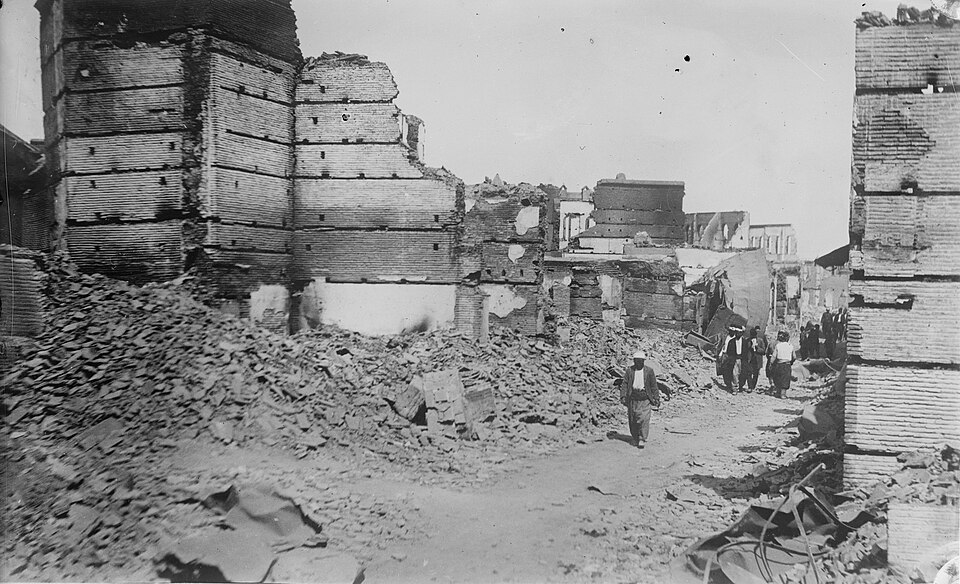
History has a dark sense of timing. The Israeli government lately voted to recognise the Armenian Genocide that took place in the late Ottoman period. The announcement, however, did not arrive as a long-awaited victory of historical justice. It instead emerged at a moment when Israel itself stands accused of conducting a genocide in Gaza before the International Court of Justice. Obviously, this convergence produces an ethical friction. Israel has spoken a truth through the rhetoric of political survival, as a strategic manoeuvre in the shifting sands of a wider regional conflict involving Iran.
Meanwhile, the Turkish state has positioned itself as a defender of Palestinian rights. It has rightly called out the devastation in Gaza, labelling Israel’s actions as genocidal. One could argue that Turkey’s position here is weakened by a psychological projection. While pointing outward at Israel’s crimes, the Turkish state is aiming to manufacture a clean conscience for itself. Turkey is using the real tragedy of Gaza as an ethical shield to obscure its own historical transgressions. Ankara has reacted defensively to Israel’s recognition, treating it merely as a hostile act amid the conflict in Gaza and the Iran War. However, the Turkish government should view it as a chance to reckon with its own history.
Recognition of the systematic annihilation of millions of Christians as a genocide, even a Christian Holocaust, in the late Ottoman period is a milestone regardless of the cynical manoeuvring of whoever issued it. Still, the current moment lays bare the ultimate limit of nationalist historiography. There needs to be a transition from a paradigm of geopolitical memory, where crimes are acknowledged only when it hurts an adversary, to a paradigm of universal memory, where state-sponsored mass violence is recognised just because it happened.
***
Using the term Holocaust to describe the Armenian Genocide is both conceptually and historically valid. In modern studies, the term typically refers only to the Nazi Shoah. However, from a comparative genocide viewpoint, applying Holocaust to the late Ottoman context highlights the comprehensive, state-driven, and ideologically motivated nature of the destruction wreaked upon Armenians, which preceded the European disaster.
Historians Benny Morris and Dror Ze’evi, in The Thirty-Year Genocide (2019), argue that events from the Hamidian massacres in 1894 to the Young Turk atrocities and the Kemalist purges of the 1920s should be seen as a single, ongoing thirty-year campaign against Christians. They claim that the state machinery, despite changes in regimes, maintained a consistent goal: eliminating Christianity in Anatolia. Similarly, Hannibal Travis in Genocide in the Middle East (2010) showed that the legal, physical, and psychological methods used by the Ottoman state provided a literal blueprint for later genocides in the twentieth century.
Importantly, Raphael Lemkin’s writings reveal that he based his idea of genocide on these events. Lemkin was deeply affected by the fact that a sovereign state (the Ottoman Empire) could systematically destroy millions of its own citizens without international law providing a way to intervene or punish the offenders. He combined the experiences of Armenians, Greeks, and Assyrians facing destruction with those of European Jews to create a legal framework aimed at protecting targeted groups from total destruction by the state. In other words, the roots of the Genocide Convention directly connect the Ottoman Christian experience to the European Holocaust.
***
Turkey following Israel’s lead in recognising the Armenian Genocide would not mean surrendering to foreign pressure or cynical manoeuvring. It means reclaiming the narrative of justice from the hands of geopolitical strategists. When a state recognises its own past atrocities, it strips foreign powers of the ability to use that history as a weapon. Denialism makes a state vulnerable. It turns history into an open wound that adversaries can salt at will. Recognition, however, is an act of domestic strength. It signals a society secure enough in its present identity to survive the truth of its past.
The demand of the current century goes beyond selective resolutions passed by distant parliaments. The demand is for an inward self-critique. Turkey must recognise the Christian Holocaust not because Israel or any other country recognises it, and not to appease the ‘West’, but because a healthy future cannot be built on top of an unacknowledged graveyard in Anatolia.
We live in an era where the word genocide is simultaneously minimised by perpetrators and weaponised by spectators. If we allow states to arbitrate which mass murders are remembered based on their current geopolitical and military needs, we reduce human suffering to a line item in a diplomatic register.
The convergence of the Gaza crisis and the recognition of the Christian Holocaust provides a necessary clarity. It exposes the utter bankruptcy of selective ethics. A state cannot validly mourn the victims of the past while remaining indifferent to, or actively creating, the victims of the present. Likewise, a state cannot champion the victims of the present while actively erasing the victims of its own past.
The only way out of this geopolitical gridlock is the establishment of a universal standard of historical accountability. Every state must undergo the agonising process of self-critique. Recognition must cease to be a tool of warfare by other means. It must become what it was always meant to be: an unconditional surrender to the truth.





Your email address will not be published. Comments are subject to our Community Guidelines. Required fields are marked *
Donate