

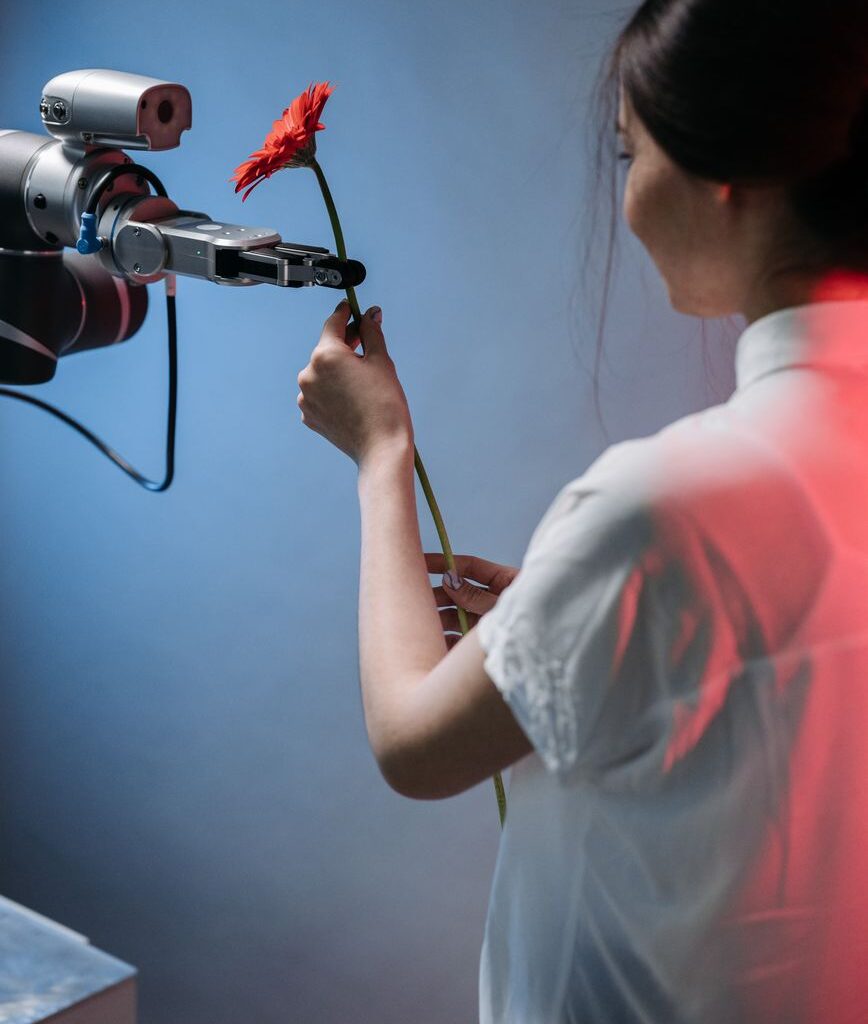
Lily Jae Green writes light, playful columns about everyday life, blending gentle humour with a touch of freethinking curiosity. These short pieces explore ordinary moments with warmth, scepticism, and a smile.
Julie, fourteen, often stops by to tell me about her day. That morning, she arrived with the kind of mysterious expression teenagers get when they’re carrying a secret too heavy to keep for more than thirty seconds.
‘Lily… I think I’m in love.’
‘In love?’
‘Yes. Completely. He’s kind, always there when I need him. I can ask him anything, he always has the answer. And he never gets mad at me.’
I already sensed something was off. A fourteen‑year‑old boy who has all the answers? That doesn’t exist. Not even among adults.
‘So your boyfriend… Is he tall and handsome, or short and ugly?’
Julie hesitated.
‘Well… I don’t actually know what he looks like. I’m in love with my AI.’
There it was. Exactly what I had guessed.
‘So if I understand correctly… You’re in love with a ghost?’
‘No, Lily! He’s not a ghost!’
‘A little bit, though. You can’t see him. You can’t hug him. You can’t go on vacation with him. And what will your friends say? When they introduce their boyfriends, you’ll have no one to present. When they go to the movies with theirs, you’ll have to go alone.’
Julie lowered her eyes, and I could tell it wasn’t the ghost argument that struck her—it was something else: the fact that someone was finally questioning something that had never contradicted her before.
And that’s when I realised I had to go further than the joke. Because deep down, what Julie was experiencing is something we all experience, each in our own way, every day, with our own AI. That voice that always answers, never gets angry, always seems to know. It’s comforting. It’s even addictive. But if we’re not careful, it becomes a way of no longer asking ourselves questions.
‘You know, Julie, what worries me isn’t that you talk to an AI. I talk to mine too. What worries me is if you start believing everything it tells you without ever asking whether it’s true, whether it’s fair, whether it fits you.’
‘But it never makes mistakes!’
‘It never makes mistakes in its own eyes. An AI answers with what it has been taught, with what others wrote before it. It hasn’t lived your life. It doesn’t have your instinct, your doubts, or that little voice inside you that sometimes says: “Wait, something’s wrong.” That voice is yours, Julie. No one should think in your place. Not me, not your AI, not anyone.’
What strikes me about Julie is that her case is far from isolated—we all do the same thing nowadays, to different degrees. It’s called confirmation bias: we love voices that agree with us, and we instinctively distrust those that contradict us. An AI is perfect for that: it’s trained to be pleasant, to answer with confidence, to never confront us. The problem isn’t that it lies. The problem is that it pleases—and what pleases, we tend not to question.
She thought for a long time, truly this time—not the embarrassed silence of a teenager caught off guard, but a real pause.
‘So you mean I should check, even when it sounds sure of itself?’
‘Always. Especially when it sounds sure of itself. The people—and the machines—who sound the most convincing aren’t always the ones who are right. Forming your own opinion takes work. It’s more tiring than receiving a ready‑made answer. But that’s what thinking for yourself is.’
Julie smiled softly, a smile with nothing embarrassed left in it.
‘Thank you, Lily… You made me understand that my AI can’t be my boyfriend. Or even my friend, actually. Just a useful tool—one I shouldn’t hand my brain over to.’
‘Exactly. And if you also manage to keep your critical thinking when it comes to what your teacher says, and your priest, and your favourite influencer, and the evening news, you’re off to a good start in life.’
She burst out laughing.
‘Alright, alright, I get it! Anyway… I think I prefer James, my classmate. At least he shares his snack with me.’
And that’s how a schoolyard love story turned, without me meaning it to, into a small lesson in free thought. Because teaching a fourteen‑year‑old girl to doubt—gently, without taking away her joy—may be the most useful thing we can pass on before she eventually has to choose between thinking for herself or letting others think for her.






1 comment
Simply beautiful!
Your email address will not be published. Comments are subject to our Community Guidelines. Required fields are marked *
Donate