In the space of a few short years, artificial intelligence has gone from a concept straight out of science fiction to an omnipresent force that has infiltrated every aspect of our lives, whether it be the healthcare system or the publishing industry. Searching for some new recipes? Ask Gemini. Want to conduct academic research? Leave it to ChatGPT. Just need someone to bat ideas off of during a brainstorming session? Luckily, Claude and DeepSeek have got your back. Over one billion people across the globe are reportedly using AI in 2026. In the US, a Pew Research Center report found that over half of Americans engage with it on a regular basis.
Yet no one uses it quite so regularly as President Donald Trump and his administration. It seems that every day, the White House releases a new piece of AI-generated content on its various social media channels. Certainly more so than any other government in the world. As a journalist watching these events unfold from across the pond, two thoughts have repeatedly played on my mind. Firstly, what is the administration trying to achieve through its use of AI? And secondly, has this fundamentally altered American politics?
The White House’s first piece of AI slopaganda has been viewed almost 40 million times since its release in February 2025. In a phoney cover of Time magazine, the president stands before the Manhattan skyline with a grin on his face and a crown on his head, alongside the caption: ‘LONG LIVE THE KING’. Now, I am certain that those words speak for themselves. Don’t be fooled into thinking that he is entirely egotistical, though; when the White House recently posted a photo of Trump standing side by side with the central figure of the British monarchy, they at least had the decency to caption it ‘TWO KINGS’, referring to Trump and Charles III (you know, an actual king).
But Trump’s choice of location for the first image, Manhattan, is highly significant. When his father, Fred Trump, died in 1999, Donald took over the family’s extensive real estate business. He was the main driving force behind the decision to move the company’s focus away from the residential areas of Brooklyn and Queens to the more glamorous borough of Manhattan. As a result, business boomed. Midtown Manhattan itself is the epitome of the qualities that Trump finds most admirable: wealth, power, and success. Just look at Trump Tower, his glitzy high-rise apartment block on Fifth Avenue. The mogul may have left his stamp on Manhattan, but evidently Manhattan left a lasting impression on him, too.
With so many luxury properties under his empire’s belt, Trump encapsulates the myth that is the American dream: the idea that if you work hard, you will inevitably make it big. (That he inherited money and power seems to have no bearing on how he views himself—or on how his most devoted followers view him.) This is a message he has repeatedly hammered home to his supporters, who are now reeling from the cost-of-living crisis (including higher energy prices thanks to the war he launched against Iran), during his last three presidential campaigns.
‘The president uses social media to make a point,’ said Mike Johnson, Speaker of the US House of Representatives, when questioned last year on the administration’s penchant for posting memes. ‘You can argue he’s probably the most effective person who’s ever used social media for that.’
Other AI-generated posts from the White House depict Trump in various other roles, such as a conductor, jet pilot, superhero, Sith Lord, the Pope, and even Christ. All of these are positions of control. Conductors lead the orchestra. The Sith ruled the galaxy in the original Star Wars trilogy. And the Pope is the most authoritative figure in Catholicism. As for the Jesus post…the less said about that, the better. Put simply, the White House is trying to convey the message that Trump is a strong leader and that his opponents are not worthy of being president. This is something that the administration is particularly keen to get across at a time when rumours surrounding Trump’s cognitive skills and physical health have reached a fever pitch.
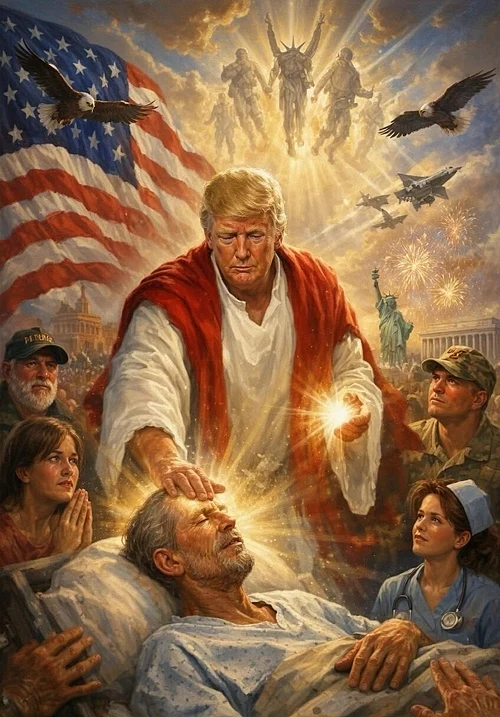
The imagery used, while caricature-ish, is highly effective. In one post that is reminiscent of an action movie poster, two patriotic eagles flank Trump as he determinedly strides forward into the ‘Golden Age’. In another, a lion, possibly the most ferocious creature in the animal kingdom, appears to see the president as its equal and takes a selfie with him. Even Trump’s Secretary of War, Pete Hegseth, has jumped on the bandwagon. Much to the dismay of Kids Can Press, the former Fox News host used an AI-generated image of Franklin the Turtle brandishing a bazooka to demonstrate America’s triumph over narco-terrorists.
These posts are reflective of an administration filled with machismo and bravado. From threatening tariffs on any country that doesn’t bend to America’s will, to pursuing the war in Iran with ‘maximum lethality’, and even demanding that Greenland (or Iceland, as the president repeatedly called it during his speech at the World Economic Forum in Davos back in January) become part of the US, Trump’s aggressive style of governance is both dominating geopolitical discourse and overshadowing cross-party collaboration at home. He has even used AI to make bizarre threats towards Iran (‘NO MORE MR. NICE GUY!’).
‘Donald Trump wants to dictate policies rather than have a classic “let’s work together across party lines” approach to governing,’ writes American businessman and founder of Bridgewater Associates, Ray Dalio, in his latest book, How Countries Go Broke: The Big Cycle.
When the president signed a record 143 executive orders in the first 100 days of his second term, he foreshadowed what was to come. Trump has since gone on to reverse a number of Joe Biden’s policies, told the Federal Reserve Chair how to do his job, and threatened to cut funding for universities that he deemed too ‘woke’. Now, he is facing down the Supreme Court in an attempt to overturn the 14th Amendment and end birthright citizenship. By seeking to present their leader as a king, mocking those who took part in recent No Kings protests, the White House isn’t just enabling Trump to alter America’s institutions to his liking. It is emboldening him. Perhaps this is why, despite the Constitution’s two-term limit, he has repeatedly floated the idea of running for president again in 2028. However, Dalio warns of allowing a world leader near-unchecked power: ‘Unlike for a CEO, there is no board for the U.S. president. Are there effective regulators in place? If so, it is not clear to me who they are.’
There are both merits and pitfalls to the administration’s strongman politics. It has brokered a tenuous ceasefire in Gaza and reduced illegal immigration along the southern border (although the exact number of migrants deterred from entering the US is debatable). But it has also frozen lifesaving foreign aid, left communities reeling from ICE deportations, slashed funding for medical research, and triggered a war with Iran that not only puts thousands of lives at risk, but also raises oil prices and threatens global food security. The White House seeks to portray itself as all-powerful, using AI-generated images to prove that nothing will stand in the way of America and its president. But at what cost?
We know that artificial intelligence is being used as a tool to spread political propaganda throughout America. Now, we are also beginning to see how AI-generated content reflects the biases of its users. During the run-up to the New York City mayoral election, which Democrat Zohran Mamdani ultimately won in November 2025, independent* candidate Andrew Cuomo posted a deepfake video claiming that his opponents’ supporters were criminals. The clip, which featured a black man shoplifting and another dressed as a pimp, was swiftly criticised for the racist stereotypes that it presented to Cuomo’s 115,000 X followers. Several months later, the president came under fire for posting an AI-generated video of American politicians as characters in The Lion King.
Why the uproar? Because he chose to depict former president Barack Obama and his wife Michelle as primates (a trope that dates back to the late 1500s, when it was used as a way to dehumanise dark-skinned Africans and justify their enslavement). One of the most influential people on the planet either didn’t bother checking the content that was being uploaded to his Truth Social account or thought it was appropriate to portray the Obamas in this way. The post was up for 12 hours before it was eventually pulled, and the president has since refused to apologise for it, blaming a junior member of staff for creating the video in the first place.
Artificial intelligence is being wielded by politicians to bolster their campaigns and even coordinate strikes on enemy targets. Their complete lack of seriousness over how it is utilised can be summed up by this quote from an anonymous senior White House official, recently given to Politico: ‘We’re over here just grinding away on banger memes, dude’. Unsurprisingly, ordinary citizens are concerned about how this will interfere with their everyday lives and influence their voting decisions. A 2025 YouGov survey suggests that 52% of Americans fear AI’s ability to spread political propaganda, while 76% are distrustful of AI-generated content, according to a recent Quinnipiac University poll. Additionally, the aforementioned Pew Research Center report found that just one in ten believes AI will have a positive impact on elections.
In fact, the situation in the US has become so dire that Staffan Lindberg, founder of the Varieties of Democracy Institute at the University of Gothenburg, claims that we are witnessing ‘the most severe magnitude of democratic backsliding ever in the country’. Meanwhile, the administration continues to churn out AI-generated content that spouts prejudice, propaganda, and misinformation. It seems that the American people have had enough. Their anxieties and resentments were on full display at the third No Kings Day of Action in March, during which protesters demanded greater accountability from officials, particularly the president himself. Why? Because they fear that democracy as they know it is being dismantled, one ‘banger meme’ at a time.
*This originally read, incorrectly, ‘Republican candidate’, and was amended on 19 May 2025.






Your email address will not be published. Comments are subject to our Community Guidelines. Required fields are marked *
Donate