

The subtitle to Love Thy Stranger is How the Teachings of Jesus Transformed the Moral Conscience of the West. Author Bart D. Ehrman, a former Episcopalian, later fundamentalist Christian who deconverted and describes himself as ‘an agnostic/atheist’, wants to give not the devil, but his unseated deity, his due in this particular regard. He argues elegantly but ultimately unconvincingly.
Any resemblance to Tom Holland’s book Dominion, which propounded a similar thesis, is very largely coincidental. Ehrman himself writes that when he saw Holland’s volume come out, he feared that Holland had unwittingly stolen his thunder. This work of his, however, has its own, much more specific focus. He does not claim, as Holland does, that everything has in effect become Christianized, but that Western ethical thinking has; and he does not course along all of history in his attempt at a demonstration, but zeroes in on the development of his own stated subject, ethics.
His writing is lucid, scholarly when it needs to be and folksy when that is appropriate, and packed with interesting information (like, say, the fact, not known to everyone, that ‘symposium’ originally meant a drinking party). Ehrman also clearly enjoys making contrarian interpretations of a number of Biblical points.
Among the matters he examines are the nature and extent of ideas of morality before Jesus’s time—his pages on Epicureanism are particularly fine—with special emphasis on altruism and on forgiveness. The idea that Jesus held extreme positions and meant them literally, and why. How, and for what reasons, his disciples began to alter those positions almost immediately after his death. The importance, for a correct understanding of the unfolding changes, of distinguishing clearly between forgiveness, freely given and received, and atonement.
What Ehrman centrally seeks to drive home is that, before Jesus, when (and if!) people felt charitably or forgiving towards others, it was towards their own circle and their own kind—while Jesus, and later Christianity at large, changed the ideal (at least) to charity and forgiveness towards all, even enemies, even people totally unknown. Hence the book’s title.
The author admits that this is hardly what usually happens: ‘[H]ow many hundreds of times’, he asks with particular regard to forgiveness, ‘have we heard “I just can’t”?’ But he insists that ‘the sense that we should help strangers in need’ is now the default mental setting (not Ehrman’s wording), even when not followed through, and that this innovation in ethical thinking came about because of Jesus and his followers, who thus ‘transformed the moral conscience of the West’. I.e., the book’s subtitle.
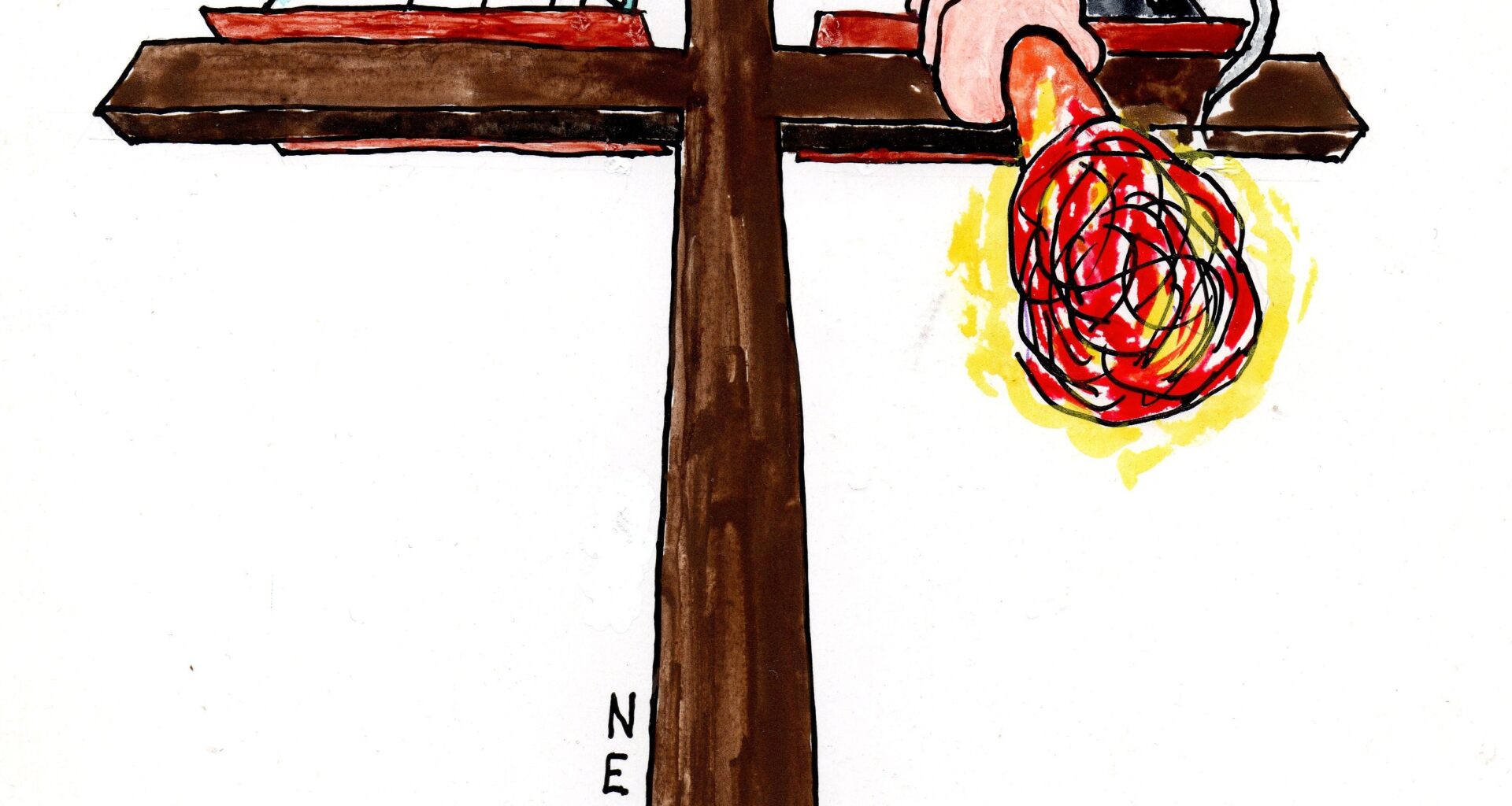
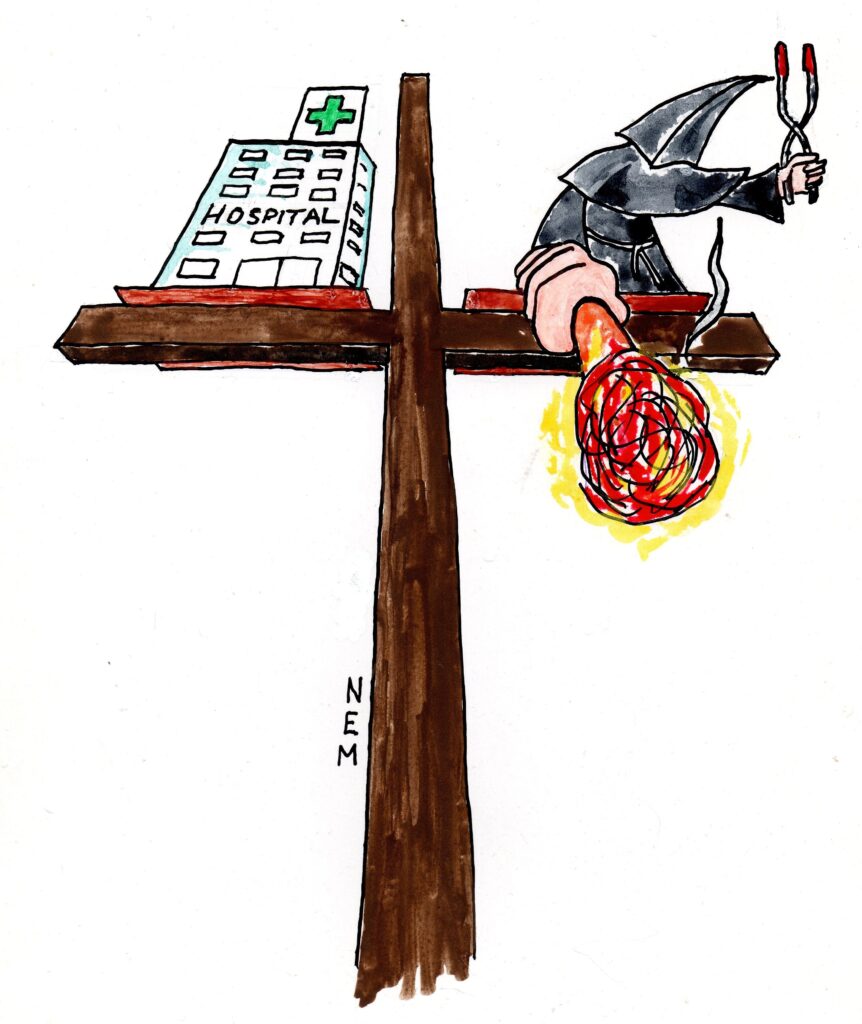
And while individual compliance with the ideal is iffy, there is an institutional derivation of those teachings that is both tangible and ubiquitous. Namely, the hospitals and other charitable establishments (orphanages, poorhouses, etc.) begun as an offshoot of the monastic movement. Ehrman, because of the variable nature of personal follow-through on the dictates of charitableness, necessarily makes a lot of this other, fixed, bricks-and-mortar product.
The above definitely merits comment, and will get it, but it is worth stopping to notice the following. The reader of this book will not find a single word in it regarding doubts, or even a glimmer of an inkling of a suspicion that doubt is conceivable, that Jesus genuinely was a historical figure. (Ref. his resurrection, Ehrman writes more cautiously.) With regard to what it is said that Jesus said, the author at one stage devotes some lines to the fact that there are ‘many contentious issues’. Then he goes back to making unhedged quotations from Jesus’s lips.
Now, back to the hospitals and such. Almost at the beginning of the book, Ehrman asks and then answers himself, ‘Would these values and institutions have arisen without Christianity? There is no way to know.’ And almost at the end, he repeats, ‘Whether these institutions would have evolved… based on other influences is impossible to know.’ This question he poses lies at the crux of his argument about Jesus’s influence, because he uses the hospitals as prize exhibits with which to defend it.
But that the answer is ‘impossible to know’ happens to be wrong. There is a way to see the overwhelming likelihood that such public institutions for the needy would anyway have arisen. It is to note the fact that social progress has been achieved non-religiously in the West even on incomparably harder matters, like that of slavery (with no help at all from the Bible, although individual Christians might espouse abolitionism with the fervour they used for religion) and gender equality (which to this day, in the twenty-first century, is still officially rejected by the largest Christian denominations like Catholicism and Orthodoxy).
Additionally, such institutions as hospitals have arisen everywhere, even when they neither influence nor receive influence from other regions, as Ehrman admits with regard to parts of Asia—so it is tantamount to certain that the West would not have been different. Cf. the Muslim awqaf system. (‘I am not so sure’ is Ehrman’s position on this, in his last footnote; he puts quite important stuff in footnotes). Ehrman goes on to state that ‘what we can say is that they were Christian interventions’. However, since it is clear from the above that it would happen, the fact that there were mainly Christians around, so they were the ones who did it, proves nothing, one way or another, about Christianity.
And while we are on the issue. Yes, Christians launched hospitals. But when someone tried to improve care there much beyond wiping brows, feeding equivocal brews, and saying prayers over the ill, by actually pursuing medical facts, the light at the end of the research tunnel could be that of a pyre with them writhing atop it. It happened to Michael Servetus, it is worth recalling over and over, for affirming that blood circulated through the lungs; so it is no mere figure of speech.
Which leads to the literally painful circumstance that the Christianity that Love Thy Stranger says ‘transformed the moral conscience’ also brought—in his own words on one of the occasions in which he touches on the matter—‘crusades, inquisitions, wars of religion, and pogroms against Jews that led to the Holocaust’. Could we not have had one without the other, please? That alleged moral transformation was selective indeed.
What Ehrman says on the fact that some people emphasise any good brought by Christianity, and some the bad, is only that ‘both sides of the argument are making simplistic and overgeneralized claims’. Not so—bringing up gruesome religious persecutions, at least, is neither simplistic nor overgeneralized. Lacking further elaboration, his attitude seems to be that the one came with the other, that is the way things are, and to harp on it is pointless. It may bring to mind, on an infinitely lower plane but presenting the same essential attitude, the song ‘Love and Marriage’ by Cahn and Van Heusen, immortalised by Frank Sinatra: ‘Love and marriage … go together like a horse and carriage … you can’t have one without the other’. Here is news: yes, having one without the other can happen. On the matter of charity coming as a package with the Inquisition, it should.
On forgiveness, the book says that the concept ‘as understood by contemporary ethical philosophers could not be found in the Greek and Roman worlds. It arrived through the teachings of Jesus. This is a radical claim…’ Rather than radical, it is either just plumb wrong, or only sustained by either playing semantics or not considering the Jews’ land as part of the Roman world—i.e., regarding only actual Romans as part of the Roman world. Ehrman, by profession a Biblical scholar, cannot be unaware that, for example, Leviticus 19:18 enjoins, ‘Do not seek revenge or bear a grudge against anyone among your people’. This indeed puts the aforementioned original limits on who is to benefit from it, but as for the forgiveness itself, which is what Ehrman is talking about here, the precept says nothing about first demanding atonement, or anything else.
Ehrman gives detailed acknowledgement that the Jewish tradition taught a lot about charity and altruism, only making the point that Jesus extended the intended recipients of those virtues to include strangers. But with regard to forgiveness, he makes a clear before-and-after separation, not seeing precedents that only needed to be broadened.
In support of his view, Ehrman quotes Hannah Arendt: ‘The discoverer of the role of forgiveness in the realm of human affairs was Jesus of Nazareth’. In the Mahabharata (obviously outside the Greek and Roman worlds Ehrman restricts himself to in his claim, but Arendt here talks of ‘human affairs’, not Graeco-Roman human affairs), there is a party known as no less than ‘the king of dharma’. His name is Yudhishthira. (Roger Peyrefitte, who in his book The Jews seemed to be trying to prove that just about everybody was Jewish, would probably seize on the ‘Yud’ part of the name to include that Indian hero too in the tribe. Okay, that was a joke. But then again, he did hold Stalin to be Jewish… as do others who note that Stalin’s real name was Dzhugashvili.)
On forgiveness (kshama), thus spake Yudhishthira: ‘Forgiveness is virtue … Forgiveness is Brahma; forgiveness is truth … forgiveness is holiness; and it is by forgiveness that the universe is held together’. Maybe Arendt did not get around to reading the Mahabharata, though she surely was taught the Bible. In any case, she here makes a flat general statement, and turns out to be flatly mistaken. Or else she is splitting fine hairs on what ‘to discover’ means, much like Bill Clinton’s famous ‘what “is” is’.
Moving beyond that, Ehrman never resolves a contradiction between his insistence that Jesus meant his words (if he existed and said them, that is) to be taken literally, as in his claim that the world would end in those very years, and ‘the fact that Jesus conveys his message by using stunning and humorous metaphors’. The impression left with the reader is that the author uses one or the other view of Jesus’s intended literalness as suits each circumstance.
Elsewhere in the book, Ehrman refers to Jesus starting ‘a religion that would take over the world’. That must be news to the two-thirds of the world’s population that is not Christian. Just a slip, no doubt, but strange in a person who is so careful with the meanings and use of words.
At a lesser level, when Ehrman works out the equivalent, in today’s dollars, of a figure mentioned in a New Testament parable, and although he gets the final figure right, where he says along the way that ‘a talent [a monetary unit] would be $348’, he actually means $348,000. This is mentioned to avoid bafflement among readers who follow the maths. Similarly, when he speaks of ‘excessive wealth generated by industrial and postindustrial societies that created the middle class’, he very likely means ‘excess’, not ‘excessive’.
All that said, Love Thy Stranger has a point. Jesus—or what the writers of the Gospels presented as Jesus—extended the reach of goodwill to strangers. Here, given that Ehrman frequently remits his readers to his previous books, this reviewer may perhaps be forgiven a reference to his own book Beyond the Gods—Facing Life’s…, chapter 19, ‘If religion were to disappear, would we lose its side benefits?’, and chapter 22, ‘…Religion’s dietary laws, etc.’ The rational thing to do is to ‘isolate the valuable ingredient, if any’ in a religious tenet, and then apply it in a secular form, without the mumbo-jumbo.
Ultimately, did what Ehrman calls a transformation in people’s thinking transform their actions? Spottily at best—as Ehrman admits, even as he finds comfort in the notion that ‘at least it is a widely held ideal’. The real bottom line has been the following: love thy stranger, yes—unless, of course, he or she holds a different view on the Trinity.
Related reading
‘Do as I say, not as I do’: a review of ‘Dominion’ by Tom Holland, by Nicholas E. Meyer
Image of the week: ‘They got there first’, by Nicholas E. Meyer, by Nicholas E. Meyer
Digging for Christian Foundations: Tom Holland on Triggernometry, by Adam Wakeling
Did Christianity make the Western mind? by Charles Freeman
A reading list against the ‘New Theism’ (and an offer to debate), by Daniel James Sharp
Do we need God to defend civilisation? by Adam Wakeling
What has Christianity to do with Western values? by Nick Cohen
‘The Greek mind was something special’: interview with Charles Freeman, by Daniel James Sharp
Pandering to Christian nationalism is a dangerous game, by Stephen Evans
Christian nationalism threatens democracy. Secularism protects it. By Stephen Evans






Your email address will not be published. Comments are subject to our Community Guidelines. Required fields are marked *
Donate