
Six days after the stabbing of two Jewish men in Golders Green, London, on 29 April, Prime Minister Keir Starmer warns Iran that fomenting hatred in the UK will not be tolerated. Given the number of reports that a newly set-up group, Harakat Ashab al-Yamin al-Islamiyya, is funded by Iran, and claiming to be behind a string of attacks against synagogues and Jewish people across Europe, this is the right call. It should lower the temperature of public debate by implicitly making the point that the recent attacks are not a sign of homegrown antisemitism. (Underscoring the Iran connection, a commander of a militia linked to the Iranian Revolutionary Guards Corps appeared in a New York Court on 15 May charged with involvement in a series of anti-Jewish attacks across Europe, including the Golders Green stabbings, and of planning further such attacks in the US.)
But Starmer does not stop there. He goes on to issue a number of directives on how each one of us in British society should tackle antisemitism, thus undermining his own warning to Iran. Yet even the annual figures for antisemitic incidents as produced by the Jewish organisation, Community Security Trust, which records a wider range of non-crime incidents than police figures, and the commentary by Jewish research organisations, link the spike in incidents to Israeli actions against Palestine. From 1,662 incidents in 2022, the figure jumped by 147% to 4,103 incidents in 2023/24. Nearly a quarter of the 2022 figures were reports of online abuse. While I do not condone the rise in antisemitism caused by the actions of Israel, the solution to reducing the problem should surely focus on reining in Israel by all political and diplomatic means available, including stopping the sale of arms.
When Starmer calls for some pro-Palestinian marches to be banned and for tougher action against their slogans, on the grounds that these marches are incubating hatred of Jews, we see a glimmer of the grand scheme. The British establishment, both Labour and the Tories, and Reform and mainstream media are broadly supportive of Israel. The marches are partly driven by anger at the British government’s complicity in the Gaza genocide. Green leader Zack Polanski and former Labour leader Jeremy Corbyn have faced slurs and attacks for their anti-Israel stance. It played a large part in the downfall of Corbyn and has become a useful strategy to weaken Polanski’s growing popularity.
It is important that slurs of antisemitism do not shut down debate. As one of the many feminists who have been regularly condemned both as ‘Islamophobes’ and as ‘secret jihadists’ for simultaneously opposing the dictates of Islam due to their impact on women’s rights and for fighting anti-Muslim hatred, I know how labels can silence people. We must be steadfast in maintaining a focus on Israel’s genocidal intent and practices. What are the skewed narratives that are being promoted by the government, mainstream media, and social media to deflect our focus?
I have been to several pro-Palestine marches and have witnessed the presence of large Jewish blocs, including descendants of Holocaust survivors and orthodox Jews, marching peacefully alongside others. The only time there is raised tension is when the marches encounter pro-Israel demonstrations, with their mix of Israeli flags and Union Jacks; the medley now also includes MAGA flags and Iranian monarchist flags. The marches are well-stewarded, and the stewards move people swiftly on. One of my most poignant memories was seeing the descendants of Holocaust survivors who had positioned themselves next to the pro-Israeli demonstrators, separated only by a line of stewards. A powerful and visible reminder that Jews, like any other community, are not a monolith. As the truth about these marches gets no mainstream coverage and as left-wing dissenting Jews are rarely heard in the media, the view that these are ‘hate marches’ has crystallised into fact.
The government has been trying to find an excuse to shut these down almost from the get-go. There were 32 national marches for Palestine between October 2023 and October 2025. Since the October 2025 ceasefire (a ceasefire poorly observed by Israel), there has been only one march, itself a feeder march into a bigger anti-far-right march. That, in itself, suggests that the focus was always on Israeli actions against Palestine and not the Jewish community here.
Starmer wants to ban slogans that fuel these ‘hate’ marches. One such example was the popular slogan ‘From the River to the Sea, Palestine will be free’. This was interpreted as supporting the elimination of Israel from the face of the Earth until it was pointed out that it was actually a reference to a declaration to be found originally in the Likud party charter—that is, the right-wing party headed by Benjamin Netanyahu—that there will be only Israeli sovereignty between the river and the sea, a clear statement of intent to eliminate Palestine. The Palestinian version was merely a demand for Palestinian freedom. The latest bête noire is ‘Globalise the intifada’. Intifada is the Arabic word for resistance against oppression; this resistance was initially fought by Palestinian youths with stones, and is hardly a Trojan horse for antisemitic tropes.
Now, coming to the assault on the Jewish men in Golders Green: it was horrific, the videos were indeed stomach-churning, and such acts should have no place in Britain, or anywhere else. But this incident has been used to turbocharge an agenda to prevent criticism of Israel by suggesting that alternative narratives are antisemitic slurs. The headlines were not rewritten when the news slowly emerged that a Muslim man had also been stabbed that day. Nor were they rewritten four days later, when the media reported that an Iranian Muslim had saved the 76-year-old Jewish victim from being killed. Complicating the picture would have weakened the argument that the attacks were evidence of a widespread, homegrown antisemitic campaign.
There were other factors that weakened that argument. Essa Suleiman, the attacker, has a history of severe mental illness, having been released from a psychiatric hospital on the same day. The fact that his Muslim friend featured among the victims suggests that it may not have been an attack motivated by antisemitism at all. Although the attack has been framed by police as a terrorist incident and the investigation is being led by the CPS Counter-Terrorism Division, Suleiman has been charged with attempted murder, not terrorism offences. Interestingly, white attackers in similar situations are more likely to be seen as mentally ill than terrorists.
Most of the mainstream media, including the BBC, edited the video to delete scenes of the police viciously kicking the attacker in his head at least five times, after he was tasered, in the clips I have seen. The man had a knife in his hand. Why not kick his hand to dislodge the knife instead? When Zack Polanski reposted a tweet about this uncalled-for police brutality, Met Commissioner Mark Rowley wrote a public letter to him reprimanding him for criticising brave police officers in the week before local elections. Owen Jones quite rightly points out that this is interference in the political process.
The view that the liberal left has abandoned the Jews has also been gaining ground. Jonathan Freedland of The Guardian asks where the anti-racists organising marches against antisemitism are. Where indeed? I remember the anti-fascist marches of the 1970s and 1980s, organised by groups like the Anti-Nazi League, which campaigned against both antisemitism and racism. The political landscape has changed so dramatically that those seemingly natural alliances are no longer possible. The fascists of today have shifted their hatred to Muslims and, in many cases, are actively courting or being courted by Israel. The anti-racist left who would normally be marching in support of Jewish communities are being blamed for the rise in antisemitism for organising and participating in pro-Palestinian marches. There is no one left to organise antisemitism marches except the right, who identify with the Zionists and attract people like Nigel Farage and Boris Johnson. An antisemitism conference held in Israel in January 2026 was attended by far-right parties with deep antisemitic roots from across Europe because the Diaspora Minister, Amichai Chikli, laid the blame for antisemitism at the feet of radical Islam and the ‘woke left’.
In any case, anti-racist marches do not take place every time black and Asian people have been killed; the number of these is so great that the marches would have suffered from attendance fatigue. From 2000 to 2013, there were 85 such killings. Interestingly, the police do not keep figures on racist killings. The Institute of Race Relations did. Their project recording these killings came to an end in 2013, so we have no figures since then. And this figure does not even include black deaths in custody, i.e., killings by the state, but only killings in the community. When anti-racists march, they choose particularly egregious killings like that of Stephen Lawrence or Ricky Reel, which have hit a nerve because of police failures and/or because they have families working hard to keep them in the public eye.
In falsely hyping the narrative that Britain is unsafe for Jews, including interviews with Jews saying that they are emigrating to Israel, the media has contributed to a small exodus. The demands we hear in the media are for the government to do more to ensure the safety of Jewish people. Starmer organised a COBRA meeting on the back of these stabbings to decide what measures to introduce. This is an unprecedented response to a racist incident. A new £25 million fund has been announced to enhance security around Jewish establishments. If the Golders Green attack turns out to be the work of a lone individual, and not Iran-backed, such attacks are near impossible to prevent.
Surely Israel is less safe than the UK. In the two-year war with Gaza, 1,152 security personnel died. Conscription into the Israel Defence Forces applies to everyone, with some exemptions, between the ages of 18 and 21. The figures speak for themselves: between 132,000 and 192,000 Israelis have emigrated since October 2023. Israel itself justifies its occupation of southern Lebanon, its invasion of Palestine, and its war against Iran as part of its search for security. Yet approximately 740 Jews have left the UK for Israel in 2025 in search of safety. Sadly, black and minoritised communities do not have that option, as many of them fled home countries which had persecuted them or become unsafe in other ways. The reports of Jewish people opting to leave Britain for the ‘safety’ of Israel seem incomprehensible.
When I made this point in a social media post, a Jewish friend said that I didn’t understand the mindset of a people so traumatised by the Holocaust and centuries of persecution that they see Israel as a place of safety. While the trauma of the Holocaust is understandable, I was heartened to see the descendants of Holocaust survivors who set aside their own trauma and turned up at the pro-Palestinian marches to proclaim, ‘Not in my name’.
The same friend sarcastically congratulated me, ‘Well done for wading in where angels fear to tread’. In other words, I was a fool. But I believe it is very important not to be daunted by charges of antisemitism when making the case against Israel. It has become a pariah state by all accounts, and we need to hold on to our democratic right to say so.
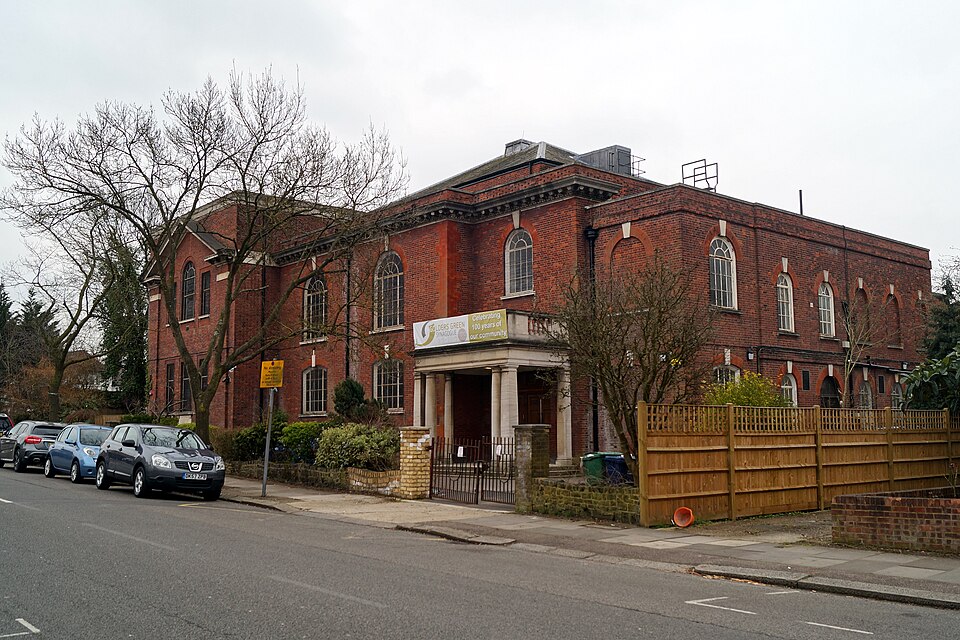
Featured image: Golders Green Synagogue. Photo by Erfurth. CC BY-SA 4.0.



3 comments
Many things about the situation become clearer if, every time one mentions “Jewish”, you have to clarify “Do I mean Jewish Diaspora Liberals, or Jewish Israeli Nationalists?”.
Because Judaism is now made up of two very different diverging parts. And the fact someone is a Israeli Nationalist is far more important than the fact they’re Jewish.
For example, it’s unsurprising Jewish Israeli Nationalist/Fascists are thinking of moving to Israel. It’s unsurprising that the left don’t march in support of these people.
Israel has turned far to many Jews into Nationalist/Fascists. 8f we make clear when we’re talking about Jewish Nationalist/Fascists, and when we’re talking about Jewish Diaspora Liberals, everything becomes much, much clearer.
Your assert Israel’s genocidal intent and practices. Yet the worlds experts on genocide have concluded in their public letter (with links to peer reviewed research papers):
“On October 7, 2023, Hamas invaded Israel and acted with the intent to destroy, in whole or in part, Jews and Israelis, as a national, ethnical, racial, or religious group, as such.
Thus, Hamas committed the crime of genocide and remains the only party to legally meet the requirements of the elements of the crime of genocide.”
Source: https://www.scholarsfortruthaboutgenocide.com/
Antisemitism has taken several forms over the centuries, while maintaining a similar shape. Jews are always the epitome of evil, guilty of the most worst crimes imaginable at that time in history. Antisemites have always comforted themselves with the thought that getting rid of the Jews would make the world a better place.
Back in 13th century England, just before all the Jews in the country were expelled, they were accused of killing Jesus (the worst crime imaginable), murdering children, being sly and manipulative, having their hands secretly on the levers of power etc. This ‘shape’ of antisemitism was maintained for hundrends of years, though the precise libels varied, culminating in the Nazi holocaust.
Nowadays it’s not the Jews per se who are the epitome of evil. It is Israel. The world’s only Jewish state. The worst crimes imaginable to today’s right-thinking people are different: racism (apartheid), genocide and “settler-colonialism”. The murder of children, the slyness, and the ‘hands on the levers of power’ are also present. Clearly, getting rid of Israel would make the world a better place.
It is surprising how many people think that the similarity between the traditional antisemitic libels and the modern libels against Israel is just a remarkable coincidence.
And it is disappointing that The Freethinker continues to platform perpetrators of the genocide libel.
Your email address will not be published. Comments are subject to our Community Guidelines. Required fields are marked *
Donate