

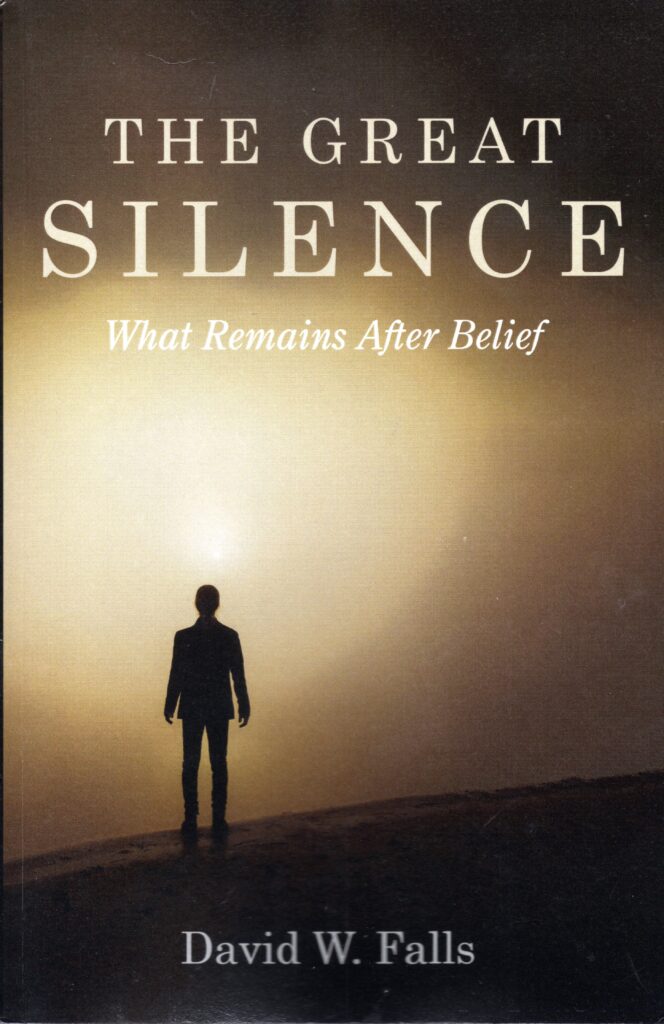
The Great Silence—What Remains After Belief is the record of a deconversion, clearly designed as a help for others who were inculcated with strong religious beliefs, but may be harbouring doubts about them. Written in the first person, it offers a step-by-step chronicle of why and how author David W. Falls discarded his faith—and how he found fully satisfying ways to fill what to him appeared as a void, after it had crumbled away. It is a work that may indeed assist people who are in similar predicaments.
What slowly, painfully chipped away at Falls’s inherited convictions was, first and most powerfully of all, God’s silence. Hence the book’s title. Other issues, failures, and contradictions in the religious narrative were gradually discovered by him later. From an early age, he had found himself unable to bury (as urged by his family and counsellors) his bewilderment that God did not give any sign, respond to, or even acknowledge any prayer, however fervent. Awful things could happen, and the all-knowing and benevolent deity he had been told about kept adamantly mum.
This is, of course, an age-old problem, affecting a great many religious people. One may be tempted to make a comparison: for decades now, astronomers have been scanning the skies with radiotelescopes looking for signs of intelligent life out there. Meanwhile, since long, long before that, multitudes of others have been anxiously scanning the heavens with their prayers, seeking signs—any kind of positive sign—from their God, also thought to be somewhere out there. So far, both searches have drawn equal blanks, but if anyone is taking bets on which group may get a hit first, the safer wager is on the radioastronomers. Their chances may be minuscule, but their hopes are not irrational.
A great many of the anguished seekers of godly signs, Falls among them, have had to carry out this search in isolation, facing the condemnation of the believers around them if they found out. This is to be noted: in some cases, like that of Falls, something good did come from the godly silence that distressed them. It was an opportunity; it led them away from the hocus-pocus (not Falls’s terminology).
What Falls describes is how—bit by bit—it became apparent to him that the silence was not a gap to be rued, but a chance to discover how to face the world on his own, not through religious say-so. ‘[I]n that disorientation,’ he writes, ‘lies the beginning of independence’. ‘[S]ilence slowly became understanding’.
The author is particularly at pains to prove that doing away with religious faith does not preclude finding meaning in life. Consequently, he leads the reader through processes by which individuals themselves generate such meaning—a concept he strongly emphasises is that of individual responsibility, in addition to such virtues as empathy and generosity towards others. Falls also offers plenty of reassurance to would-be deconverts that if they are used to regarding the universe not matter-of-factly but with a sense of wonder, that feeling can and does persist.
As an aside, it does not diminish the merit of all that Falls derives from grappling with God’s silence to note that it depends on a particular conception of godhead. When people invent a phantom being, they are free to endow it with whatever features they want. It so happens that, in our time and place, the mainstream definition of God is one that is permanently interested in everything that goes on, is benign and merciful, and is potentially susceptible to flattery, entreaty, and bribery. These are the godly qualities that historically suggested themselves—because of psychological predilections, projections, fears, compensatory mechanisms, and the like.
Nevertheless, the imagined divine characteristics could have been completely different ones. Consider, for example, a god who created the world and then self-destructed. Or one who is nice up to two days of the week—of his own choosing—but is an ogre the rest of the time, and additionally has aphasia and writer’s block. In cases like that, the silence argument would collapse.
Still, the kind of god that Falls discarded as a mental crutch is also the one most of his potential readers will have in mind, so more power to him.
With regard to Falls’s writing style, two things stand out sharply. The first is that he has an outstanding talent for expressing himself aphoristically, as in ‘The mind prefers coherence to openness’ or ‘Storms obey physics, not prayer’. Before disclosing the second characteristic, let it be stated that one possible good reason for it suggests itself, and will be found in the next paragraph. That second trait is a monumental repetitiveness. This manifests itself in two ways. Once having well covered each of the matters the book wishes to discuss, it returns to them over and over, and not just as recapitulation. Secondly, many of the actual phrases used in discussing them come back again and again with major or minor paraphrasing.
It could be that Falls adopts this as a tactic because he is targeting a readership he knows well. He may be envisioning people who, having been accustomed all their lives to a repetitious drumming of religious tenets, need to be told things—even things they may now be willing to listen to—many times for the ideas to get through. (People who, additionally, may not know very much outside religion, and of course their specific jobs. This is a book that, when mentioning Aristotle, helpfully supplies the information that he is ‘the fourth-century BCE thinker who laid much of the groundwork for Western logic’. Incidentally, The Great Silence quotes a plethora of thinkers, and thus spreads knowledge.)
So we get, ‘The silence that once felt like failure became a space to think more clearly’. ‘The silence that once disturbed me began to feel like an open space rather than an absence’. ‘The silence left behind by faith did not shut down questions—it redirected them’. ‘When belief falls away, what remains is not emptiness but attention’. ‘Meaning did not disappear with the loss of God. It shifted from expectation to engagement’. ‘The search for understanding did not end with disbelief. It simply changed methods’. (Not a full list.)
Or, in another example, ‘Would a just and merciful being reward those who feigned belief to avoid punishment while condemning those who searched honestly but remained unconvinced[?]’ ‘I could not see how a God worth worshiping would value obedience over honesty’. ‘Would a being worthy of reverence truly prefer pretense to sincerity[?] Would He reward belief adopted out of fear while condemning those who followed evidence as far as they could see it[?]’
At one point, Falls, who used to be a technologist at Microsoft, devotes a section to man vis-à-vis the digital machine. Here his combined gifts for aphorism and for limitless rephrasing really go to town.
‘[A]rtificial intelligence… exposes how easily the sacred can be replaced by function’. ‘I realised how much [of] theology [that technology] quietly replaced’. ‘What surprised me most was not the power of the machines, but the reverence they inspired… Only this time, the idol spoke in code’. ‘The miracle of creation has become computation’. ‘The divine voice has been replaced by the algorithmic whisper’. ‘The temple has become the touchscreen’. ‘The impulse that once reached for heaven now seeks perfection through analytics’. ‘Every gap once filled by the divine was now explained by the dynamics of information itself. The gods did not vanish; they became equations’. ‘The computer, seeking harmony, had found liturgy’.
And further: ‘Revelation had become a reproducible function of data’. ‘What we once sought in temples now emerged from servers. The impulse that once carved idols from stone now coded them from silicon’. ‘The human search for meaning continues—but through circuits instead of scripture. The miracle of creation has become computation’. ‘What faith once promised through prayer, technology now delivers through design’. ‘Instead of prayer, there is search’. ‘We no longer kneel; we log in’. ‘The reverence once directed toward gods migrated into systems of code and analysis’. ‘We no longer kneel before icons; we tap them’. ‘What was once divine command now marches under banners and manifests in code’.
The author is hurtling so fast towards the end of one sequence of such one-liners on this subject that he stumbles: ‘The gods still speak, but now they speak in code’. One can infer that he really meant something like ‘Scripture [a human artefact, as he has demonstrated] still speaks, but now…’ However, his loose phrase ‘The gods still speak’, while having a good ring to it, is an unfortunate choice in a book built around the fact that God is silent.
The tiny number of other non-sequiturs and suchlike could, like the above, be tweaked in future editions of the book. For instance, after saying, ‘The systems were not designed to disprove God…’, ‘The program wasn’t built to challenge belief’, ‘The machine does not mock belief…’, and ‘[T]hese reports… carried no ridicule or triumph’, it is jarring to find that ‘AI doesn’t just challenge [sic] religion…’
Out of the force of habit, which he acknowledges, Falls very occasionally falls back on some religious phraseology or thought forms, or he or his editor haven’t fully thought out a sentence here and there. ‘What many call divine silence is sometimes the echo of our own need for meaning’. Why ‘sometimes’? ‘What believers call revelation may be the mind projecting its values onto the unknown’. Why ‘may’? ‘[T]hose who learned to live with uncertainty—scientists, poets, skeptics, and mystics—share one trait: they resist premature answers’. Considering how mystics adopt their ‘answers’, do they really belong on that list, starkly incomplete (or incompletely defined) though it is?
But this has to be noted: whether these minor matters were intentional or not, and whether they are arguable or not, particularly in texts propounding an end to religious delusion, the crucial distinction to be made is that the lay view does not demand ‘purity’ of viewpoints. Ideological immaculateness is an obsession with religion, and has to stay there.
Falls takes his strivings seriously indeed. He learned of the research by neuroscientist Michael Persinger (and Stanley Koren, not mentioned) into, among other things, whether the brain can be prodded to generate religious feelings. ‘His device, which he called the “God Helmet”, used weak, pulsed magnetic fields directed at the temporal lobes… Intrigued, I decided to build a “God Helmet” for myself… I modified a motorcycle helmet, wiring it with coils, a power supply, a pulse generator, and a relay timer to control both the field intervals and intensity. I calibrated the magnetic strength carefully…’
The results he obtained would seem to undercut the standpoint that the nonsense is all in the brain (that, or his Helmet wasn’t up to tickling it properly). But the point is that Falls was willing to risk electrocution or brain frying if his wiring calculations were off. Well, he is, after all, a high-tech boffin.
Falls is fighting the good, the necessary fight. Note: people who buy his book should be aware that there are several others also titled The Great Silence —they should double-check that the one they order has the subtitle What Remains After Belief.



Your email address will not be published. Comments are subject to our Community Guidelines. Required fields are marked *
Donate