

In the recent local elections, Nigel Farage’s Reform UK party gained nearly 1,500 councillors, in addition to the eight MPs they already had. As some of us continue to reel over these results, picking at snippets of hope that might curtail that sickly gut feeling that voters and mass media have colluded to legitimise the far right, this feels like a moment to revisit Stuart Hall’s analysis of Margaret Thatcher’s landslide victory in 1979. Hall’s analysis taught us two vital lessons. Firstly, ideology is important, and it is a separate and distinct plane that intersects with, but cannot be reduced to, the economy. Secondly, people within the same socio-economic group or within the same race/ethnicity group may have divergent interests. This is why some people may vote for political parties that, on the face of it, do not seem to reflect their interests. This is essential to understanding why, in this round of local elections, several Asians stood as candidates for Reform and many Asian and/or working class people may have voted for Reform candidates even though Reform are likely to make experiences of racial disadvantage and economic position significantly worse.
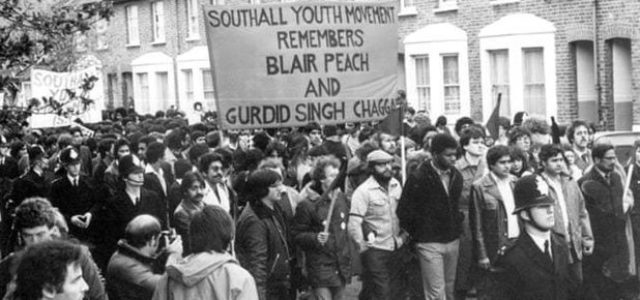
Some months before Thatcher strode to power on a ticket of self-interest, individualism, and racism, Blair Peach, a teacher at an east London school, travelled to Southall—where I was born and raised—to join thousands of local people for a huge protest against the National Front (NF). It was 23 April 1979, and the NF had intentionally selected Southall for their meeting as the area had become a well-known safe haven for immigrants. As they hurled racist abuse and demanded that local people ‘go home’, they clearly intended to make minorities feel that there is no safe place for them in the UK.
The NF were protected by the local police and their notoriously brutal division, the Special Patrol Group (SPG), who were brought in to ‘disperse’ those peaceful anti-fascist protestors. The inquiry into Blair Peach’s murder found that he was ‘almost certainly’ killed by members of the SPG who bludgeoned him with a baton as they viciously chased protestors off Southall Broadway. Moreover, they arrested over 700 protestors and charged 342 with various violent offences. Some were maliciously carted off in police vans and dropped off in remote areas outside London. Some of those charged were later acquitted because of a brilliantly coordinated campaign for justice.
A range of progressive projects and inspirational figures emerged from that moment and came to shape local and national politics by standing up for the right of immigrants to build lives in the UK, for workers’ rights, race equity, and the right of women and girls to live free from violence. I was so incredibly fortunate to have grown up in the shadow of this rainbow coalition. And I’m indebted to those local community groups that keep our history alive by teaching about the way that the people of Southall stood up to racism, in all its forms. I am also certain that it is this continuous activism and new waves of immigration (from Somalia, Eritrea, South India, and Afghanistan) that have protected the Southall constituencies from any Conservative or Reform gains.
Fast forward 47 years, on 23 April 2026, I picked up an electoral campaigning leaflet for recent local council elections in the neighbouring borough of Hounslow, the first set to be distributed there. Sadly, it was for Reform and proposed three Asian candidates—two Sikh men and a Hindu woman. All three were long-standing Labour Party members and claimed they were forced to exit the party because of the lack of local accountability and branch transparency. However, they were almost certainly denied a seat by Labour and enticed by the local Sikh parliamentary candidate for Reform, Prabhdeep Singh. One of them, Bandna Chopra, defected to Reform after she was deselected from a Labour Party seat that she had held for eight years. Local Labour denounced her Reform candidacy, stating:
It’s a match made in heaven, the deselected Labour councillor and the party which has become a dumping ground for those who have failed to be successful in the mainstream parties. She has found the only party with an entry bar low enough to have her as a candidate.
In turn, the three Heston East candidates for Reform claimed that Labour has failed the borough; they regurgitate a narrative of decay and disgust—rising crime, fly tipping, uncollected rubbish, and rising numbers of assaults. These seemingly innocuous civic concerns strike at the heart of people’s feelings of insecurity, but more importantly, they conceal significant structural problems which were set in motion by the Conservative Party in 1979 and exacerbated through austerity measures, again by the Conservative Party, from 2010. None of these issues can be resolved by Reform UK’s political agenda.
In fact, some of the claims don’t hold up against the facts: both Hounslow and Ealing are among the top 20 safest areas across London. In fact, Hounslow is the 26th safest area across England and Wales. Crime has declined year on year and is lower in Hounslow and Ealing than across London. Weapons-based offences have also fallen significantly in Hounslow since 2018, and anti-social behaviour appears to be particularly high for just one or two months a year.
If anything, it is ‘violence and sexual offences’ that have increased. This is a vague category but likely includes domestic and sexual violence against women, something that certainly could not be tackled by patriarchal men, let alone a party run by misogynistic Farage and funded by unaccountable millionaires, such as Charles Harbonne, whose personal economic interests are fast manifesting as Reform’s public policies. Where Farage and his elite cohort of rich men continue to evade their legal duty to declare and be transparent about donations and donors, they claim victimhood and use dog whistle politics on immigration to avoid all personal responsibility.
Moreover, Reform have actively folded civic concerns into a larger narrative about immigration, re-presenting them as direct consequences of ‘weak border controls’ and ‘bogus’ migrants. Here, Sara Ahmed’s work is incisive. She shows how the continuous use of key words in close proximity to others—immigration, crime, illegal, bogus, asylum, rubbish, dirt, chaos—enables the far right and mass media to embed psychological associations between them that short-circuit all rational argument and research evidence. In this way, a reference to one thing, like fly tipping, conjures up another, like immigrant, and becomes stuck to non-white bodies, while socio-economic explanations are elided.
As many have noted, sexual exploitation and abuse have become an even more obvious part of these lazy associations. Sexual abuse has been re-presented by the far right as a reflection of the incompatibility of Muslims and immigrants with the ‘British’ way of life. Yet, there is no Reform attention to over 109 white English activists within far-right groups who are convicted sexual offenders, nor recognition that many of the non-white offenders are British-born and bred.
A lot of far-right concerns have been mainstreamed. Just think how rare it is for friends and family to say anything positive about immigration, about the value of immigration in social terms, if not the net economic value. How often do you hear about the vital contribution of migrants to the health service, to the arts, to the development of your civil and political rights, to community spirit or community care, to the food on your table, and the cheapest deliveries to your door? The association of immigration with decay and disgust has seeped into our minds, social relations, and communities. It has supplanted all the counterweights to our insecurities and all the value that decades of immigration and the defence of human dignity have brought to our lives.
Right wing populism across Europe has moulded all these complaints—flytipping, crime, immigration—into a language that claims moral superiority and the status of ‘common sense’, a phrase that is a staple of the language of Reform’s electoral campaigns. One of their Sikh candidates, Pritpal Singh Mann, appealed to voters to follow Reform’s commitment to ‘common sense’ governance. Again, Stuart Hall can help us here. He explained that particular racialised, class-based projections of ‘common sense’ are central to the neoliberal project, and that after fifty years of rhetoric against benefits claimants, our sense of ‘fairness’ has become pinned to so-called ‘common sense’ demands for reductions rather than increases in state provisions and to demands to close our borders. ‘Fairness’ is for British nationals only, not for refugees fleeing conflict or economic migrants working hard to avoid poverty in other parts of the world.
But we need to ask ourselves how voting for hate can make any sense at all. Since the recent elections, six elected Reform councillors have had to resign, four of them because of social media posts which celebrated the rape of a Sikh woman and likened Muslims to rats; Holocaust denial; quips about how Nigerians should be melted down and used to fill pot holes; and calls for the destruction of mosques. At the very least, we should expect the Asian candidates for Reform to ask themselves why this party attracts so many overt and violent racists.
But this is not the first time that ethnic minority voting patterns have reproduced the groundswell of hate politics. As I found in my PhD research, longstanding Labour Party branches across west London boroughs started to leak ethnic minority supporters at the turn of the century, particularly around 2007. Whereas Muslims in several east London boroughs exited Labour to join Respect as a protest vote against New Labour’s War on Terror and assault on Iraq, in west London, the Conservative Party became a viable vehicle for right wing factions of existing ethnic minority vote banks for the first time in decades.
When the longstanding Labour Sikh Punjabi (albeit secular) MP for Ealing Southall, Piara Khabra, died in 2007, two Sikh councillors jumped from the Labour Party to the Conservative Party out of dissatisfaction that a Hindu (albeit secular) candidate had been selected from the Indian Workers Party base to replace Khabra. One of them had supported Sikh fundamentalists and even threatened violence in the council chamber. Yet, the Sikh candidates claimed that they had experienced religious discrimination as turban-wearing Sikhs. This all exposed a hotchpotch of business, religious, class, and gender interests that had underscored the Sikh Punjabi involvement in the Ealing Southall Labour Party. Also, the crumbling homogeneity of a Sikh Punjabi ‘community’ that had stood together in the face of racist violence and tightening immigration controls since the 1950s. And, an easy alignment between Sikh histories and the Conservative harking back to the glory days of empire, something I have discussed elsewhere as ‘symbiotic sovereignty’.
Soon after this, the ascent of UKIP and then the Brexit vote surfaced yet more fissures within traditional ethnic minority vote banks. Even though the ethnic minority vote leaned more towards Remain and they could see a clear connection between their position as racialised minorities and the racist tropes of the Leave campaigns, there were a significant number of British Black and Asian Brexiteers. Neema Begum’s analysis of their motivations is important. She found that these racialised minorities felt little affinity with the European Union because of the sense that migration into the UK from (white) EU countries occupied a privileged place over migration from the Global South. Also, they felt a strong sense that countries within the EU were more racist than Britain. So Asian Brexiteers saw themselves opposing a white supranational entity. It is important to see how racism can play out in these different ways, and that Asians might have voted Leave alongside Eurosceptics for entirely different reasons.
And yet they did vote for Brexit in the context of a high-profile racist campaign led by Nigel Farage, who foregrounded images of Muslim/Arab migrants pushing into the EU and fuelled anxieties about Turkey joining the EU. Moreover, his tag line ‘Take Back Control’ appealed to archaic conceptions of the authentic English man whose land is overrun by non-English people. This fits well with Farage’s desperate 1994 bid to get Enoch Powell to support and even stand for his UKIP party (Farage was the dominant figure in UKIP for much of its existence; he left it in 2018 to form the Brexit Party, which became Reform in 2021).
One would have to be living in complete seclusion not to see the nativist ethnocentric messages at the heart of Farage’s campaign to leave the EU. But then, how do Asians come to support Reform and even stand as Reform candidates? Missing from the existing analysis of support for Brexit and UKIP, and now Reform, is specific attention to Asian (particularly Sikh and Hindu) complicity in new waves of biocultural racism. The fact that Farage’s team offered positions to Hindus who praise Narendra Modi’s violent anti-Muslim Indian government tells us that he is well aware of the turn to the right within Asian communities, and particularly the virulent anti-Muslim hostility, moralistic conservatism, and business self-interest that aligns with his own ideological project. This is where ideology, and the tools of ideological reproduction, really count and can override race and class solidarities.
I have written elsewhere about the rise and rise of Sikh fundamentalism within Sikh dominated areas in the UK, but I reiterate here that, since at least 9/11, Sikh fundamentalist groups have been pushing for the state and its institutions to stop using the term ‘Asian’ and to distinguish between Sikhs and Muslims. The exposé on Asian offenders of child sexual exploitation spurred them on, with three main Sikh fundamentalist groups gaining considerable airtime to argue that it is Muslims, not Sikhs, who are perpetrators of child sexual exploitation, and that Sikhs have long since been victims of the same Muslim barbarity.
One of them, the Sikh Awareness Society, led by Mohan Singh, gained the public support of notorious racists Katie Hopkins and Tommy Robinson, and he encouraged gurdwaras up and down the country to host them. Tommy Robinson’s claim that there is an inherent problem with Muslims aligns with and is increasingly being voiced by Sikhs, whose cheek-by-jowl histories and daily lives with Muslim neighbours and work colleagues are drowned out by the amplification, across all media platforms, of Sikh fundamentalist messaging, as well as the fact that a large number of gurdwara spaces have been sequestered for Sikh fundamentalist activists. In the meantime, Sikh women’s groups are threatened and abused when they speak out about Sikh men perpetrating gender-based violence.
The fact that there is an ideological alignment between the religious supremacy of Sikh fundamentalist groups and the racial supremacy of the Reform party has not yet been addressed. Fortunately, though media platforms are amplifying the power of Reform, the party is not doing as well as it claims. At least 79 Reform UK councillors have been forced to resign from their seats since May 2025, including six that were elected on 7 May 2026. They have not won the lion’s share of council seats. This is a distinct misrepresentation by the press; in fact, their share of the votes was at least 10 percentage points lower than they had predicted and lower than in previous elections. Many Reform councillors do not have the experience that is required to understand and manage local council budgets, and they do not have any idea of how to address the global events that are driving up the cost of living.
However, their ideological venom can have a lasting impact, most acutely seen in the research evidence based on Theresa May’s ‘hostile environment’, which drove a wedge through local communities, exacerbating fear that led migrants to commit suicide. And more recently, far-right rhetoric has stoked the resurgence of colour racism. The Sikh woman who was raped in Birmingham last year was subjected to racist abuse by a man who pursued her because he assumed she was Muslim. And the people who were attacked on the streets during the summer riots of 2024—the Indian man dragged from his taxi, the Caribbean woman who was forced to kneel and then punched in the face—were neither Muslim nor migrants.
Colour racism is coming for all of us, including the Sikhs who voted for Reform, and it is incumbent on all racialised minorities to do their part to change the narrative on Muslims and migration, to reconstitute our collective anti-racist histories, and to push the far right back to the margins where it belongs.
The far right and ex-Muslims: ‘The enemy of my enemy is not my friend’, by Sara Al-Ruqaishi
The Rise of the British Radical Right: First Reform, then Restore? by Zwan Mahmod




Your email address will not be published. Comments are subject to our Community Guidelines. Required fields are marked *
Donate