
Trains of (Free)Thought is a four-part series of reflections prompted by the author’s travels through France, Italy, Switzerland, and Germany between 26 August and 23 September 2025. Other instalments in the series can be read here. All images are the author’s unless otherwise stated.
The words ‘righteous’ and ‘righteousness of God’ struck my conscience like lightning. When I heard them, I was exceedingly terrified. If God is righteous [I thought], he must punish. But when by God’s grace I pondered, in the tower and heated room of this building, over the words, ‘The one who is righteous will live by faith’ [Rom 1:17] and ‘the righteousness of God’ [Rom 3:21], I soon came to the conclusion that if we, as righteous people, ought to live from faith and if the righteousness of God should contribute to the salvation of all who believe, then salvation won’t be our merit but God’s mercy. My spirit was thereby cheered. For it’s by the righteousness of God that we’re justified and saved through Christ. These words [which had before terrified me] now became more pleasing to me. The Holy Spirit unveiled the Scriptures for me in this tower.
– Martin Luther (from Henry F. French (ed.), Martin Luther’s Table Talk.)
Penned at some point between 9 June and 21 July, 1532, this account described events that had taken place years earlier, likely in 1518 (see Diarmaid MacCulloch’s Reformation: Europe’s House Divided, 1490-1700). While ruminating over the meaning of righteousness during his time as a lecturer at the University of Wittenberg in the German lands, the studious monk Martin Luther (1483-1546) had, he believed, experienced an intellectual breakthrough about the working of divine grace: that it was not determined by human deeds, but bestowed by God. This ‘tower experience’, or Turmerlebnis, ultimately led him to conclude that believers were justified by faith alone. For Luther, the phenomenon that best articulated his profound moment of realisation was lightning: a sudden flash of theological lightning starkly illuminating the mystery of salvation embedded within the pages of scripture.
This kind of allusion to meteorology befitted Luther, whose emphasis on the primacy of faith and scripture intermingled with his interest in the providential significance of features and events in the celestial firmament and the natural environment, from eclipses of the sun and the appearance of comets to thunderstorms, floods, and fires. Rather than imbuing these events with determinative significance derived from astrology, a practice he strongly condemned, Luther instead argued that such phenomena could indicate the wrath of God or express the ongoing cosmic conflict between heavenly and satanic forces. Indeed, evidence of divine intervention not only saturated the physical world, but also framed the entirety of human history.
The seismic process of religious reform that spread throughout much of Europe in the wake of Luther’s theological intervention and his vociferous criticisms of the Roman Church owed much to this mentality, which was shared by most Christians of the sixteenth century. As the eminent historian Diarmaid MacCulloch has written (in the book cited above), ‘The Reformation would not have happened if ordinary people had not convinced themselves that they were actors in a cosmic drama plotted by God: that in the Bible he had left them a record of his plans and directions as to how to carry them out’. Just as divine intent could manifest in the physical world, believers insisted that the world and its inhabitants should align with the will of God in anticipation of the apocalypse. This sense of spiritual urgency had galvanised Luther’s doctrinal arguments and theories of religious politics, which he articulated across several early works, including the Ninety-Five Theses (1517); To the Christian Nobility of the German Nation (1520); On the Babylonian Captivity of the Church (1520); and On the Freedom of a Christian (1520).
The preoccupation with the end of days also helps to explain Luther’s later embrace of anti-Jewish hatred, expressed with vitriolic zeal in On the Jews and Their Lies (1543). This text drew upon a recurring assumption among Protestants that the onset of Final Judgement was predicated on widespread Jewish conversion to the ‘true religion’. Deriding the Jewish people for their failure to embrace Christianity, Luther called for the suppression of rabbinic preaching, the destruction of synagogues, and the seizure of property, as well as suggesting that the murder of Jews was justified. A reminder, if needed, that erudition and innovation in theology guarantee neither wisdom nor benevolence, the legacy of this work has been long and sinister. As MacCulloch suggests, it provided ‘a blueprint for … Kristallnacht’, or the Night of Broken Glass, a heinous outburst of antisemitic destruction in November 1938 that portended the wider campaign of extermination that the Nazis waged against Jews in Europe until the defeat of Germany in 1945.
***
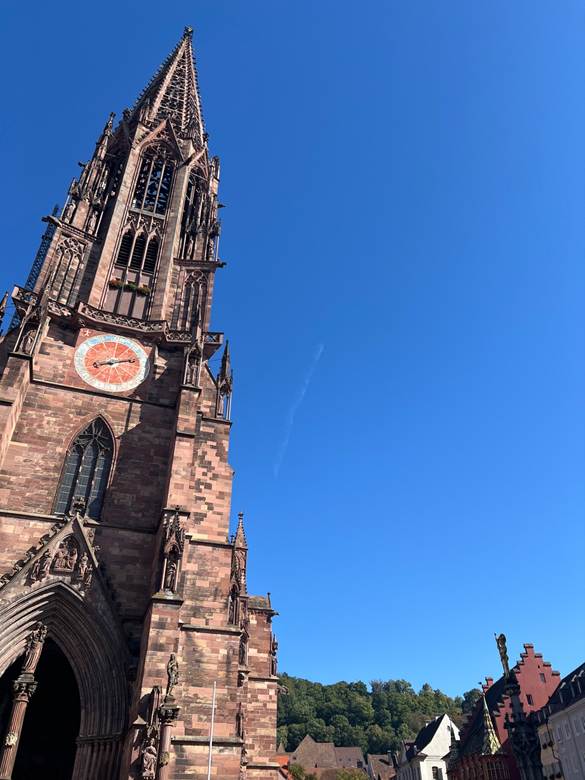
Situated at the edge of the Black Forest, the central square of Freiburg im Breisgau, with its bustling market, rustic restaurants, and cheery beer halls full of life under the stoic shadow of the cathedral, represents a dramatic collision of individuality, community, spirituality, and the natural world. The very etymology of the city’s name underlines its origins as a centre of commercial autonomy in the state of Baden-Württemberg (Freiburg means ‘free town’). It is also a university town. The institution, now named Albert-Ludwigs-Universität Freiburg, was founded in 1457. The Protestant Reformation swept the German lands during the sixteenth century, yet Freiburg was one among a minority of municipalities that remained Catholic. As confessional divisions intensified, the city for a time served as a refuge for Desiderius Erasmus (1469-1536), who, much dismayed by the tumult and hostility that was gripping many parts of Europe, particularly in the form of iconoclasm, left his abode in Basel in 1529 after the city became Protestant. (See, again, MacCulloch’s Reformation and also The Stanford Encyclopedia of Philosophy’s entry on Erasmus.)
It is appropriate that Erasmus, at once a devout Christian humanist and himself an irreverent satirist of religious decadence, should seek sanctuary in a city whose name and history evoke a sense of intellectual as well as economic independence. He was, among much else, an advocate for the idea that people should have the right to voice their opinions: ‘In a free state, tongues likewise should be free’, as he had put it in The Education of a Christian Prince (1516). This observation deftly affirms the responsibility of a sovereign country to enshrine and protect the individual liberties of its people. The notion that one should guarantee the other has long underpinned the political frameworks within which freedom of speech and freedom of religion have been able to flourish. Fittingly, these words were cited by Erasmus University Rotterdam in the aftermath of the 2015 Charlie Hebdo attacks. When a state fails to uphold the right of all its people to speak freely, enquire openly, and worship in peace, oppression only spreads and intensifies. The old synagogue in Freiburg im Breisgau was among those destroyed in 1938 during Kristallnacht.
***
The foundational principle that an independent nation should protect the freedom of its citizens is enshrined in the emphatic and unambiguous language of the First Amendment to the Constitution of the United States: ‘Congress shall make no law respecting an establishment of religion, or prohibiting the free exercise thereof; or abridging the freedom of speech, or of the press; or the right of the people peaceably to assemble, and to petition the Government for a redress of grievances’. The British tradition is older, of course, but perhaps less assured than is often supposed. While the Bill of Rights (1689) in England and its Scottish counterpart, the Claim of Right, laid crucial foundations for freedom of speech, neither measure prevented prosecutions for blasphemy in Britain. In 1697, Thomas Aikenhead, a student in Edinburgh, became the last person in Britain to be executed for blasphemy after openly expressing atheistic and irreverent views about Christianity (see Michael Hunter, Atheists and Atheism before the Enlightenment: The English and Scottish Experience, 2023).
More than two centuries later, prosecutions for blasphemy persisted. In 1977, Mary Whitehouse successfully brought a private prosecution against Gay News for publishing a poem that depicted Jesus as homosexual. This was the last such conviction in England. The common law offence of blasphemy was ultimately abolished with the passage of the Criminal Justice and Immigration Act 2008, marking the end of blasphemy as a criminal offence in the United Kingdom.
In the United States, recent political violence raises serious questions about the discourse around freedom of speech. Alongside the outpouring of grief and outrage in reaction to the assassination of Charlie Kirk, a disturbingly high number of people seem to have responded with shoulder-shrugging indifference, smirking amusement, or even maniacal glee, while yet others took the pseudo-intellectual route of equivocation and victim-blaming by insinuating that Kirk somehow invited this sort of atrocity because he held—and dared to openly discuss—conservative political and religious views. Those who have tacitly excused or openly celebrated this awful killing would benefit from a cold-water-bucket-load of refresher courses on the importance of freedom in general and the necessity of freedom of speech in particular.
Regardless of ideological disagreements, such appalling acts are assaults on the very principle of liberty. That Kirk was shot on a college campus, surrounded by students eager to hear new arguments and debate ideas, throws the struggle between civilisation and chaos into even sharper relief. If universities are no longer sanctuaries for open enquiry and conversation unencumbered by censorship, intimidation, or violence, then they are no longer universities. The consequences of such a deterioration in intellectual rigour and moral clarity are catastrophic. As J.K. Rowling commented after the assassination: ‘If you believe free speech is for you but not your political opponents, you’re illiberal. If no contrary evidence could change your beliefs, you’re a fundamentalist. If you believe the state should punish those with contrary views, you’re a totalitarian. If you believe political opponents should be punished with violence or death, you’re a terrorist.’
The United Kingdom should take heed of this message no less than the United States. Here, also, many people seem to be forgetting, wilfully or otherwise, that a key principle of freedom of speech is that it is important because it protects the views you might not want to hear as well as your own. For instance, there are ongoing efforts to sway the Labour government in favour of adopting a definition of so-called ‘Islamophobia’ developed by the All Party Parliamentary Group on British Muslims. Doing so would risk making legitimate criticism of religion into a hate crime. As a recent report from the Free Speech Union explains, the definition not only conflates religion and race, but also seeks to curtail the ability of historians and journalists to scrutinise the origins and development of Islam in political and cultural contexts. While some might be willing to abide the curtailment of this work out of some misplaced sense of benevolence, they fail to understand that we all have an interest in allowing research and investigation to proceed unencumbered so that we might maximise the information available to us as we navigate the obstreperous waters of contemporary debate.
For the government to embrace this definition would be especially dangerous given the importance of condemning Islamist extremism, particularly the brutality of Hamas, a terrorist organisation which carried out the deadliest single-day atrocity against Jewish people since the Holocaust when it attacked Israel on 7 October 2023. That these are conversations some would prefer did not take place is all the more reason to ensure that they do. As well as failing to recognise the hostility and violence that critics of Islam already face, endorsing this definition would also be incongruous with important legal interventions that have already been undertaken to protect freedom of expression in this area. One of the most recent of these is a judicial ruling, which has determined that criticism of Islam is protected speech under the Equality Act 2010. While it represents a promising indication that the courts can serve as a bulwark against state efforts to resurrect blasphemy laws, it has been argued that even this development risks perpetuating the assumption that our liberties are prescribed and proscribed according to the whims of whomsoever is in charge.
The American and British contexts are, of course, different in some respects, but together they should encourage us to insist anew upon freedom of speech without fear of violence, suppression, or harassment. The following excerpt from John Stuart Mill’s On Liberty (1859) has been on my mind recently, particularly as I reflect on the history and future of academia, journalism, and the meaning of the ‘public square’:
If all mankind minus one were of one opinion, and only one person were of the contrary opinion, mankind would be no more justified in silencing that one person, than he, if he had the power, would be justified in silencing mankind … The peculiar evil of silencing the expression of opinion is, that it is robbing the human race; posterity as well as the existing generation; those who dissent from the opinion, still more than those who hold it. If the opinion is right, they are deprived of the opportunity of exchanging error for truth: if wrong, they lose, what is almost as great a benefit, the clearer perception and livelier impression of truth, produced by its collision with error.
Perhaps more than any other defence of free speech, these remarks show us an assertive and robust way of dealing with different opinions. We need not cower before difficult ideas. We are perfectly capable of hearing them and deciding for ourselves. Just as we will not silence others, we each reserve the right to have a voice. We are resilient enough to articulate our arguments clearly and unapologetically, while making the effort to understand new perspectives, all without sacrificing our own values and ideals. How else are we meaningfully to challenge those views with which we disagree?
Part of the power of Mill’s intervention, in my view, is that it combines a sense of intellectual resilience with a degree of personal humility and introspection. Either our arguments and ideas can withstand contact with new knowledge and opinion, or they will adapt and change. In other words, proceed with earnest conviction that you have something valuable to say, but make room for the possibility that you might be wrong.
***
Sinister threats to these principles are evident in recent attacks on many of the spaces traditionally associated with free expression, free enquiry, and freedom of religion: town squares, universities, and places of worship. In both the United Kingdom and the United States, disgraceful efforts to intimidate and persecute Jewish people seem to involve, among other things, an overabundance of self-assuredness and an obnoxious unwillingness to hear alternative viewpoints. Evidence abounds that, by its very nature, antisemitism threatens the principles of liberty. Unencumbered by critical thinking, attendants at pro-Palestinian demonstrations since 7 October 2023 have either tacitly excused or overtly advocated anti-Jewish hatred and violence. Keffiyeh-clad activists have blocked the way of Jewish students trying to access their campuses, libraries, and classes at institutions like Columbia University and UCLA. The campaign of harassment that Professor Michael Ben-Gad has faced at City St George’s, University of London represents the latest in a long sequence of attempts to silence and bully academics, journalists, and politicians simply for being Jewish or advocating on behalf of Jewish people.
This behaviour is wholly contrary to freedom of speech, open debate, and learning. On the contrary, such movements shout down as enemies any who even appear to deviate from ‘the cause’. They imagine an ecosystem of ‘oppression’ and ‘resistance’, which incubates violent intent – often with fatal consequences. Many of those who incite or make excuses for such depraved and illiberal acts seem to derive their views from a sanctimonious sense of conviction that they are somehow ‘on the right side of history’. Yet, we rarely get to decide what side of history we are on – history does. To think otherwise is merely to replicate an apocalyptic view of the world, according to which we strive for self-righteous perfection in anticipation of some climactic judgement. This is a confused and dangerous way of interpreting the cultural and political landscape around us. It fails to admit the possibility of error. It forecloses curiosity, connection, and cooperation. It risks creating a society that is both more demanding and less trusting, in which the temptation to prescribe ideological purity, the pressure to conform, and the need to ‘double down’ conspire to discredit civility and promote censorship through violence, thereby depriving us all of the right to listen and speak for ourselves.
None of this is to suggest that we are obliged to provide an uncritical platform to all voices indiscriminately. This very impulse is playing its own role in misguided efforts to achieve some imaginary definitive victory over the ‘other side’ at all intellectual and moral costs. Reflecting this dichotomous perspective, some conservative figures in the United States have recently made dubious appeals to old loyalties, supposedly aligned interests, and misplaced fears of surrendering ground as a way of justifying their refusal to condemn the antisemitism plaguing parts of the American right wing.
Lacking the courage to call out the bigotry of various unsavoury personalities who threaten to corrupt from within, proponents of this ‘broad-church’ strategy suggest that to do otherwise would be to replicate the very ‘cancel culture’ they understandably despise. However, this is not a question of ‘cancelling’ people with whom one disagrees. It is a question of one’s capacity to challenge them. As commentator Ben Shapiro has recently argued very effectively, providing mainstream cover for antisemitism, while offering no scrutiny or pushback, is not a heroic defence of free speech. It merely offers a means through which to further normalise and amplify the reach of a particularly corrosive contagion that is already airborne. Representing a sickly inverse image of the narrow-mindedness that ostracises and suppresses earnest differences of opinion, the prospect of waving through all-comers into the ‘big tent’ no matter how despicable their views is no less dangerous. Neither approach properly realises the purpose and value of freedom of speech.
Those of us across the political spectrum who wish to more fully embrace liberty should neither silence nor ignore our political opponents. Instead, we must summon confidence enough to assert our principles, set out our arguments, and marshal our evidence, so that we might critique those with whom we profoundly and utterly disagree as convincingly as possible. The imperative effort to identify, expose, and counter the evil of antisemitism demands such a collision of truth with error.
***
This reckoning will not always be convenient or comfortable, but politicians, policymakers, and pundits on the right and the left need to do more to bring it on. It does not necessarily mean debating every nefarious character who crosses our path. Rather, it requires us to confront chaos and discern what is true. Perhaps we can better prepare ourselves for this endeavour by returning to the unruly will of lightning. Whereas Luther invoked it to describe a moment of realisation that aided his effort to order his theological ideas and the world around him, lightning was a source of yet more mystery and contradiction in the work of D. H. Lawrence (1885-1930), who once gazed at the Black Forest during a storm that seemed to signal the absence of divine order:
Now it is almost night, from the bronzey soft sky
jugfull after jugfull of pure white liquid fire, bright white
tipples over and spills down,
and is gone
and gold-bronze flutters bent through the thick upper air.

And as the electric liquid pours out, sometimes
a still brighter white snake wriggles among it, spilled
and tumbling wriggling down the sky:
and then the heavens cackle with uncouth sounds.

And the rain won’t come, the rain refuses to come!

This is the electricity that man is supposed to have mastered
chained, subjugated to his use!
supposed to!

– D. H. Lawrence, 'Storm in the Black Forest' (1929)
While Lawrence rejected the divinity of Jesus and the notion of a personal God, he remained determined to form his own spiritual identity and pursued religious meaning in his travels. Rather than embracing modernity, he became increasingly interested in an almost pantheistic interpretation of flora and fauna. Like Luther, his interventions put before us the complicated and uncomfortable idiosyncrasies of the past. As an excellent scholarly article by Professor Judith Ruderman has outlined, Lawrence’s writing sometimes expressed sympathy and admiration towards Jewish people, yet also incorporated troubling antisemitic tropes. We stand to gain something by interrogating his work. In doing so, we might better understand and, where necessary, challenge his ideas, strengthening our own intellectual and moral fortitude in the process. With this poem, Lawrence himself acknowledged the messy, restless, and untameable qualities of nature.
In many ways, these are characteristics of human beings as well. Censoring, subjugating, or legislating against those with whom we disagree risks quelling the innate and irrepressible spirit of liberty that we must strive to preserve. Instead, the best way forward is to listen and speak all the more.
Related reading
The assassination of Charlie Kirk, by Fariborz Pooya
Islam and free speech, 20 years on from Jyllands-Posten: interview with Jacob Mchangama, by Daniel James Sharp
Britain’s blasphemy heritage, by David Nash
The problem with ‘Islamophobia’, by Mark Lilly
Convicted for blasphemy in modern Britain: an interview with Hamit Coskun, by Daniel James Sharp
10 years since the Charlie Hebdo attack: a message from the Freethinker, by Daniel James Sharp
The Antisemitism Awareness Act will mean the demise of free speech in America, by Kunwar Khuldune Shahid
Secularism and the struggle for free speech, by Stephen Evans
American democracy will soon turn 250. Freethought can reinvigorate it. By Patrick Seamus McGhee



Your email address will not be published. Comments are subject to our Community Guidelines. Required fields are marked *
Donate