
I’m excited to announce the ninth in the Freethinker’s series of free online seminars for all those interested in freethought history and its enduring relevance. The webinars, hosted by me and lasting around one hour, will feature expert guest speakers, to whom you’ll have a chance to ask your questions. There is no set schedule for these webinars; the best way to stay informed about when they are happening is to sign up for our free fortnightly newsletter, which will also keep you updated on all other things Freethinker.
The webinars will be recorded and uploaded to our YouTube channel. (This post will be updated and the video of the webinar—on which more in a moment—will appear below once the recording is available. All posts about these webinars will be accessible here, and all such posts will also be updated in due course when the webinar recordings are available, thus forming a complete catalogue of the series).
Register for Freethought History Webinar #9: Bradlaugh and India: A Trans-Imperial History of Freethought and Republicanism. With Barathy M.G.
The webinar will take place on 14 April 2026 at 7 pm UK time (2 pm ET/1 pm CT/12 pm MT/11 am PT) via Zoom.
About the webinar: Charles Bradlaugh (1833-1891) was a gifted speaker and a committed Republican who played a central role in shaping the freethought movement in Britain in the second half of the nineteenth century. In 1866, he founded the National Secular Society (NSS) in London. Thanks to Bradlaugh and his fellow freethinkers, NSS branches soon appeared across the world. To propagate the messages of freethought and republicanism, he travelled widely throughout his life. Despite poor health, his only visit to India in 1889 cemented his status as a genuinely international thinker. Long before this visit, Bradlaugh had argued that Indians should be treated not as colonial subjects but as fellow citizens of the empire. When Bradlaugh died in 1891, his funeral was attended by a young Mohandas K. Gandhi, who would later become a central figure in India’s struggle for independence.
However, while Bradlaugh’s political commitments attracted widespread admiration among Indian thinkers and activists, his religious, or more precisely, anti-religious, orientation generated considerable unease. Christian missionaries, Hindu reformers and revivalists, and the Theosophists were all troubled by the rise of ‘Bradlaughian’ freethought associations in India. The quick-witted atheists inspired by the NSS were perceived as posing a significant threat to these groups. Importantly, freethought associations in the Indian subcontinent did not merely replicate Western ideas; neither did they uncritically transplant European versions of atheism and freethought. Rather, they articulated their own progressive agendas shaped by the specific conditions of colonial society, taking up issues such as caste oppression, gender inequality, and the promotion of scientific temper and rational inquiry.
What emerges, then, are two Bradlaughs in relation to India: a republican who forcefully articulated the Indian cause, and a freethinker who called for the abolition of religion itself. While such tensions are not unfamiliar to students of history, Bradlaugh presents a unique blend of atheist freethought and republican politics that set off a storm in a colony far removed from his home country. In this presentation, Barathy M.G. will speak about Bradlaugh’s relationship with the Indian subcontinent, with a particular focus on the freethought associations he inspired among the Indian intelligentsia.
About the speaker: Barathy M.G. is a doctoral candidate in History at Ashoka University, India. His research focuses on the intellectual history of religion and unbelief in colonial South Asia, with particular attention to the evolution of modern rationalist thought in the Tamil country between 1870 and 1930. He is a recipient of the Charles Wallace India Trust Short-Term Research Grant and currently serves as an Associate Director of the International Society for Historians of Atheism, Secularism, and Humanism (ISHASH).
You must register to secure your place at the webinar. To do so, click here or on the image below. I can’t wait to see you there.
With thanks to Bob Forder for suggesting these seminars and helping to organise them.
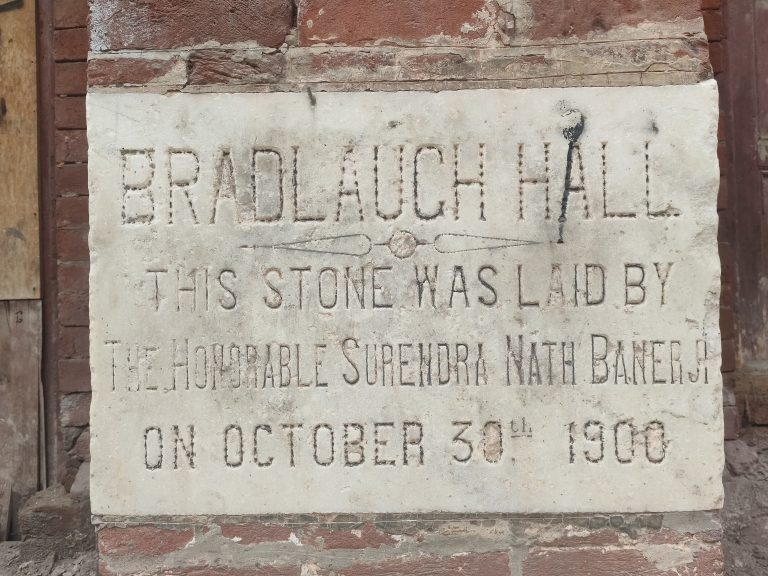
The featured image of this article and in the poster above is a photo by Mohammad Moiz Khan of the foundation stone of Bradlaugh Hall, in today’s Pakistan. Bradlaugh Hall was erected in 1900 by Indian nationalists and admirers of Bradlaugh to ‘honour Charles Bradlaugh and provide a venue for nationalists to assemble without requiring permission from the British authorities’, as Andrew Whitehead put it in a 2022 article for the Freethinker, which you can read here. Bob Forder’s Freethought History Webinar on Bradlaugh might also be of interest; see here. And you can find more Freethinker material about Bradlaugh here.


Your email address will not be published. Comments are subject to our Community Guidelines. Required fields are marked *
Donate