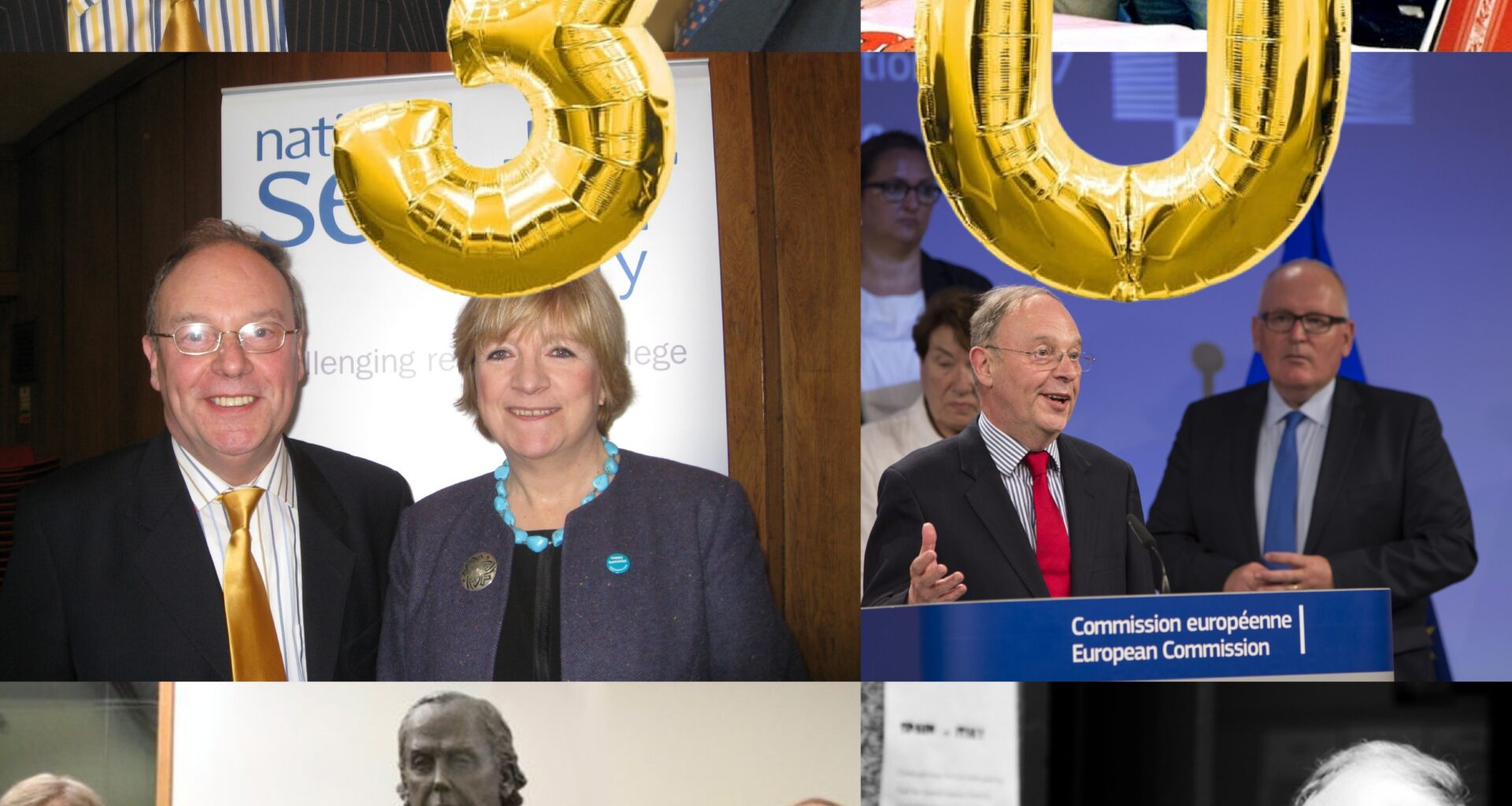
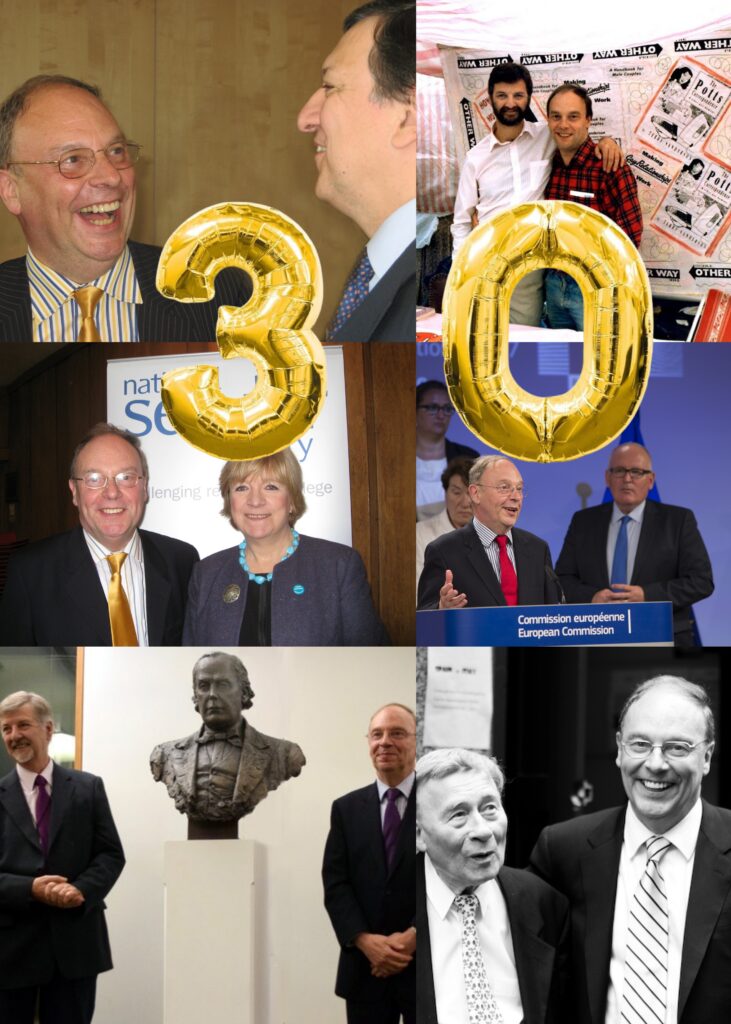
The original version of this interview was conducted by Helen Nicholls of the National Secular Society (NSS) and published on the NSS website on 29 May 2026. This interview celebrates and looks back upon Keith Porteous Wood’s three decades of NSS activism; he joined as executive director in 1996 and became President in 2017. The interview is republished here with the permission of the NSS, with a small amount of extra material added.
You’ve been with the National Secular Society for thirty years now. What first brought you to the organisation?
I heard about the National Secular Society through being an active member of the Gay and Lesbian Humanist Association. The NSS’s relevance seemed compelling. As a gay rights campaigner, I felt the main obstacle to equality was religious interests, and I soon became a volunteer. I had been in fairly high-flying finance posts, but I wanted to do something more consequential as a second career and was prepared to take a huge salary drop to do it.
I should say that it was Terry Sanderson who persuaded me to apply for the job. Terry was my partner, and he later became NSS President himself, serving from 2006 to 2017. He died in 2022, after several years of illness, and his absence is still keenly felt. Marking thirty years of my involvement necessarily means marking twenty-five years of his, and I cannot think about this anniversary without thinking about him. His writing, his commitment, and his extraordinary personal bravery in the cause of gay rights and secularism shaped the NSS in ways that are hard to overstate.
When you arrived, the NSS was at something of a low ebb. What did you find, and what did you set about doing?
By the mid-1990s the NSS had become a shadow of its former self, with just a few hundred members. The organisation was in dire need of modernisation and professionalisation. One of the things I am most proud of from these thirty years is having brought that about: transforming the NSS from a largely volunteer-run body into an effective national campaigning organisation with a strong council. Without that structural foundation, the parliamentary work, the legal cases and the international engagement would not have been possible in the way it became.
What do you consider the most significant achievements of the past thirty years?
There are several I return to. Terry’s idea of a demonstration against public funding of Pope Benedict’s visit to the UK resulted in nearly a mile-long march through the heart of London, the largest such protest before or since, and a vivid demonstration of the appetite for secular campaigning.
Working with Evan Harris MP, we tabled an amendment to abolish the common law offence of blasphemous libel, a key objective of the NSS since its foundation. The government was so alarmed it might succeed that they asked us to withdraw the amendment in the Commons in exchange for an undertaking to support it in the Lords, after a sham consultation with the Church that was effectively given no alternative but to accept abolition. Our fallback had been to take the case to the European Court of Human Rights, where the offence would almost certainly have been found to be in contravention of the Convention.
We also inserted crucial freedom of expression safeguards into the Racial and Religious Hatred Act, which would otherwise have introduced what amounted to an all-religions blasphemy law through the back door. That campaign was run jointly with the Christian Institute and was won by a single vote. Had the Prime Minister stayed another five minutes for one further vote in the Commons that evening, we would have lost.
I am also particularly proud of our work at the United Nations on the Holy See’s accountability for clerical child abuse. I discovered that the Holy See had ratified the UN Convention on the Rights of the Child but was failing to produce the required five-yearly reports. I raised this formally at the Human Rights Council and am almost certainly the only person to have criticised the Church there. It forced the Holy See to produce a report, which triggered a full examination of its record. The devastatingly critical Concluding Observations that resulted are now regarded by the human rights community as among the most significant document the committee has ever issued.
What has been the hardest campaign to fight?
The issue on which I spent the most time was the Equality Act and the regulations that preceded it. This was a sustained battle extending over more than ten years and hundreds of meetings. It was essentially an effort to limit often unreasonable demands for religious exemptions, particularly from the Church of England. It never felt like an even playing field. Civil servants leaned towards granting such exemptions, and on more than one occasion I discovered that pro-religious pressure was coming from Number 10 directly.
Most troubling was a last-minute amendment inserted clandestinely into draft regulations in 2005, permitting employment discrimination by religious bodies where it would “avoid conflicting with the strongly held convictions of a significant number of their followers”. In effect this sanctioned discrimination on grounds of sex or sexual orientation. We traced the wording back to the Church of England. The Parliamentary Statutory Instruments Committee was incensed, likening it to Lambeth Palace having a teletype machine capable of directly altering draft legislation. The committee placed its objections formally on record. Despite this, the wording remains largely in place in the Equality Act 2010 to this day.
In 2010, a bizarre episode occurred involving Tony Blair’s wife, Cherie Booth, in her role as a court recorder. She told a devout Muslim that he would not go to prison after breaking a man’s jaw ‘based on the fact you are a religious person’. We complained to the Office for Judicial Complaints (OJC). It ruled that she was not guilty of judicial misconduct and that no disciplinary action was needed. Nevertheless Booth was given ‘informal advice’ from a senior judge regarding her comments.
Seemingly the OJC was disturbed that the NSS would decry the decision, so they pre-emptively informed the press of it before informing us as complainants. They even threatened us with unspecified heavy legal action if we criticised their decision. In the event, the press contacted us and we made it quite clear what we thought.
How would you respond to those who argue that Britain is already a secular country, and that the battles have effectively been won?
It is one of our biggest obstacles, and a dangerous complacency. Politicians and the public assume that because Christian observance has declined so markedly, we have become a secular country and the fight is over. What they do not appreciate is that the decline in attendance is not mirrored in decline in the institutional power of religious bodies. That power, and the influence of extremely well-funded, socially conservative religious organisations, some of them operating from the United States, is actually growing, here and across Europe.
Which secularist issue is most urgent right now?
Education, without question. It is where the absence of secularism is most directly felt by ordinary people. Around a quarter of schools in England are Church of England, despite only around 1% of the population now attending a Church of England service on a normal Sunday. We remain almost uniquely in the world in mandating largely Christian worship daily in publicly funded schools, including those with no religious foundation. There should be an entitlement to education in a secular school.
It is also possible to open new religious schools at vast public expense. A new Catholic school in Wrexham will cost more than £100 million of public funds to build, will be maintained entirely from public funds, and will then belong to the Church. All of this in Wales, where the nonreligious are the largest religion or belief group.
After thirty years, what has surprised you most?
When I arrived I rather naively expected to find that my perception of the power of the churches was somewhat exaggerated. The reverse turned out to be the case. Even now, with church attendance at minuscule levels, the influence of the established church on government remains very significant, not only through the bishops in the Lords but through what appears to be a much deeper entrenchment within government departments, the law and the establishment more broadly.
I also came to the NSS with some optimism about the direction of travel, and in many respects that was justified. The campaigns I have described represent real and lasting change. But the intensity and organisation of the pushback, particularly from well-funded religious organisations, has been something I did not foresee. Parliamentary engagement on secularist issues has declined significantly since my early days, at least in part because so few people attend church that MPs no longer think there is a problem. That pushback and complacency are, I think, the greatest challenges we face going forward.
Related reading

Your email address will not be published. Comments are subject to our Community Guidelines. Required fields are marked *
Donate