Credo: I Believe
I believe for every drop of rain that falls a flower grows – Every?
I believe that somewhere in the darkest night a candle glows – Well, yes, probably. So what?
I believe for everyone who goes astray someone will come to show the way – Why do we have prisons? Which way was Cranmer shown? Captain Scott, ‘Mad’ Mike Hughes, Anne Boleyn, Peoples’ Temple, Steve Irwin?
I believe above a storm the smallest prayer can still be heard – By ‘heard’, do you mean aurally perceived or receives a response? You mean the latter, don’t you? I draw your attention to Benson et al., 2006 (STEP).
I believe that someone in the great somewhere hears every word – Who? Oh, you mean God. How do you know?
Every time I hear a newborn baby cry or touch a leaf or see the sky – We can all do that, and be moved, but…
Then I know why I believe – Really?
‘I believe…’ has become commonplace as a way of asserting what one cannot possibly know. Often, ‘I believe…’ is spoken when declaring something that is demonstrably untrue, which provides self-delusive self-assurance. I no longer feel comfortable speaking or writing the term. A hypothetical approach is more rational, in that it inspires methodological inquiry and the accumulation of evidence upon which to establish a properly robust belief. Once adopted and practised, that need not be a long-winded process. The English language is rich with alternatives: I consider, I think, I judge, I feel, I suspect, I suppose, I guess, I deduce, I infer, and when it is justified, I know.
In an online conversation last year, an English caller to a Bible-literate American rationalist’s YouTube channel prefaced unsupportable, indeed unfalsifiable, claims about his God with ‘I believe’ twenty-four times. Some examples:
Caller: I believe He [God] knows all things that are able to be known. I believe He knows my thoughts. He knows, and I believe, the future is a knowable thing. I believe that since we have suffering, and if I believe He’s created the best possible world, that all the suffering, either in a direct or indirect sense, creates a greater good.
One asks: ‘Yes, but for your beliefs to be worthwhile, and before you adopt them, surely your God needs to exist. Does He?’ The reply is likely to be prefaced with ‘I believe…’
Just like the majority of his Christian colleagues, the caller provided no plausible verification of his beliefs, and none of the above can be verified. Indeed, there is no reason to believe them at all. He had just absorbed them in a way that no serious free thinker ever could. Indeed, he was tackled on believing in the absence of some sort of evidence and he remained defensively (more likely vacuously) confident of his method. The host was arguing the topic of the existence of natural evil being permitted or perpetrated by the caller’s tri-omni-God and ran circles around the caller for half an hour.
Host: What’s prohibiting God from creating the world without natural disasters?
Caller: So, I believe the Lord created the world in harmony and unity and there’s been a fall [Adam’s], and what you’re seeing are effects. Those effects would be implemented in many ways. What we’re seeing it in the realm in which we live, we see it as natural disasters, natural evil. If we lived in a very different reality, it would be different. But the, the fact is uh there are consequences for things. That is, you can’t have uh…the fall and sin and then no consequences. If there is an actual ontological effect of a cause and a fall, you have to have the effects of that. Um…
The caller’s beliefs were asinine, and his defence inept. Rather than argue with knowledge, he chose to present his reasoning using his inadequate understanding of basic syllogistic philosophy. Each time the caller waded stickily through a set of his beliefs, the host pointed out how he had just contradicted one or other of the omni- characteristics (-potent, -scient, and -benevolent) he had already said he believed applied to his purported God. Each next argument undermined another of the omni-s, round and round.
In addition, he had no comprehension of what the host had meant when he said, up front, ‘My claim is your God doesn’t exist.’ Having been told that, both directly and also in the title of the discussion he had voluntarily entered—Your god is imaginary. Prove me wrong—the oblivious caller just assumed that both were discussing the question with a biblical mindset. For instance, he assumed that Adam’s Fall and Sin were included in the host’s worldview and spoke of them as if presumed by them both. So naïve. So unaware of his situation. I was disappointed that the host did not question this, but he had plenty else to discuss.
Across the entire continuum of Christianity, from fundamentalist to moderate, belief is treated as a valid alternative to knowledge. It is a basic method in religion, and the religious and the uncritical then apply it to any preferred idea or ideal which cannot be supported with evidence, and thus it becomes true (to the believer). Believers who want to believe something simply embrace belief, even if (as is often the case) a belief contradicts reality or erroneously explains an unknown.
Credimus: We Believe
My atheism is consistently reinforced, indeed enhanced, by the BBC’s religious broadcasts on Radio 4. If I am awake early enough, Prayer for the Day is often the cause of incredulous hilarity (perhaps pity for the presenter), while other programmes, such as Thought for the Day, Sunday, and Sunday Worship, even the perversely fascinating annual relay from the Keswick Convention of beaming, arm-waving evangelicals, provide regular entertainment.
Having a lie-in on 19 January 2025, my disbelief received a boost from Radio 4’s Sunday Worship. The topic was Celebrating the Nicene Creed, which compelled my drowsy mind to enjoy a little critical analysis. Poet-priest Malcolm Guite and Canon Susanna Gunner were celebrating the Nicene Creed, marking the seventeen-hundredth anniversary of the Council of Nicaea, which formulated the Creed in 325 CE. Guite’s animated amazement when considering its antiquity was preposterously exaggerated.
[I]t is worth pausing for a moment to consider how astonishing this anniversary is. The Nicene Creed has summarised, expressed, and opened out the heart of our shared Christian faith for seventeen centuries! Almost nothing else in our culture and heritage has lasted that long.
This creed has persisted through wars and revolutions, through changes of dynasty, the birth and development of languages, the rise and fall of empires. It has even survived the tragic divisions of Christendom. For even as Churches and nations battled each other over different understandings of church order, of scripture and of sacrament, they still held this creed in common.
As soon as the preacher had marvelled that the Nicene Creed has survived for seventeen centuries, I started thinking of reasons it was far from unique in that respect. Has nothing else in our culture and heritage lasted for at least seventeen hundred years? What did he mean by ‘our culture’? Human culture? No. British culture? No. Exclusively Christian culture? It had to be.
The first thing to enter my mind was flint arrowheads and scrapers. They are firmly embedded in our culture as markers of past cultures, and today, not only are few people unaware of these ancient artefacts, a reasonable number of people like Phil Harding (of Time Team fame) are still knapping them skilfully. Even after such tools were replaced with bronze and iron, the practice continued for various uses; for instance, flints for tinder boxes and firearms were knapped right up into modern times. Wikipedia tells us that ‘Brandon [Suffolk] knappers made gun flints for export to Africa as late as the 1960s’, meaning that flint knapping has been practised since long before the Palaeolithic, for several million years.
How about the old cottagers’ method for farming, butchering, and sharing a pig, which before refrigeration would be too much for a single household to use efficiently? Instead, each time pork and pork products were required (everything except the squeak), the community would co-operate and divide the parts of a single pig among everybody, blood and liver first, the economical way to keep a village supplied with protein until the fridge-freezer made it unnecessary. The practice—which for ancient practical reasons probably predates the Nicene Creed—can be seen in medieval illustrations and read about in journals, and was even recorded as still happening only forty years ago during conversations with elderly country folk.
Mythology includes Noah’s Flood. The story was composed maybe five thousand years ago, and it is, of course, untrue, yet Bible adherents have known it well for a long time. Reality includes Eratosthenes’s calculation that the Earth is round, deduced from shadows created by vertical rods set at different locations, centuries before the authoring of the Nicene Creed. That has been common knowledge ever since—well, until now, when an increasing number of inconsequential nutters attempt its refutation. If our planet were not roughly spherical, a lot of irrefutable knowledge would be rubbished and very little would make sense anymore.
All of the above and much more arrived in reality or ancient myth, in the distant past, and all have lasted in cultural awareness as long as or much longer than the Nicene Creed. So, what’s so special about the Nicene Creed, written in 325 CE and still in use (by a minority of the world’s inhabitants) today? It’s an old survivor, but in that not at all astonishing. Also, by today’s standards, the beliefs it affirms are arguably arrant trumpery moonshine.
When it comes to Creeds, I have known, memorised, chanted, and disbelieved the Apostles’ Creed (see green box below) since I was a boy chorister, and can still recite it, but I had only vague awareness of the Nicene Creed, which is more of a Catholic thing. So, in order to write this essay, I had to look it up and get learning.1 It seems to me that the Apostles’ Creed, as used today in the Church of England, is just a seventeenth-century précis of the Nicene one, perhaps a translation from a Latin version.
Nowhere in the BBC service was the Creed spoken in full, and what they did chant was not from the Nicene Creed of 325 CE but instead the first verse of the extended 381 CE Constantinople version, in English. Since it was specifically the anniversary of the 325 version that the service was celebrating, you might think somebody would have considered that (but we understand that the chanting of dogma requires only vacuous autopilot).
Nicene Creed, 325 CE (verse 1)
Original Greek: Πιστεύομεν εἰς ἕνα Θεὸν Πατέρα παντοκράτορα, ποιητὴν οὐρανοῦ καὶ γῆς, ὁρατῶν τε πάντων καὶ ἀοράτων. [Pistévomen eis éna Theón Patéra pantokrátora, poiitín ouranoú kaí gís, oratón te pánton kaí aoráton.]
English: We believe in one God, the Father Almighty, poet/creator of heaven and earth, visible and invisible.
Latin: Credo in unum Deum, Patrem omnipotentem, factorem caeli et terrae, visibilium omnium et invisibilium.
English: I believe in one God, the Father Almighty, Maker of all things visible and invisible.
BBC English, 2025: We believe in one God, the Father, the Almighty, maker of heaven and earth, of all that is, seen and unseen.
Once the congregation had chanted the first verse, the preacher proceeded, discarding all the rest (box). That first verse translates Greek to English, literally, as: ‘We believe in one God the Father almighty, poet/creator of heaven and earth, visible and invisible’. So, where did ‘of all that is…’ come from, slightly but significantly skewing the meaning of the final phrase? Later, the second preacher’s reasoning leant heavily on ‘of all that is…’ and its context, yet it is not in the original, which naturally piques a critic’s interest. It is just added in the Latin and English conflations of the original and Constantinople editions (box).
The Apostles’ Creed
The Book of Common Prayer, 1662
I believe in God the Father Almighty, Maker of heaven and earth:
And in Jesus Christ his only Son our Lord, Who was conceived by the Holy Ghost,[a] Born of the Virgin Mary, Suffered under Pontius Pilate, Was crucified, dead, and buried: He descended into hell; The third day he rose again from the dead; He ascended into heaven, And sitteth on the right hand of God the Father Almighty; From thence he shall come to judge the quick and the dead.
I believe in the Holy Ghost; The holy Catholick Church; The Communion of Saints; The Forgiveness of sins; The Resurrection of the body, And the Life everlasting. Amen.
The Niceno-Constantinopolitan Creed (325 & 381 CE; English version)
We believe in one God, the Father, the Almighty, maker of heaven and earth, of all that is, seen and unseen.
We believe in one Lord, Jesus Christ, the only Son of God, eternally begotten of the Father, God from God, Light from Light, true God from true God, begotten, not made, of one being with the Father. Through him all things were made. For us men and for our salvation he came down from heaven; by the power of the Holy Spirit he became incarnate of the Virgin Mary, and was made man. For our sake he was crucified under Pontius Pilate; he suffered death and was buried.
On the third day he rose again in accordance with the scriptures; he ascended into heaven and is seated at the right hand of the father. He will come again in glory to judge the living and the dead, and his kingdom will have no end. Amen
The Constantinople supplement (381 CE)
I believe in the Holy Spirit, the Lord, the giver of life, who proceeds from the Father and the Son, who with the Father and the Son is adored and glorified, who has spoken through the prophets. I believe in one, holy, catholic and apostolic Church. I confess one Baptism for the forgiveness of sins and I look forward to the resurrection of the dead and the life of the world to come. Amen.
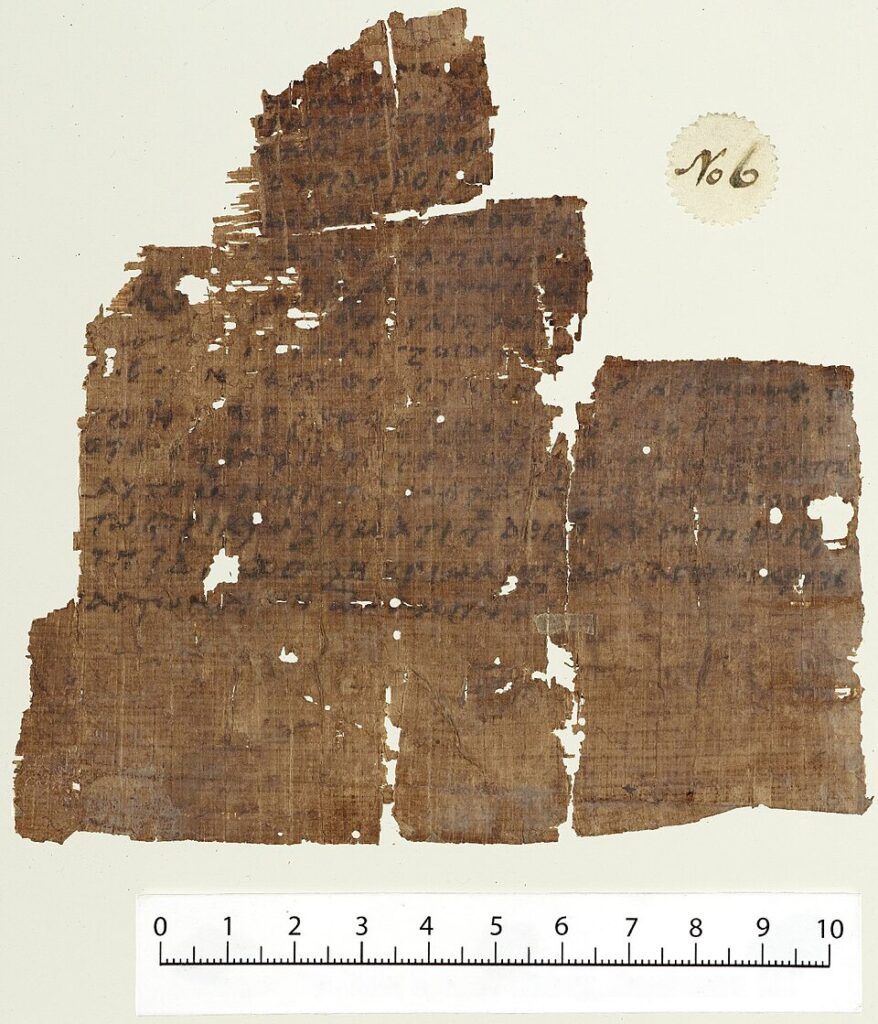
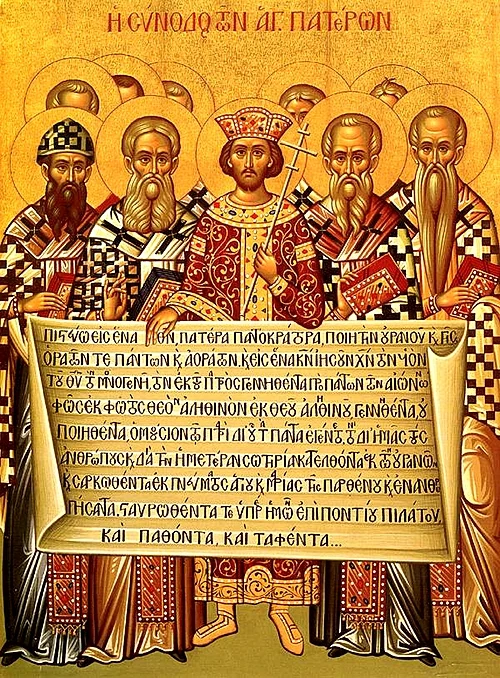
This insertion surely parallels the massive translation problems associated with the English Bibles, highly magnified there through multiple translations and copies of unaccredited lost documents, which cannot be checked. We have at least some idea of the original sources of the Nicene and Constantinople Creeds, and each more-or-less mirrors the other, even if there must be some doubt as to their accuracy due to the former being available only as a tattered sixth-century copy and the latter as a relatively modern, frequently referenced but never dated icon.
So, the preacher continued:
‘We Believe’! When the creed was translated into Latin … it was Credo (‘I believe’), but in the original Greek and now in our modern English translation the plural We is restored. We join together and say, ‘We believe’, and that plural pronoun is important. Our faith is something we hold together, something that draws us together.
He hits one of my most sensitive critical nerves. Belief. It is significant because of its almost universal subtext: ‘True or not [all too often not], I have chosen to believe’, rather than: ‘It is true, and I can verify it to your satisfaction, so belief is a secure conclusion’. Belief is not optional, not a preference. Genuine belief should be firmly bedded on a foundation of reason and evidence, not personal or collective inclination.
Although item by item, ‘I believe’ or ‘We believe’ are declared with dogmatic confidence, these creeds say nothing about truth; indeed, just the opposite! They claim what cannot be confirmed or falsified. What they do contain is a sequence of incredible beliefs which have no foundation in evidence or reality, only in strictly imposed, routinely observed, inflexible doctrine. Creedal beliefs are so important an aspect of Christianity that they are taught, spoken and multi-repeated in chorus, so as to embed themselves in tragically malleable minds, later to be regurgitated as facts.2
These beliefs are, of course, constantly sustained with implied or overt threats of Hell—routinely reinforced by the creed text itself—ranging from relatively benign separation from God to extreme eternal hellfire, depending on which denomination of priest is preaching. Hell, ‘lite’ or profound, is universal in Christian doctrine, deeply entrenched in the minds—or hearts, if they prefer (see below)—of believers. Contradictions of religious beliefs are met with illogical attempts to dilute the immutability of real truth—think ‘my truth’, ‘our truth’, or ‘alternative truth’, all anathema to a critical thinker.
As Mr Guite told his congregation: ‘We join together and say, “We believe” and that plural pronoun is important. Our faith is something we hold together, something that draws us together.’ Who needs truth when given permission to believe anything you want to by the simple application of faith (in the Hebrews 11:1 sense), and you can confidently convince yourself of it in the secure company of others around you by reciting a Creed over and over?
Faith is foundational to Christian belief, so when pressed for clarity, Christians draw our attention to its definition in Hebrews, to which they confidently adhere.
Hebrews 11:1 Now faith is confidence in what we hope for and assurance about what we do not see. (NIV) Now faith is the assurance of things hoped for, the conviction of things not seen. (NRSVUE/ASV)
Fair enough. Any of those translations provide confirmation of what Christians want ‘faith’ to mean, to themselves, but when we ask for evidence, they reach for the 1611 King James version, the only one where the word evidence appears, ignoring the more competently translated modern Bibles they might cite until decisively challenged.
Hebrews 11:1 Now faith is the substance of things hoped for, the evidence of things not seen. (KJV)
Assurance and conviction are not evidence, just attitudes, but if they can point a finger at the word in the old 1611 version, now they have proved their assertion with evidence, so then they can get bogged down in spurious inquiry about what ‘things not seen’ might mean: air, atoms, gravity? In any of its translations, faith as prescribed by Hebrews 11:1 is the antithesis of critical thought, but it provides secure validation for those who are obliged to believe, circumventing the inconvenience of evidence. Fortunately, there are alternative definitions of faith.
Faith is the excuse people give for believing something when they don’t have evidence. Faith is not a virtue. Faith is gullibility. It’s evidence that determines whether or not your perception of reality is reasonable and in conjunction with the world as it is. – Matt Dillahunty (recent)
Having faith is believing in something you just know ain’t true. – Mark Twain (1835-1910)
The sermon was continued by a second preacher:
Susanna Gunner: In its opening sentence, the Nicene Creed speaks of God as Creator. Creator of what? ‘Of heaven and earth’, it says and then, ‘of all that is, seen and unseen’. That tiny word ‘all’ is huge. As far as humanity goes, it means each one of us, those we love as well as those we find difficult to love, and the millions we’ll never meet, some living quite near us perhaps but forced to the unseen edges of things by circumstance of many sorts. We’re all of God’s making, all gathered together in this utterly inclusive creed.
She spoke ‘God as Creator’ without any hint of the jolt that ridiculous affirmation of ignorance would trigger in our minds if we were to say it. She simply continued expounding this never-yet-demonstrated ‘fact’ or faith-based belief, displaying what ought to be a very uncomfortable cognitive dissonance of modern knowledge versus demonstrably incorrect biblical creation dogma, underlain by the ‘obvious’ assumption of the existence of the creator Himself. We often hear preachers citing the Genesis creation account with not a hint of their ever having considered its limited explanatory capacity and utter incorrectness. It’s in the Bible, so just read it with the confident air of authority assumed to accompany your priestly status.
Having without any justification established the veracity of God’s creation, she proceeded by addressing that tiny word ‘all’, which she declared is ‘huge’, encompassing the entirety of humanity. Of course, she diverged from the Nicene Creed, which does not contain that ‘all’ concept at all—‘all that is, seen and unseen’—and, using that common clerical method, reckless extrapolation, claimed that it specially referred to ‘each one of us’. That is not what it says.
Then—inexplicably forgetting to make the arguably ludicrous claim that we are, of course, all made in God’s image, because Genesis 1:27—she confidently asserted that we are all gathered together in this wholly inclusive Nicene Creed. However, something she failed to acknowledge was that many of us don’t count ourselves among this ‘all’, and I feel confident we’re not unusual in that. That is as daft as her colleague’s astonishment at the apparent social longevity of the Creed.
Demonstrably, her presumption of total inclusivity is wrong. The Christian Creator is ‘known’ only to Christians, a mere fraction of the world’s human population, and no matter how convinced the speaker is that that ‘tiny word, all’ encompasses everybody without exception, she’s easily shown to be wrong, though her blinkers will remain firmly in place. There are billions of adherents to non-Christian religions, plus those wicked unbelievers. She’s learnt that silly but widespread dogma from her seminary instructors, who in their turn were taught likewise for generations, and they all just trot it out when preaching, but without reflecting on its palpable wrongness.
Her Bible may assert that we all know God in our ‘heart of hearts’, but that is beyond investigation and patently untrue. Only we know the contents of our brains. It is merely words in an old book, and just because Luke said so (Luke 2:35: ‘…so that the thoughts of many hearts will be revealed’), nothing is proved. (It should be unnecessary to remind people that the heart is a blood pump, not the locus of consciousness.) Our thoughts are inaccessible to other people, including ardent but naïve Christians who think they know better because it is written that a long-dead saint reputedly, but unverifiably, said so. Here is the passage routinely quoted at unbelievers, ‘proving’ that despite our actually knowing otherwise, we all know God.
Romans 1:19-20 …since what may be known about God is plain to them, because God has made it plain to them. For since the creation of the world God’s invisible qualities—his eternal power and divine nature—have been clearly seen, being understood from what has been made, so that people are without excuse.
Those of us who have the capacity for honestly interrogating our own brains do not detect the presence there of such asinine beliefs. The Bible is wrong, the priesthood is wrong, and their congregants are wrong. The service continued in conventional fashion, but that is enough to reveal the uncritical, or we might even suggest infantile, reasoning displayed.
Secular Belief
It is unfortunate that, today, the assertion of belief is commonplace in secular discourse. BBC News is a regular culprit, reporting without question or nuance what people say they believe or stating that scientists believe they have made an important discovery, for instance, when the existence of the long-sought Higgs Boson particle was confirmed by two magnificent experiments at CERN’s Large Hadron Collider in 2012.
As the moment of the official announcement approached, the BBC’s science correspondent Palab Ghosh set the scene, his report based upon reliable information already leaked to the press. Statistical confidence was reported to be 99.9999%, but Ghosh chose to say that the scientists had now just about managed to confirm what they had long ‘believed in their heart of hearts’. I was impressed by the probability percentage but not by the presenter’s portrayal of the scientific method, which a responsible science correspondent should have etched onto his ‘heart of hearts’! No proper scientist simplistically believes anything, and certainly not in his/her biblical ‘heart of hearts’. Hypothesis, yes. Theory, yes. Belief, no.
St Columba’s Well is a minor tourist attraction in Invermoriston, by Loch Ness. A sign announces:
It is believed that a well, or spring, has been on this site since early Pictish times. Until the 6th century AD the water was considered to be poisonous, causing boils and ulcers to appear if splashed on the skin. Then in AD 565 St. Columba drove out all the evil spirits around the well and blessed for all time the water coming out of it. The water was then clean and pure and was said to have great curative powers.
Confronted with such information, we have choices: soak it all up uncritically (usual) or analyse it (sensible). ‘Believed that’, ‘considered to be’, ‘evil spirits’, ‘said to have’? Does anybody actually know any of this guff? Did Columba really visit Invermoriston? Did he really visit and—as reported by 7th-century St. Adamnan—encounter and banish the monster to the depths of Loch Ness with a sign of the cross? What is true about this sorry little seepage? Clean and fresh maybe, but what do they mean by ‘pure’?
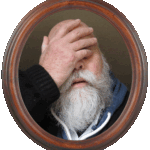
And finally, I invite you to a communal face-palm. By no means uniquely, a MAGA supporting American tells a reporter that a) he does not believe a fact that can be conclusively proved to be true (based on news and court records) while b) believing something which is patently untrue (a Trump fantasy), and that because of his conviction that law and order is ‘absolutely important to him’, c) he has chosen to vote for a repeatedly convicted criminal:
Interviewer: Is law and order important to you?
Trump supporter from St Louis: Absolutely.
Interviewer: And [your] shirt says, ‘I’m voting FELON 2024’. What does that mean?
St Louis Man: Well, [Trump] was convicted, but not that I believe it. I believe the last election was rigged too, so…hmm…
Interviewer: So, law and order, and you’re voting for a felon.
St Louis Man: Yes, sir.
- Since this is a theological topic and I’m a pragmatic biologist and unbeliever, I might innocently have adopted the occasional misconception.
↩︎ - An editorial aside…
See Charles Freeman’s study AD 381: Heretics, Pagans and the Christian State (2009) for an insightful analysis of the creation and enforcement of Christian orthodoxy. As Freeman shows, the acceptance of the Niceno-Constantinopolitan Creed was the result, ultimately, of Roman imperial authoritarianism, rather than a rationally argued conclusion of eminent theologians. As for Gunner’s ‘utterly inclusive creed’, I hope it isn’t too crude in the eyes of ‘sophisticated theologians’ for me to point out that the Creed promulgated in 381, along with its concomitant decrees, excluded all non-orthodox (as newly defined) Christians as well as pagans in an astonishingly extreme, and extremely damaging, turn from the classical tradition of free thought. Freeman:
Never before in the Greek or Roman world had there been such a sweeping imposition of a single religious belief alongside the active suppression of alternatives. The only precedent comes from ancient Egypt when the pharaoh Akhenaten replaced the mass of Egyptian deities with the single sun-god Aten in the fourteenth century BC—and even this policy was quickly reversed by his successors. [The emperor] Theodosius’ decrees were especially startling because less than sixty years earlier, in 313, the emperor Constantine had issued, with his co-emperor Licinius, an Edict of Toleration in which he promised ‘that no one whatsoever should be denied freedom to devote himself either to the cult of the Christians or to such religion as he deems best suited for himself’. As late as the 360s, the principle of freedom of speech and thought was being proclaimed by the court orators as essential to a healthy society.
(See also Freeman’s articles for the Freethinker and our interview with him. The latter includes these highly relevant words: ‘The big ethical issue about Christianity is the ethics of exclusion. Jews, Muslims, pagans—you are either in or you are out.’)
Not to mention the fact that 381 did not mark the end of the theological wrangling over Christian orthodoxy, nor the authoritarianism and violence that such orthodoxy required for its formulation and enforcement.
~ DJS, editor
↩︎


Your email address will not be published. Comments are subject to our Community Guidelines. Required fields are marked *
Donate