Introduction
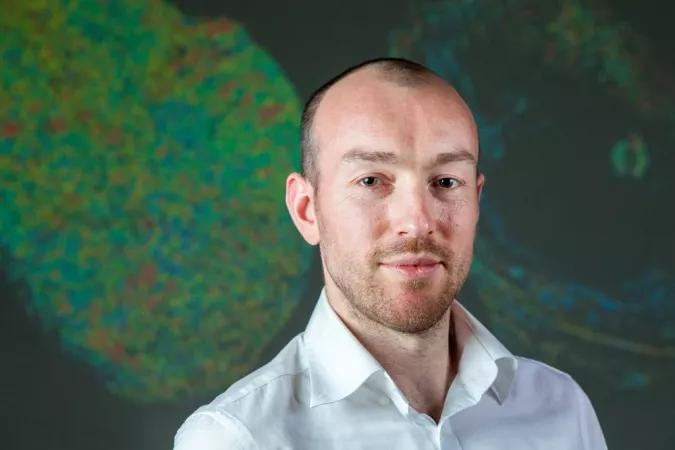
Dr Simon Walker-Samuel is Professor of Biophysics and Imaging at University College London, a world-class cancer research scientist with the Institute for Cancer Research, a trustee of Humanists UK, and a public advocate for freethought. He has debated many leading scientists of faith in the public sphere, and he kindly took some time to share his thoughts with me. Below is the transcript of our conversation, lightly edited for clarity and concision.
Interview
Samuel McKee: Did you have any faith background?
Simon Walker-Samuel: My parents never really talked about religion or their beliefs, and I only really found out what their beliefs were later on in life, but we never went to church, and we never did anything to do with religion, nor did my grandparents on either side. But I got sent to a school that did have a religious ethos, and there was a strong tension in my mind at that point. I thought, ‘What is this?’ And I just didn’t understand it at all, because I’d not been exposed to it. So even from primary school, you’d do sort of prayers and assemblies with religious settings; you’d learn hymns, and you’d think, ‘This is odd.’ There was a religious ethos all the way through secondary school, too, and I always got this feeling of being on the outside as a result. I thought, ‘Why is my family background this?’ I spent a long time trying to work out what had happened to cause that disconnect between the two.
Where did that lead?
I read some Dawkins during secondary school leading up to GCSE. I remember discussing this with a very open-minded priest in an RE lesson. I said that I’d read The Blind Watchmaker; what did he think of that? And he said, ‘Wow, that’s a great book.’ We discussed it a bit, and that was great. There was a sort of open-mindedness. Had some great discussions at that age. And then the four horsemen [of New Atheism] thing happened when I was at university, and there was a lot of debate about religion. I was taught by Jim Al-Kalili at university, who was part of Humanist UK; he was great for physics.
Wow.
I think that further sharpened my take on things. But I was just left going, ‘Why? Why?’ You know, there were all these claims made throughout my schooling, and I thought, ‘I don’t know why I would believe that. I don’t get the basis for ascribing belief to your view of the world. Is it true?’ I did a lot of questioning, asking religious thinkers, ‘Is that a story or is that true?’ And there was never a clear answer to that. Now I have a sense of why that was—the missing link was faith. That’s the bit I was never given.
You’ve become an advocate for humanism. You’re a trustee of Humanists UK. Why is that important? What can humanism offer people?
I, like most people who call themselves humanists, didn’t realise that there was a term that encapsulated what I believed or didn’t believe. And humanism isn’t just about the negative. I’m an atheist; I don’t believe this [God] thing. But humanism is about the positive beliefs as well: valuing science and creativity and art and all that kind of stuff. I think it’s good to have a term that encapsulates what are actually the beliefs of a very large proportion of UK society—about 30% of the UK population. If they knew what humanism was, they’d probably call themselves a humanist, but most people haven’t heard of the term.
So, I think it’s important to promote that and just say that it’s an acceptable set of beliefs. I know from my schooling, for example, that morality and religion were seen as very much hand-in-hand, that your sense of morality came through religion. And I thought, ‘Hold on, I think I’m a good person, but I’m not religious, so how can that be?’ I think humanism provides access to moral philosophy in a way that isn’t so easily accessed through a religious framework.
You’ve advocated for atheism and Humanism UK in debates and discussions, too. Why do you think it’s important to do that, and what’s your approach to doing it?
I think it’s really important to get the concept out there. It’s a difficult line to tread. I don’t want to even give the sense that I’m saying, This is the right way to think, this is the only right way, that person’s wrong, I’m right, you should believe this, because I think people need to make up their own minds based on the evidence. And I tend to think that the case for non-religious worldviews is more persuasive in that sense than the case for religious worldviews. You present your argument, and you say, ‘It’s up to you.’
You’re Professor of Biophysics and Imaging at University College London, and you’ve done some really important work with the Institute for Cancer Research. We’re in a funny place in terms of science denial and antagonism against science today, but we’re still hopeful that science and reason can help people think better. What are your hopes for the future? Do you agree that science and reason are the best way for people to think properly about the big questions of life?
Yes, I definitely think so, and that is part of humanism as a sort of rational approach to the world: valuing evidence, valuing science. It’s an amazing privilege to do a science undergraduate degree, I think. I mean, particularly in physics, I had the best time, the best four years. When I was at Surrey University studying physics, it just opened your eyes to the world in a way that you wouldn’t see otherwise. You got an understanding of why evidence and reason are so important, and why statistics are so important. That’s another thing that slightly gets swept away if you don’t have the privilege of that kind of access to that kind of education.
And not everyone does it. There are the arts and other things as well, but I think there’s something about understanding that scientific worldview and why the subjectivity and bias that we as humans tend to overlay on things can be so damaging.
You’re right that I think we are increasingly relying on, or increasingly accepting, as a society, science and reason. I think the anti-science movement (anti-vax and flat earth and things like that) is a small proportion that gets amplified through social media. Engagement on social media is driven by both negative and positive comments and responses. So you can be a flat earther and be piled on by scientists going, ‘This is nonsense’, but then be amplified as a result. I think the anti-science lobby, although it’s big in some places like the United States, for example, is probably going to die out and be replaced by something a lot more rational, particularly as measles epidemics become more frequent, and maybe there’ll be another pandemic. I think we’re going to have to have another reminder of why it’s so important to think rationally and scientifically about the world.
Are you hopeful that we will win the war against cancer soon?
We’ve made amazing advances in treating cancer. Things like T-cell therapy have really transformed things. Diseases that would have been terminal diagnoses 20 years ago are now quite treatable. I do feel positive, and there’s always progress being made. Yes, it is slow progress, but that is characteristic of how science often works. It’s not really through big, sudden breakthroughs; it’s through little incremental bits of progress over a long period of time. I definitely think we’re moving forward.
Read more of Samuel McKee’s interviews with leading scientists and humanists, including Peter Atkins and Jerry Coyne, here.





Your email address will not be published. Comments are subject to our Community Guidelines. Required fields are marked *
Donate