


Jesus, posits S.M. Carlson at the outset of The Jesus Dilemma, and in several rephrasings, is ‘the most influential figure in human history’. (Seeing him as such is the first of his three systematic mistakes.) In truth, there is no such thing as one sole most influential figure. And if a list were to be attempted of top influencers, it would have to be of the people who led us away from magical thinking and towards a really better informed, healthier, and more empowered life—the likes of Thales and Aristotle and Newton and Darwin, Gutenberg and Jenner and Pasteur, Jefferson and Pankhurst, in a count that of necessity is woefully incomplete. They actually changed the world.
Or take Watt. By harnessing steam power in a practical way he made formal slavery un-‘necessary’, at least initially in activities that could be mechanised, and abolition could gain traction. That was a mega-seismic change. Before Jesus, on the other hand, most of the world believed in supernatural beings, and after him, the same situation pertained. What there was, for a section of the believing throngs, was a switch in dramatis personae—as there had been other switches before him; nor would his be the last. And his ‘be good unto others’ message came, firstly, with close precedents—and secondly, did not afterwards diminish the aggregate level of mischief-making either. Christianity, like many other faiths before and after it, just added another reason for people to persecute and murder one another, citing ‘wrong’ religious ideas and affiliations.
About this latter phenomenon, by the way, Carlson says nothing—a significant gap in what aims to be a comprehensive look at Jesus and his legacy. He brings in that Christianity has ‘inspired countless acts of charity’, with blinkers for the also countless acts of ghastly torture and murder. Not a peep about the wars of religion, the Inquisition, or even the initial loathing towards his own chosen persuasion (see below) by other followers of Jesus. As he methodically runs through a roster of Christian denominations, you could go away with the impression that all that splintering, not to mention relations with other religions, was as quiet and amicable as a vicar’s tea party.
In fact, he says so. ‘Through Jesus, God is actively restoring humanity and creation to its intended state of harmony, unity…’ And again later: ‘Jesus Christ stands as a beacon of hope, redemption, and unity’—emphases added. This, from a person who manifestly has read history, and can be assumed to scan the daily news too.
Before continuing with an examination of the book’s ideas, more information about its contents and method. Its subtitle is Faith, History, and Mythology. (What the ‘dilemma’ in the title is supposed to be is unclear; everything is presented as quite certain, including its position on the debates about Jesus’s existence, doings, and sayings. It would appear to be a harmless come-hither title choice.) Other than the aforementioned see-no-gore gap, Dilemma is indeed very broad in its coverage. It goes through many different angles of the case of Jesus, including the search for parallels in other religions, as well as current problématiques.
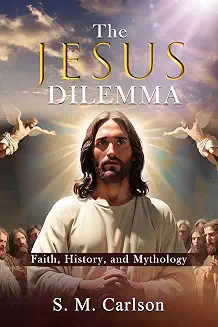
Thus, The Jesus Dilemma could serve as a handy digest of information on world religious matters. As such it could profitably include an index. Still, it has a detailed table of contents (six and a half pages of it, extending down to subsection headings), which partly offsets that omission.
The author is a one-time atheist who converted to Mormonism, or in the latter’s preferred formulation, LDS, for Latter-Day Saints (and not to worry, atheism does not punish ‘apostates’). As he runs through religions and related questions, Carlson is generous with praise for everyone (save atheists, who are largely glossed over, one notable line, among the few exceptions, being a quote he provides about ‘secularists… with self-congratulating pride’). Then he ends with the LDS position on each pertinent matter. The volume contains an invitation to readers to write in for free copies of the Bible and/or the Book of Mormon.
Beyond these aspects, it does not proselytise for LDS. (For Jesus, yes, of course. The favourite concept is ‘richness/rich/enriching’; it is used 55 times. Also doing yeoman service are ‘unique’, ‘engage’, and ‘testament to’.)
There is some conceptual repetitiveness (e.g. with regard to Jesus in Islam, or in references to Krishna; in fact we are told the latter is the charioteer of Arjuna three times), but in tolerable amounts overall. The text is clear, and relatively light on jargon such as ‘salvific’. In one sense, nevertheless, its style is reminiscent of that of scholarly papers: it can hardly state anything, even when it is perfectly uncontroversial, without backing it up with quotes from other texts that say it too. As is known, if an academic article has occasion to say ‘a week has seven days’, it duly references Sliwowski, Casimir, Calendrics, Copernicus Press, Warsaw, 1986, pp. 307-8, and Das Pereiras, F., Moritumo, A., et al., Recent Corroborations in Heptadic Research, Journal of…, and so on and so following.
In academe, this is done for two reasons: to prove to evaluators that the author has read the literature, and, in a milieu in which the number of times one is cited helps in advancement, to invite reciprocal treatment: today I quote you so that tomorrow you will quote me. In the present book, however, readers are surely ready to credit Carlson with the former on trust, and he does not need the latter.
Back to the mistakes that can be seen to course systematically through the book. The first had to do with the level of importance of Jesus, as reflected in a quote from another LDS writer to the effect that ‘The most important single thing that has ever occurred in the whole history of created things is the atoning sacrifice of Jesus Christ’. (Wait! If Jesus is God, or coequal to him or whatever, and the sentence says ‘created things’ with potential ambiguity over what that phrase covers, is there a conceivable heresy here that God is created rather than being eternal? Up to the eighteenth century a person could be burned alive over a slip like that.)
The second systematic mistake is the estimation of the Jesus phenomenon’s universality. ‘The universal appeal and significance of Jesus Christ are undeniable’. ‘Jesus’s influence is seen in every corner of our world’. His movement ‘led to the transformation of the Roman Empire and the world’ (emphasis added). ‘Jesus of Nazareth… left a legacy that shaped the world’ (no further added emphasis needed at this point). Jesus’s impact has been ‘influencing every corner of human civilization’.
Carlson obviously knows that two-thirds of the world is not Christian. His modus operandi therefore is to point to comparable conceptions that have arisen in other traditions, and then blithely extrapolate that Jesus had something to do with those processes. (Buddha and Zoroaster, who, among others, promulgated such conceptions first, might hold with equal insistence that Christianity is Buddhist and Zoroastrian.) One way Carlson puts it is, ‘The interconnectedness of these beliefs testifies to the universal resonance of Jesus’s message’. From ‘resonance’ to actual, essential, causal presence is, for him, an imperceptible step.
At heart, this is the logic: many civilisations built pyramids. Ancient Mesoamericans built pyramids. Conclusion: ancient Mesoamericans shaped the world.
The third systematic error operates comparably but is the most egregious. This one is about truth. Now the reasoning is that, by finding similar yearnings among people around the globe, it is demonstrated that what they yearn for is truly the case. If everyone (well, again, everyone save atheists) devoutly wishes to have ghostly floating figures ruling, guiding, and protecting and/or punishing them (Carlson calls it ‘the human need for a connection to a higher power’), then such figures exist.
It is the logic of fairy tales, and of the Ned Washington lyrics for Disney’s Pinocchio: ‘When you wish upon a star/ … Anything your heart desires/ Will come to you/ If your heart is in your dream.’ Great tune.

Less systemic but also telling mistakes include the following. When confronted with an obvious borrowing of myths—such as was performed first by Jewish, and later by Christian religion creators, taking from their Mesopotamian and Egyptian neighbours—the book only sees the ensuing clear resemblances as ‘embodying the universal truths that humankind has always intuited and yearned for’. Never as brazen downright cribbing.
In the same way, contemplating the manifold contradictions and differences among biblical narratives, it only sees this as stories having to be ‘tailored to the immediate needs and circumstances of different audiences’—never as proof of founders needing to invent details as they went along. People would not countenance such ‘tailoring’ in other areas they considered related to truth. Here, Carlson warns that a ‘focus on perceived errors and contradictions… overlook[s] the spiritual and theological essence of the Christian faith… [A] more agnostic, secular, academic view… may not fully account for the experiential and faith-based aspects of Christianity’. Rephrasing: if it is ‘experienced’ as true, and there is faith in its truth, it is true.
And again, faced with Christianity incorporating unmistakably pagan practices—witness Easter and Pentecost—Carlson only sees this ‘as a testament to the enduring and adaptable nature of faith’. Never as compromising its rejection of paganism.
The Jesus Dilemma asks readers to ‘note the role of parables in fostering inclusivity. Stories about women… highlight the inclusive nature of God’s kingdom’. This manages to completely blindside most of Christianity’s, and most other religions’, ingrained misogyny. The Mormon church, in particular, has never been led by a woman (a splinter group has). Carlson proudly notes that in 1978 a latter-day revelation ‘allow[ed] all worthy male members of the Church, regardless of race, to receive the priesthood’. No need to underline ‘male’. (And how good it was of the Mormon god to finally accept, in 1978, that black people, or black men at least, are equal to whites.)
The author notes that modern trends have made inroads into ‘church attendance and religious engagement’—yet finds it possible, when fired by enthusiasm, to speak of ‘the unwavering faith of billions’ (emphasis added). He writes too that Easter has ‘billions of people reflecting on its significance’. If he really believes his billions do that at Easter, one has to wonder if it is delusion, simple, internalised propaganda, or more likely, unwarranted extrapolation from his own experience.
On a lower level, about Leonard Cohen’s ‘Hallelujah’, Carlson uses the phrase, ‘while not exclusively focused on Jesus…’ The song has clearly Jewish themes, like Samson, and does not contain a single reference to Jesus—even in its original, longer lyrics. There is a dove, but that was a Jewish symbol that Christianity borrowed, which hardly bestows single ownership. The ‘not exclusively’ crack seems more than an instance of what earlier was called the second systemic mistake. It is, in a word, chutzpah. Or maybe Carlson confuses this song with Cohen’s ‘Suzanne’, which does mention Jesus once.
One matter in which The Jesus Dilemma could be right is that of depression: ‘The communal support, structured routines, and existential assurances offered by religious participation can act as buffers against life’s stresses’. True. Once again, however, being effective as a dummy (pacifier) for despairing adults says nothing about its truth. And then there is that other long-proven ability of religion—to enrage people murderously.
Carlson talks about ‘our never-ending quest for the divine’. Not ‘our’—he is not really entitled to speak for everybody.




Your email address will not be published. Comments are subject to our Community Guidelines. Required fields are marked *
Donate