Greetings, dear reader.
Analogies are necessarily imperfect—they are attempts to simplify complicated situations, so they are bound to miss out detail and be approximate, which means there’s ample opportunity for misleading an audience.
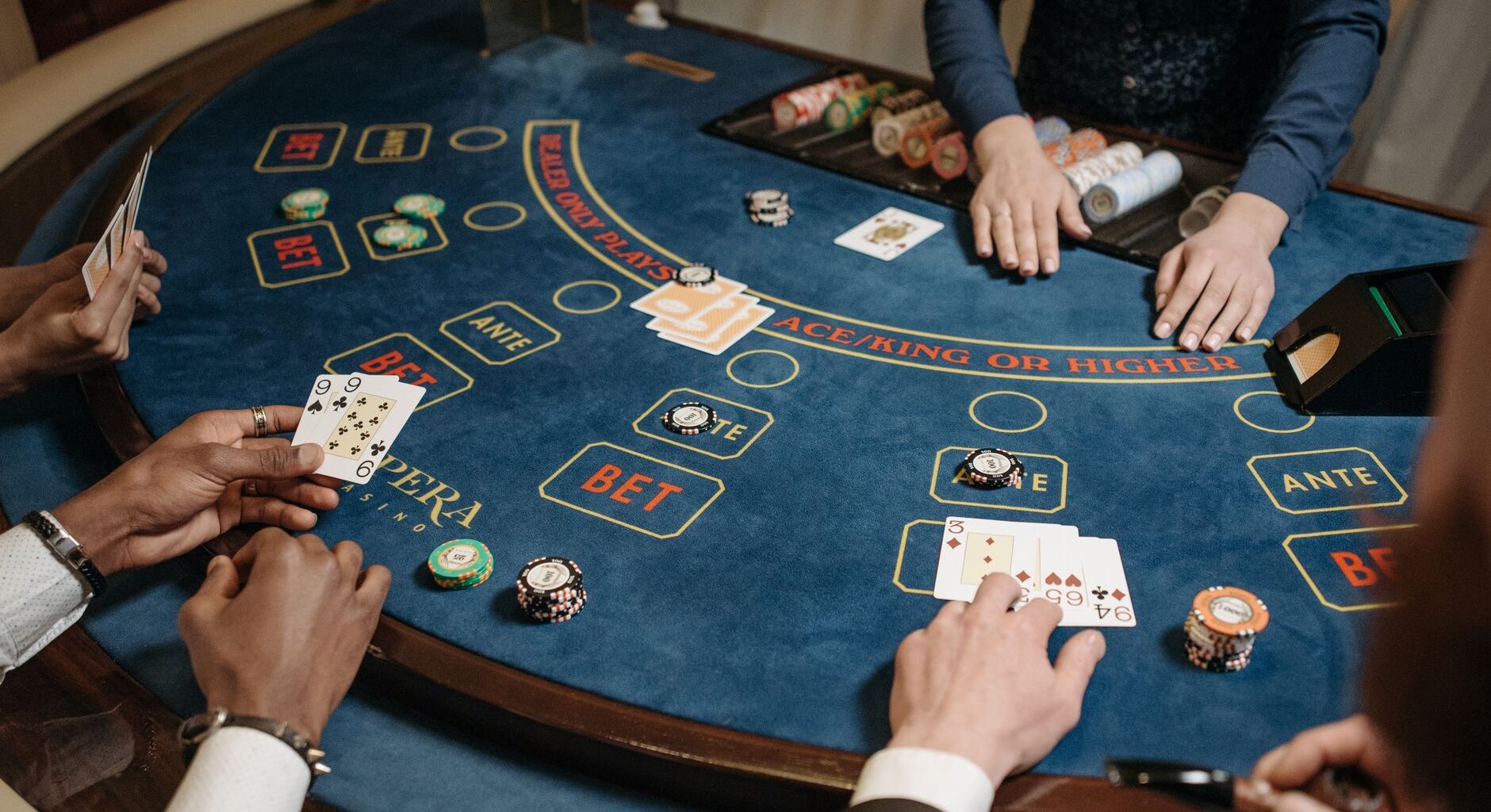
A particularly insidious type of analogy concerns cheating. A typical example purports to represent improbability. It goes along the lines of: ‘If someone keeps getting winning hands at cards, we suspect them of cheating’. You can see that being tried on me here.
The trick has already been done—it’s internal to that sentence. The scene is set. It involves dealing hands of cards, which we know should be dealt fairly with calculable odds that a good poker player can reckon up, then a switch is made to false dealing; card ‘sharping’. It’s a verbal misdirection: false dealing is not fair dealing, so the statistics of dealing hands of cards do not apply—there’s a different paradigm in action at the end of that sentence from the one implied at the beginning. It’s apples and oranges; it cannot illustrate a point about probability or improbability. This is not an analogy for statistical predictions at all. We’ve been tricked.
It’s similar to the deceptive marketing practice known as the‘bait and switch’. This is where a buyer is lured in by a seller offering a remarkable bargain only to be told that the model advertised is out of stock. But wait! This even better (more costly) one is available right now! The juicy worm has turned out to have a hook inside it. We are being tempted to spend more than we can afford. Get thee behind me, Satan!
It’s also similar to the motte-and-bailey tactic where someone conflates a modest, easy-to-defend statement (the ‘motte’) with a much bolder, controversial claim (the ‘bailey’), retreating to the motte when challenged while acting as though the bailey was never disproven. This analogy is based on early Norman fortifications which had an outer defence boundary wall or moat (the bailey) and an inner steep mound (the motte) with the lord’s fort (the keep) on top.
In all of these cases a deception is being performed by false analogising. This is worse than the usual criticisms of an analogy being inaccurate—this is deliberate misrepresentation.
An honest and fair example of an analogy was displayed by Andy Kind, the host of a recent discussion I took part in. See it here.
He wanted to make the point that I was setting an ‘unacceptably’ high standard for what counts as evidence. He said it was ‘as if I wanted a striker to score a penalty by kicking a heavy stone gargoyle rather than a football’. His criticism was graphically made; it could only have been bettered by suggesting that I wanted the player to get the goal by heading the stone carving! Nice one, Andy!
My defence was that I don’t personally set the rules: scientific method has evolved over the centuries, and we have evidence from its inarguable success that it is the best way to investigate mysteries and answer questions. That’s why I ask for multiple, independent, corroborating observations. In a similar situation, Richard Dawkins famously said of science, ‘It works, bitches!’
My opponent in that discussion, Sam McKee, wanted to set his rules. They are quite different from my allegiance to scientific methods. Despite being a cancer researcher, which depends on the rigorous application of scientific methods, Sam accepts that the existence of his god cannot be confirmed by those methods. He claims that his god is not a physical entity in a location somewhere and states that god is a metaphysical concept. He postulates an unknown realm where scientific investigation doesn’t apply. This is known as ‘non-overlapping magisteria’ (NOMA)—an expression coined by Stephen Jay Gould.
I agree that the scientific method cannot substantiate a god, but I do so for a different reason. Sam thinks that his god should be excused from scientific examination, like a person failing his pilot application due to poor eyesight, while I think it’s because believers can’t agree on what to look for, how to look, or where to look. It boils down to naturalism versus unnaturalism.
Sam agrees with me that there is no certainty and that, in the absence of evidence, the rational position is scepticism, but, unlike me, he still finds room in his mind for a god to believe in… I think he has made matters worse for himself—not only does he have to provide evidence for a god but, now, he also has to provide evidence of a ghostly land!
And how does he distinguish his god concept from Humpty Dumpty?
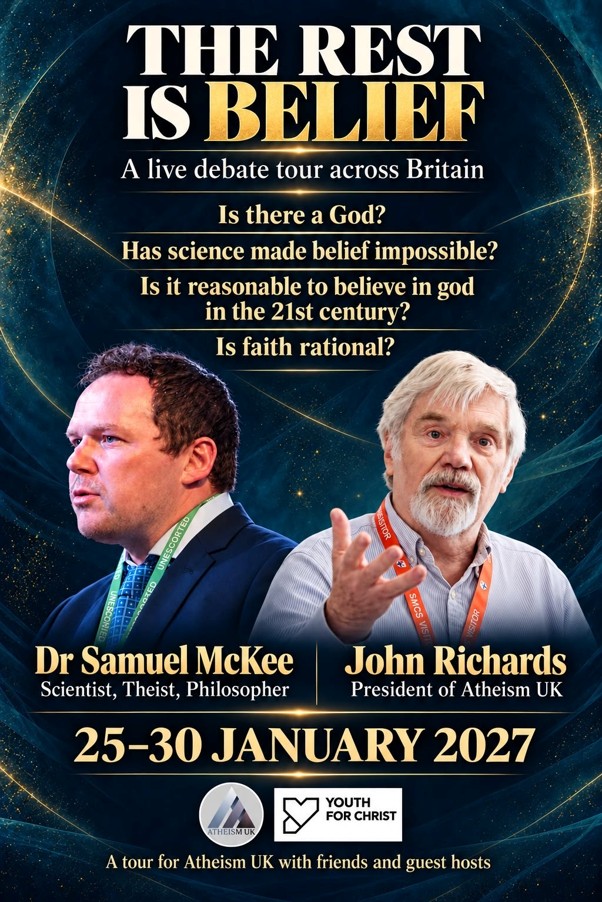
Maybe he’ll tell us next time—we are going on tour together at the end of January…
If you are interested in finding out more about the tour, contact Atheism UK here.
We must Break FREE!
We have to Break FREE!
We’ve got to Break FREE!
Atheism UK (AUK) launched the BreakFREE! campaign at ‘Hitchmas’, which featured Sir Stephen Fry, Richard Dawkins, Douglas Murray, and Lawrence Krauss celebrating the life of their late friend Christopher Hitchens in the Royal Geographical Society’s hall on 14 December 2024. You can join AUK or make a donation and receive a BreakFREE! button badge at our website: atheismuk.com.
Look out for our forthcoming BreakFREE! YouTube channel.
More of my content is on Patreon: Freethought Productions (subscriptions gratefully accepted).




Your email address will not be published. Comments are subject to our Community Guidelines. Required fields are marked *
Donate