If I asked you to design something, anything, it doesn’t matter what—a dress, a car, a house, whatever—what would you do?
You’d get a clean sheet of paper and a pencil, wouldn’t you? Or, if you were tech-savvy, you might open a laptop and select a suitable CAD software.
I’ll tell you what you wouldn’t do. You wouldn’t say, ‘I’m going to start with that wheelbarrow.’
That’s because you’re intelligent.
Surely, any designer who could be described as intelligent would take the clean sheet route?
But that’s not what has happened. Every animal from the earliest newt onwards has limbs built on the same template—they all have pentadactyl (five-digited) limbs. There is one large bone close to the body hinged to two bones, then a bunch of small bones ending in five jointed digits (hence the name). In the human arm, you have the humerus in the upper arm, the radius and ulna in the lower arm, the carpals in the wrist, the metacarpals in the hand, and the phalanges in the fingers and thumb. For the leg, it’s the femur, tibia and fibula, tarsals, metatarsals, and five phalanges (toes). The names are different, but the pattern is the same.
Humans have a full set of pentadactyl limb bones, but we can recognise the same basic structure in all amphibians, reptiles, birds, and mammals, even when some of the bones are missing or fused together. It’s a very distinct arrangement, which makes it unlikely to be a coincidence.
The doctrine of ‘intelligent design’ is equivalent to a maker having said, ‘You want a helicopter? Give me that submarine to start with.’
Does that sound intelligent to you?
Of course not!
But that’s exactly what has gone on for millions of years in the animal kingdom: it’s evidence against intelligent design and for evolution. Only an incredibly stupid designer would try to make new products from unsuitable old stock. Yet that is exactly what nature has been doing; evolution is the modification of existing structures. The fossil record reveals the sequence.
This shows that the amphibian’s limb design can be redeployed to make a horse’s leg (four toes lost per foot—they run on their middle digits), a cat’s paw with retractable claws, a bat’s skin wing, or a bird’s feathered wing. Check the bones next time you have BBQ wings—you’ll find one bone connected to two bones (the ‘fingers’ are reduced to that tiny bit with no meat on it).
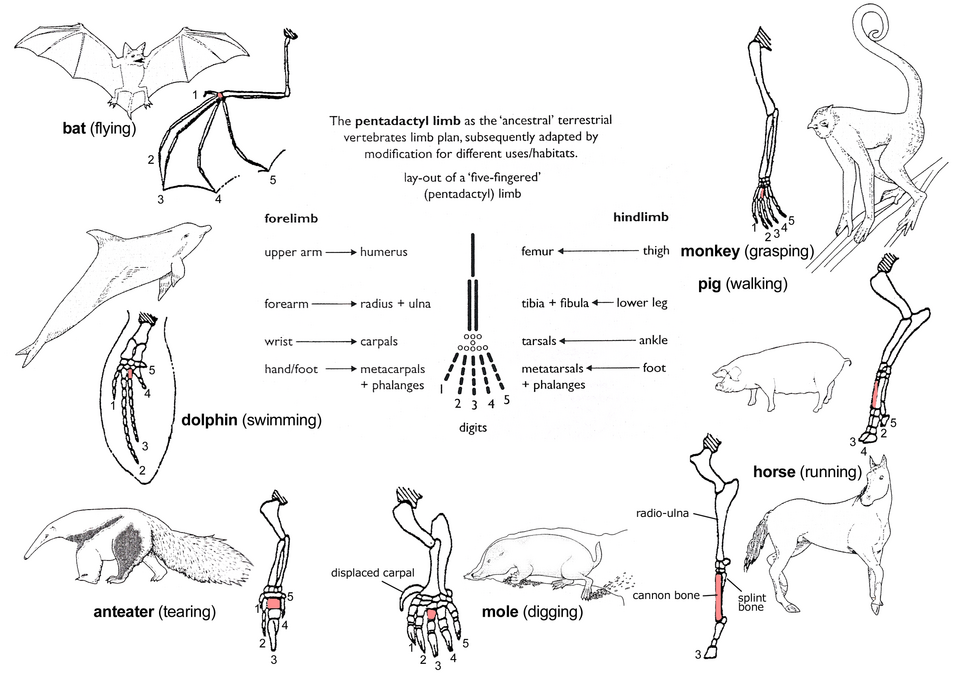
It’s obvious: we all have a common ancestor. There’s no other way to explain why such diverse limbs from the mole’s diggers to the seal’s flippers would be built on the same pattern.
You can spot lots of other examples of unintelligent design when you know what to look for. Take eyes for example: they have been produced several times with millions of years between each version, so it has been like starting anew every time. Insects’ eyes are compound with lots of individual structures grouped together, while molluscs have a camera-style eye, but it’s not like mammals’ camera eye. One of the camera eyes is constructed with the ‘wiring’ to the brain on top of the light-sensitive screen; the other one has the nerves sensibly coming out of the back so they don’t obscure the light hitting the photocells. Which do you think got the better design, snails and octopuses or us? It was them! Our eyes are, unintelligently, backwards! So much for god’s special creation. Maybe he was getting slapdash because it was the end of the week—we’ve all heard of poorly assembled ‘Friday afternoon cars’!
Then there’s the recurrent laryngeal nerve. This goes from the brain to the larynx. It was a direct short connection in fish because their equivalent of the voice box is the gills. The route goes down from the top of the fish’s head, past the heart. Then newts ‘invented’ necks. If you’d been in charge of design, you would have kept the connection short, entirely in the head, wouldn’t you? That would have been intelligent. Is that what happened? No!
Here’s where we find out why it’s called ‘recurrent’ (turning back so as to reverse direction). That nerve still goes past the heart! Yes, it goes from the brain, all the way down the neck, around the heart’s blood vessels and back up the neck to the larynx. That’s quite a journey in a giraffe—just think how far it must have been in a Diplodocus!
Nothing intelligent about that!
So the ‘intelligent designer’ was either not very smart or there was no designer, just blind evolution.
Which do you think is the likelier scenario?
We must Break FREE!
We have to Break FREE!
We’ve got to Break FREE!
Atheism UK (AUK) launched the BreakFREE! campaign at ‘Hitchmas’, which featured Sir Stephen Fry, Richard Dawkins, Douglas Murray, and Lawrence Krauss celebrating the life of their late friend Christopher Hitchens in the Royal Geographical Society’s hall on 14 December 2024. You can join AUK or make a donation and receive a BreakFREE! button badge at our website: atheismuk.com.
Look out for our forthcoming BreakFREE! YouTube channel.
More of my content is on Patreon: Freethought Productions (subscriptions gratefully accepted).
Related reading
Is ‘intelligent design’ on the cusp of overthrowing evolutionary science? by Samuel McKee
The future of biology, science vs. religion, and ‘ideological pollution’ in science: Interview with Jerry Coyne, by Samuel McKee
The Galileo of Pakistan? Interview with Professor Sher Ali, by Ehtesham Hassan
Why Design Arguments Necessarily Fail, by Samuel McKee
Image of the week: The Scopes Monkey Trial of 1925, by Daniel James Sharp
The Scopes Monkey Trial a century on: A global mess that nobody won, by Samuel McKee
The Ghost of Scopes: Creationists Never Give Up, by Samuel McKee
Debunking creationists, flat-earthers, and other enemies of science: interview with ‘Professor Dave’, by Samuel McKee






Your email address will not be published. Comments are subject to our Community Guidelines. Required fields are marked *
Donate