

The trumpet shall sound, and the dead shall be raised incorruptible.
—The apostle Paul, in 1 Corinthians 15
Is that YOU, Grandpa? I thought you were MUCH older—hey, there’s the son of a bitch who never returned the tenner I lent him!
—Fred M. Brown, at the end times
It started as an idle question by one of the cherubim, just when the Day of Reckoning was approaching fast. ‘At what age are you going to resurrect everybody, O Lord?’
‘You are importuning our magnanimous Lord,’ he was chided by one of the seraphim, who as such outranks any cherub (and has two extra wings—six instead of four—to prove it).
‘No, it’s all right,’ said God. ‘Why, at the precise age they were when they died, of course. Their resurrection will be a straight continuation of their lives when they were alive.’
‘But,’ persisted the cherub, in the hope that he might earn his wings (the additional two) by exhibiting his judicious, thoughtful nature, ‘at their moment of death they were, by definition, in such bad shape that they died. They would have to come back with the bad heart they then had, for instance—even if it cannot kill them again, because their new flesh will be incorruptible. Or, at the moment their heart stopped, they might have a body squashed by the chariot, or the bus, that ran them over. Or they will be all charred, if they died at the stake in the fire your diligent servants on earth set them on. Or their head…’
‘All right, all right, you have made your point! I shall, instead, resurrect them in their prime.’ God spoke with a tone of finality. He had already allowed his mind to be changed, and in public, more than he usually does. But it was not to be final.
‘What age, oh wise Lord, will be taken as that of their prime?’ asked another cheeky cherub. ‘Their mid-twenties, perhaps?’
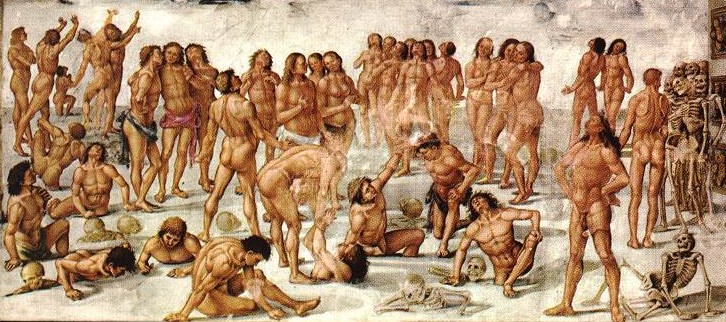
Down on earth, there have been two principal pictorial representations of the resurrection of the flesh: by Luca Signorelli and by Salvador Dalí. Signorelli’s version embodies the very assumption made by cherub No. 2: the resurrected beings, who are depicted basically lounging about, all look like young athletes. God himself endorsed the notion: ‘Of course,’ he replied.
‘A wonderful solution, oh prescient Lord!’ applauded the cherub. ‘However… what about those people whose professional prime came long after their physical prime? Grandma Moses’s artistic prime was in her eighties… or, just to stick to the letter C, Cato the Elder and Cervantes did their most important writing when long in years; Claudius, Churchill, and Charles III were all late in life when they reached the positions in which they shone the most…’
‘Then I myself will choose the “primest prime” for each such case, and that’s that!’ snapped God. The cherub was momentarily silenced, but then followed up with, ‘A majestic move, O Lord. Of course, there is also the opposite age disjunction: the child prodigies and the child stars who by their twenties, when in their physical prime, already were has-beens, professionally. Oh, and the people whom you in your wisdom caused to die in infancy, or to spend all their lives crippled—will you also be selecting a prime for them? And one final puzzle, if I may bring this up. The resurrected will naturally remember their past life, right?’ (God nodded.) ‘I was just wondering… if they come back in their prime, how can they remember what they did in the rest of their life, since in their prime they had not yet done it?’
The Lord was about to come up with something, when an archangel broke in, an idea having just struck him: ‘What, oh Lord, will they wear? The clothes of their time?’
‘They will be naked, of course, as I created them!’ (This was Signorelli’s idea too.) The Lord was becoming visibly irritated, but the archangel boldly countered, ‘A magnificent conception, oh Lord; but it will cause much consternation among the prudes, and leering among the lecherous—or both, if they are same people.’ (Signorelli neatly avoided the problem by only showing resurrected males. All of them presumably heterosexual.) ‘Both situations will lead to unwelcome distraction when they should be focusing on the majestic situation.’
‘Oh, for my sake!’ groaned God. ‘Must I think about every little detail and make every single small decision myself?’
In consternation, the heavenly notables in attendance looked at one another. ‘Ahem… yes, sire,’ pointed out one. ‘It comes with the territory, as omniscient and omnipotent ruler of Creation.’
‘The question was rhetorical,’ God retorted, even as he perceived that more of the heavenlies were now raring to speak up too. It was the first time some thought was being given to the actual logistics of the resurrection—the nuts and bolts of the thing. Before all heaven broke loose, God decided to put a halt to the conversation and call a session of the seldom-gathered Deity’s Plenary Advisory Council (DPAC). That meant every celestial being was to be there, plus one demon from hell as an observer.
Heaven’s biggest auditorium was put into use, since the angels number in the myriads of myriads (Revelation 5). Seats for the saints, the 10,000 or so of them, were set up front and centre, befitting their rank since they were expected to one day judge the angels (1 Corinthians 6). On one hand, God called the Council into session reluctantly—much, in fact, like Louis XVI summoning the Estates-General (though, of course, without any chance of eventual dethronement, let alone decapitation). On the other hand, God did enjoy assembling the saints; they had given him sound advice on occasion. And more than that. God always simply got a kick out of watching that number when the saints go marching in.
One of the obvious reasons people put together religions is to provide psychological compensatory mechanisms for their weaknesses. This can hardly be more transparently so than with the invention of the resurrection of the flesh, unless it is with the concept of omnipotence. In the case of the latter, if man cannot have all the power he would like to, he can at least project it onto his God. In the case of the former, man, feeling himself to be too good for a system in which everything that lives, dies, convinces himself that he will come back. And not just in wispy spirit—in the actual flesh. Even if this means to have the flesh then be condemned to gruesome eternal suffering—anything rather than have his brief candle puffed out definitively.
For good measure, horrified that the system he has chanced to be born into involves decay, he positively makes up his mind that, the next time around, he will be free from corruption of the flesh. He may feel pain (that has to be left in, so that if he is sentenced to roast in hell, he will be properly sorry), but he will never fall ill, and will never die again.
Omnip. turns out to be a logically self-contradictory conception: can God—as snarky young catechumens have been known to ask—create a load so heavy that he himself cannot lift it? (In ordinary life, if a notion is found to lead to a reductio ad absurdum, it is abandoned as false or useless; but, of course, in religion, absurdity is seldom an obstacle.) That other prime example of wishful thinking, the resurrection of the flesh, suffers for its part not from inherent paradox but from crushing unwieldiness and virtually assured chaos. The deliberations of DPAC were long, repetitious and mostly tedious—the preliminary praises to the presiding divinity alone caused a significant delay in the resurrection of the flesh—but can be boiled down to the following essential exchanges.
‘Where will the resurrected people even sit or stand? Already by the early twenty-first century, the total number of people ever born topped 100,000 million, and the number has kept ballooning. That is a lot of people.’ God: ‘Fine, before it starts, I shall fill in some oceans or make deserts habitable or something, to make room.’
‘That will impact on the climate, O wise Creator! Speaking of which, what about roofing—how will they all be protected from the rain? And the cold?’ G: ‘Easy. I shall suspend climate. It will always be balmy and sunny.’
‘In the end, what will they wear?’ G: ‘White tunics for everyone, and that is final.’
‘That the flesh will be incorruptible does not mean it does not need to be fed. What will they all eat?’ G: ‘Many of them were farmers, others bakers, others were makers of tinned goods, still others restaurateurs… Let them do what they used to do.’ ‘With all of them suddenly there, there will not be enough time for crops to grow from scratch before everyone dies of hunger—well, not dies, but be famished.’ G: ‘Right. I shall provide a corps of heavenly caterers. They will serve manna from here.’
‘Er, this is indelicate, O Lord, but hundreds of thousands of millions of people will produce a real mass of poo in just one day…’ G: ‘I shall previously set up myriads of myriads of chemical toilets. Yes, and make room for that, too. You!’ (Pointing at the cherub who asked the first question.) ‘You started all this. I am appointing you celestial secretary. Make a list of all these things to be done.’
At last, the resurrection of the flesh got underway. The event unfolded in ordained stages: the righteous went first. Predictably, that initial instalment proved less interesting than when the hoi polloi, ethically speaking, came back to life. Then things truly became lively (never was the word used more advisedly).
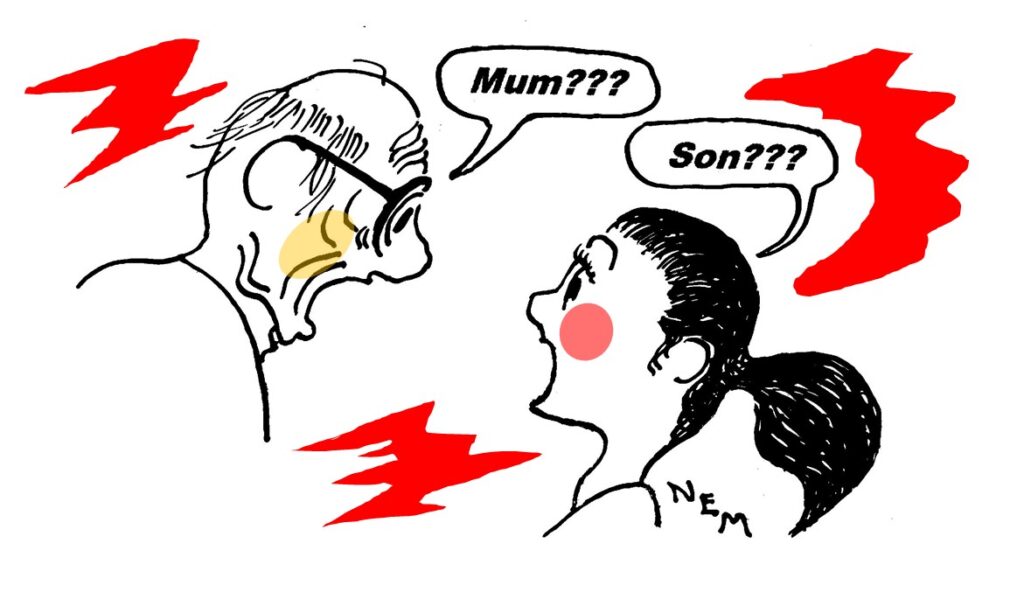
Locating family members was, naturally, the number-one to-do thing for most resurrected people (some others had hated their families). But many discovered a highly disconcerting situation: they found themselves to be older than their parents and other forebears. This would, logically, often be the case whichever criterion for the age of resurrection had been chosen. When any two people met, they might confront the most unexpected and jarring age differences. In the initial moments, the loudest sound was made by the interminably repeated and echoed question, ‘Are you So-and-So?!!?’ And then, in the crush of people, ‘Where is Such-and-Such? Calling Such-and-Such!! Has anybody seen…’
The clamour immediately reached the heavens. God then caused name tags to appear on every tunic. That helped a bit, but was of little use to the zillions who had been illiterate. Also, Greta Garbo, ever vanting to be left alone, immediately removed her tag—followed by many other individuals, generally with shady pasts, who had their own reasons to prefer to remain inconspicuous.
In any case, finding people was staggeringly difficult. Not only because it was incomparably the largest multitude ever assembled. In addition, while A wanted to find B, B was also out looking for C, and so on. And that is just for people in roughly the same generation. If person D felt the urge to get to know his or her ancestors and/or descendants, the figures rose exponentially: 2 to the power of the number of generations in question. It is the old chessboard story.
To meet ancestors up to the fifth generation, say, D would have to locate 32 people in the multitude; to instead find five generations of descendants, the number could be greater, if some of them had many children. For E, seeking to make the personal acquaintance of 30 prior generations of his or her family (still less than a thousand years), this would entail locating over a thousand million people, all of them jostling around. An ancestor worshipper F who wanted to pay personal respects to all forebears would find that, by 40 generations, this would be a far larger number than that of everybody who ever lived. The paradox is explained by the circumstance that many of the people on the expanding family tree are the same ones, occupying more than one slot. But it is still colossal numbers that we are talking about.
God then set up a main information desk plus many secondary ones, manned by angels disguised as mortals. Still, they could not give much assistance on anybody’s location—since everybody’s location kept shifting. ‘She was right there a minute ago, but…’ To complicate matters, many resurrectees, after either locating family and friends or giving up on them, hit on other search targets. Presently legions of literature professors, and just plain readers, were swarming about looking for Shakespeare, in the hope of paying homage—or even better, cross-examining him and, once and for all, settling the vexing authorship issue.
Meanwhile, others were fanning out on the lookout for Homer, to determine for good if he factually existed. Philologists frenziedly attempted to identify speakers of long-extinct languages, with particular attention to someone who could decipher the Minoan Phaistos Disc. In fact, they might chance on the honest-to-goodness person who wrote it.
Not a few noticed that this was their once-in-a-second-lifetime chance to gaze at Helen of Troy—to check out the very face that launched a thousand ships! And to see what Cleopatra really looked like! People began trying to page their favourites, hoping to set up meetings at given information counters. That sometimes worked with family members, if they could plough their way through the human thickets to reach the counters, but rarely with unrelated public figures who had no motivation to accept the summons. Rumours that Frank Sinatra had been seen in this direction, or Porphyrius the champion Byzantine charioteer in that, set off many of the crushes and stampedes that soon characterised the grand resurrection of the flesh. Bones, now being unbreakable, were not broken, and any dying had been ruled out, but the squeezes did hurt.
And yet, all the above only refers to encountering people one liked. The uglier side of the fact that everybody was there rapidly emerged and frequently came to the fore. The thugs were about too (even if bereft of weapons because God, seeing the way things were trending, hastily eliminated all loose stones and anything that could be turned into a club or other unwholesome artefact). And people kept bumping into—or grimly tried to track down—those who had done them an injury in their first incarnation. The banker who had refused a loan on no good grounds, the invader who had sacked and slaughtered, the inquisitor who had sent a person to be burned alive—they were all somewhere about.
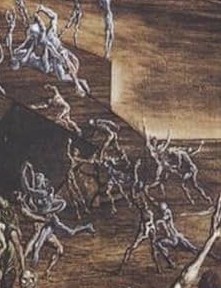
Which is when we come to Salvador Dalí’s take on the resurrection of the flesh. Even though surrealistic, it edges closer to the truth. His figures, many of them rather inchoate and androgynous, are not loafing around like Signorelli’s but are mostly active, and none too pleased. Of special interest are four pairs of people in the upper right of the painting. There is a couple that appears to be dancing in a traditional balletic way, although what the one on the left is doing with his right hand is debatable; he could be eviscerating his partner. To the right of them, there is another apparent dance, but it is more like ritualised aggression in dance form, as in Brazilian capoeira. Above the latter, a figure seems to be punching another in the stomach. And diagonally up from these two, a woman, if it is indeed a woman, made to lie on her back in the missionary position, is twisting away a rapist—unless she was not made to lie like that, and is twisting the other person towards her.
Among the resurrected, the taking of vengeance and settling of accounts became the order of the day. Many tyrants, bloody conquerors and the like, attempted to regroup their forces, or more likely, unable to find them, raise new ones; but lacking horses or assault vehicles, swords or truncheons, guns or even barking Dobermans and German Shepherds, they were often beaten up—the worst that could be done—by their almost numberless victims.
Aggressors and counter-aggressors both resorted to one weaponisable device they possessed: the cinctures, or rope belts, on their tunics. They tied up, tripped up, or, if they had the skill, lassoed their opponents. Seeing this, God snapped his fingers, and all cinctures dematerialised. Upon which, the more resourceful combatants tore their tunics into ribbons and used them instead. If they could not rip up the cloth, they twisted and employed the entire tunics as ropes. Thus they could hold the onetime oppressors still while the retaliators pummelled them. Still, even the likes of an Ashurbanipal or a Mao could count on enough people who were still in enough thrall to their auras and slogans to defend them, in which cases the fisticuffs were not one-sided.
Avenging militias were formed, and engaged the cutthroats’ defenders. Some of the groups soon were simply fighting over territory, in time-honoured fashion. When tried out in practice, the res. of the flesh had turned into a field of combat that ebbed and swelled—mostly swelled. It was chaos, it was mounting, and it was not what God had wanted, or what his theologians had envisioned. The Lord felt a strong urge coming over him: to send a new flood to end it all—with no ark this time. However, he was hoist by his own petard—it would not work because, by his own doing, the seething, rioting masses were undrownable.
Alternative plan: he could simply sweep everyone into the lake of fire in one angry go, and get done with it all. That this would be punishing the innocent along with the guilty did not faze him; the suffering of innocents, or other manifest unfairnesses in the world, never had, and he was not about to go soft now. However, he had been looking forward to such grand ceremonies for the judging of good and bad. It would be a shame to forego them. Meanwhile, something had to be done.
God sighed a deep, dejected sigh. Should he re-convene DPAC? Too cumbersome. He had better seek counsel from his beloved saints alone. He looked around—and not a saint was in sight. ‘Where are all the saints when I want them?!’ he bellowed in a voice that shook the universe.
‘Excuse me,’ replied a seraph, quaking, ‘but has it slipped your mind, O all-seeing Lord? The saints are gone! Being humans—originally—they were sent back for resurrection, and are down there trampling or being trampled, like the rest of them.’




Your email address will not be published. Comments are subject to our Community Guidelines. Required fields are marked *
Donate