

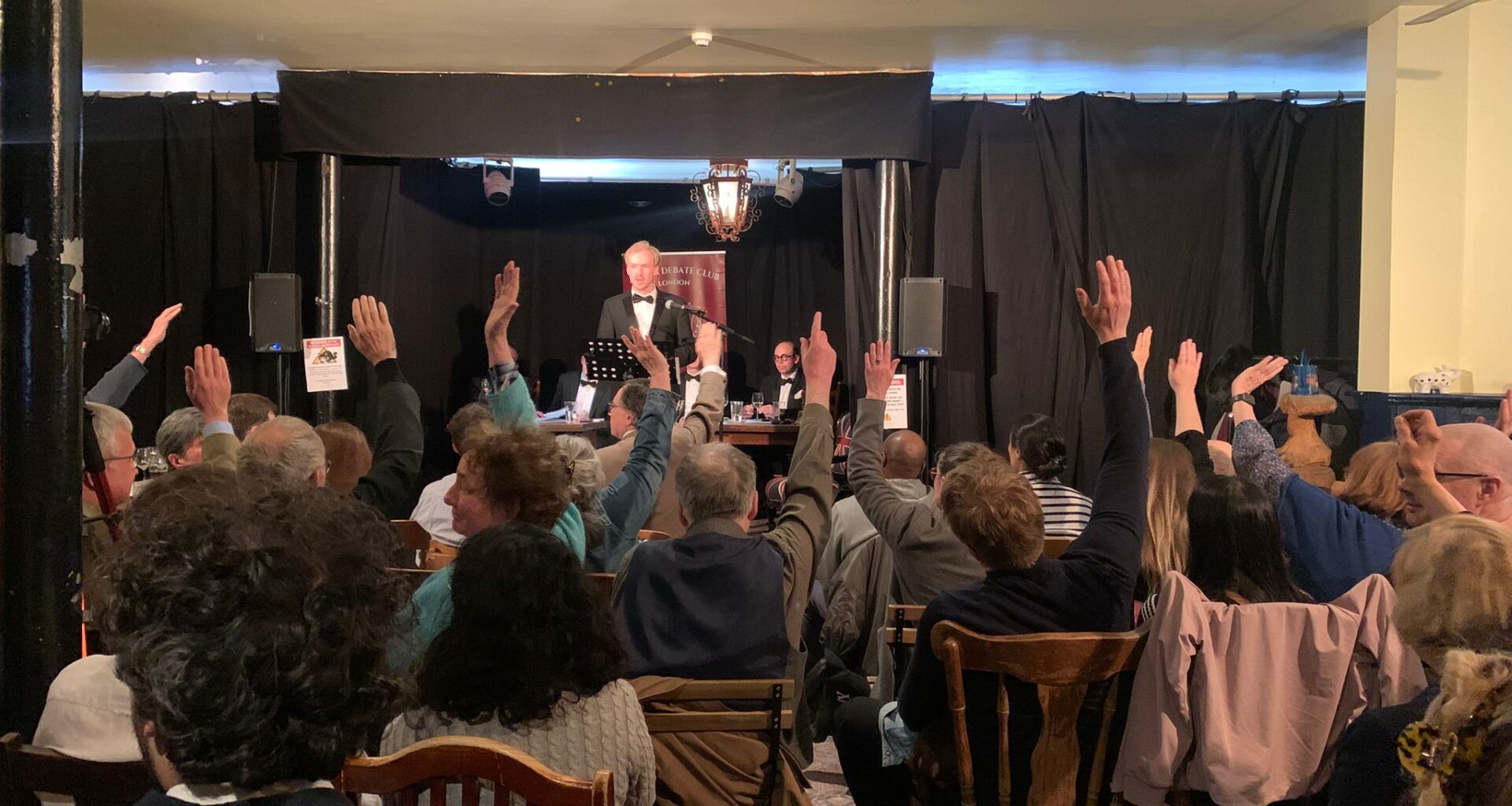
Is Christianity the foundation of what we call ‘Western civilisation’? That was the topic of debate on 28 September 2026 at the Agora Debate Club London, which meets six times a year at the Tea House Theatre in Vauxhall. Freethinker editor Daniel James Sharp was due to argue against the motion but was unable to attend due to personal reasons. Thankfully, Agora co-founder William Hagerup took his place, and he has written the following report—a debate which had a surprising twist.
The venue is a former pub turned into a temple of tea, cakes, and culture by the free-speech-loving proprietor Harry Iggulden, who opened it in 2011 as a café and tearoom by day and a theatre and events venue by night. The intimate space sits beside Vauxhall Pleasure Gardens and has a genuine community hub feel about it.
The Agora Debate Club was founded in January 2025 by Stan Billington, Kristina Bhrava, and yours truly.
‘We wanted it to be a forum for reason, free speech, and logic, guided by the spirit and values of the Enlightenment,’ says Billington, who took the initiative to start it.
For my own part I can add that I believe those values are central to a free and civilised society, but they seem to be threatened from all sides these days. That is one reason I co-founded Agora and also why I wrote The Really Practical Guide to Debating: How to Win Every Argument You Don’t Lose, published in December 2025.
The subtitle makes the point that you are not supposed to win every argument; sometimes you will be wrong. The key thing is to have an open discussion, be ready to change your mind if you’re wrong, and to approach every debate in good faith and with honesty.
The motion up for debate at the last meeting was ‘This House believes that Christianity is the basis of Western civilisation’. The topic has received much attention in recent years, not least since Tom Holland’s Dominion: The Making of the Western Mind (subtitled, more accurately, How the Christian Revolution Remade the World in the US) appeared in 2019.
Defending the motion were the historian Bijan Omrani, author of God Is an Englishman: Christianity and the Creation of England, and Sharon James, a Christian writer and social policy analyst at the Christian Institute. I argued on the opposing side together with theologian-turned-lawyer Steven M. Rhodes, a Fellow of King’s College London, where we both sit on the Council of the Alumni Association.
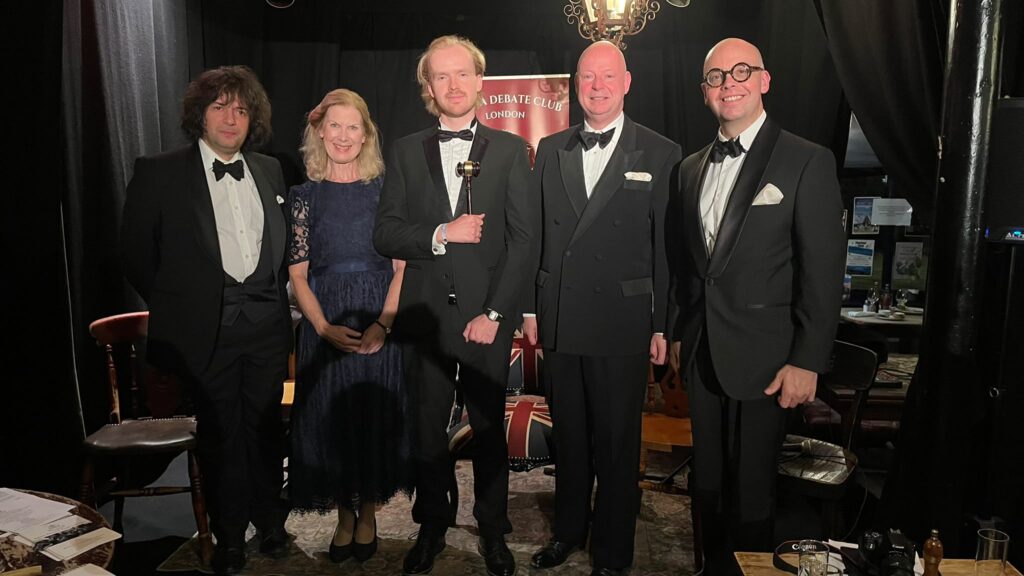
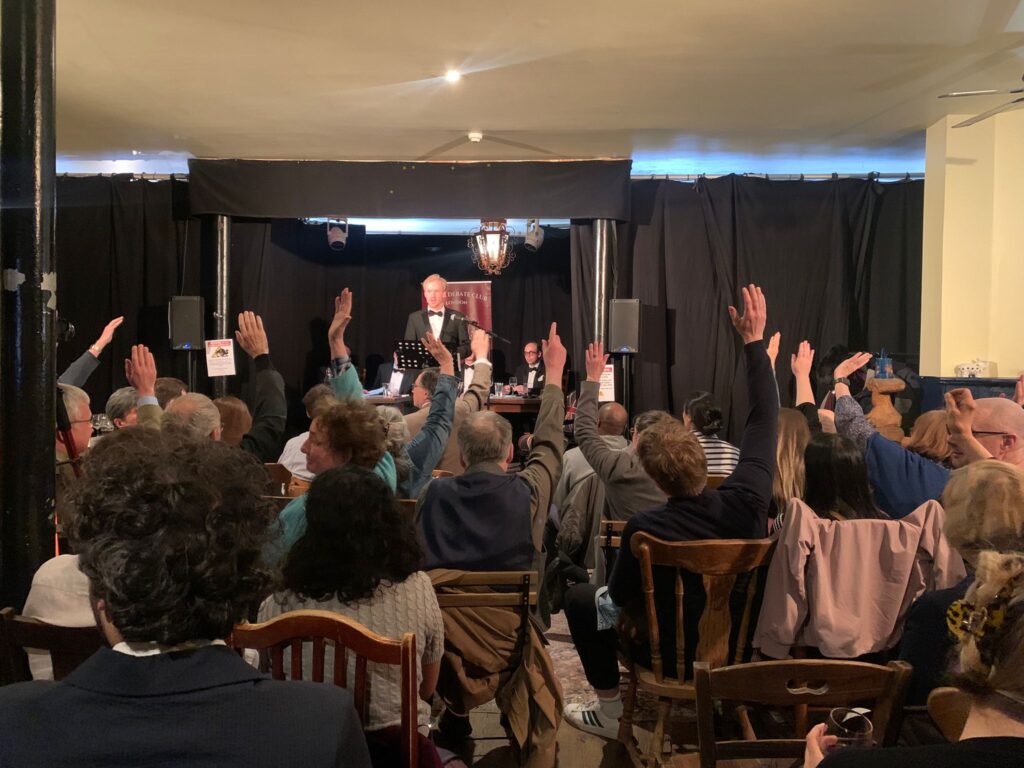
The debate was chaired by Billington, and after welcome drinks he called the room to order and took the pre-debate vote. The room was clearly sympathetic to the motion: of the 63 people present, 33 voted in favour and 9 against, while 21 were undecided.
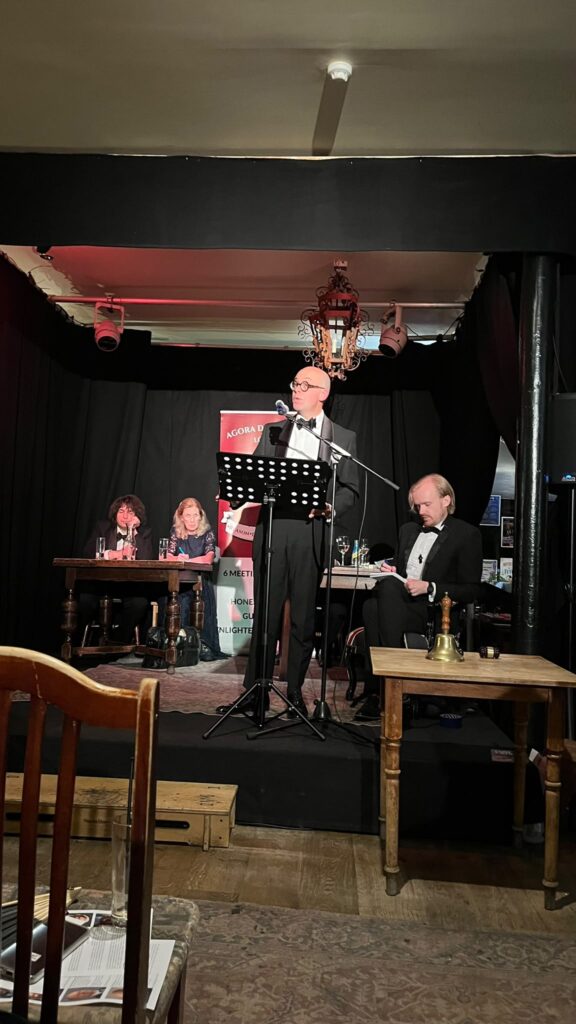
But as the debate rolled on, it became clear that the Tom Holland line of argument was falling apart. The Proposition defined Western civilisation by three features: a morality based on individual dignity; a political order based on individual rights and the rule of law; and science and a capacity for progress. It argued that all three grew out of Christian values and principles. James also argued, rather less credibly, that the healthcare and philanthropy of the West were uniquely Christian phenomena.
Rhodes then presented the Opposition’s first counter-argument, centred on the influence of pre-Christian classical thinking and on how the Renaissance return to Greek sources produced a more text-critical reading, which paved the way for the Enlightenment.
When it was my turn, I turned the spotlights on the Enlightenment, arguing that the distinctive features of Western civilisation listed by the Proposition did not emerge in the first 1,600 or so years of Christianity. Something happened in the period we call the Enlightenment to create a new, secular foundation on which Western civilisation was built.
We on the Opposition side were careful not to make it a debate about whether Christianity was ‘good’ or ‘bad’, as the Proposition at times tried to make it. We conceded that Christianity has been, and still to some degree is, important and influential, but that does not mean that it is foundational to Western civilisation as the Proposition had defined it.
One key point was the Opposition’s argument that, before the Enlightenment, morality, governance, and science had to be grounded in the authority of the Bible. During and after the Enlightenment, we argued, even devout Christian scientists such as Isaac Newton did not appeal to the Bible or to God as evidence for their theories, but based them on a new, secular form of reasoning. An important Enlightenment motto is the Royal Society’s Nullius in verba—‘take nobody’s word for it’—including the word of God, as I was able to point out.
After the debate, which included a highly engaged Q&A session, the final vote was taken. The Proposition kept its lead, but its vote fell by two to 31, while the Opposition’s rose by 17 to 26. Only six remained undecided. The net swing of 19 votes to the Opposition is the largest the Agora has recorded since it began in January 2025.
Afterwards, audience members said the debate had been extremely informative, had given them food for thought, and had encouraged them to read more, which is a key purpose of debates. Some had even genuinely changed their minds, which is very encouraging.
We aim to keep the exchange of views at the Agora respectful and tolerant, with a genuine readiness to listen and be heard, yet to take nobody’s word for it. A fitting place for a debate in the spirit of the Enlightenment.
When the debate recording becomes available, you will be able to view it on Agora’s YouTube channel. And you can find out more about Agora Debate Club London on their website.
Related reading
A reading list against the ‘New Theism’ (and an offer to debate), by Daniel James Sharp




Your email address will not be published. Comments are subject to our Community Guidelines. Required fields are marked *
Donate