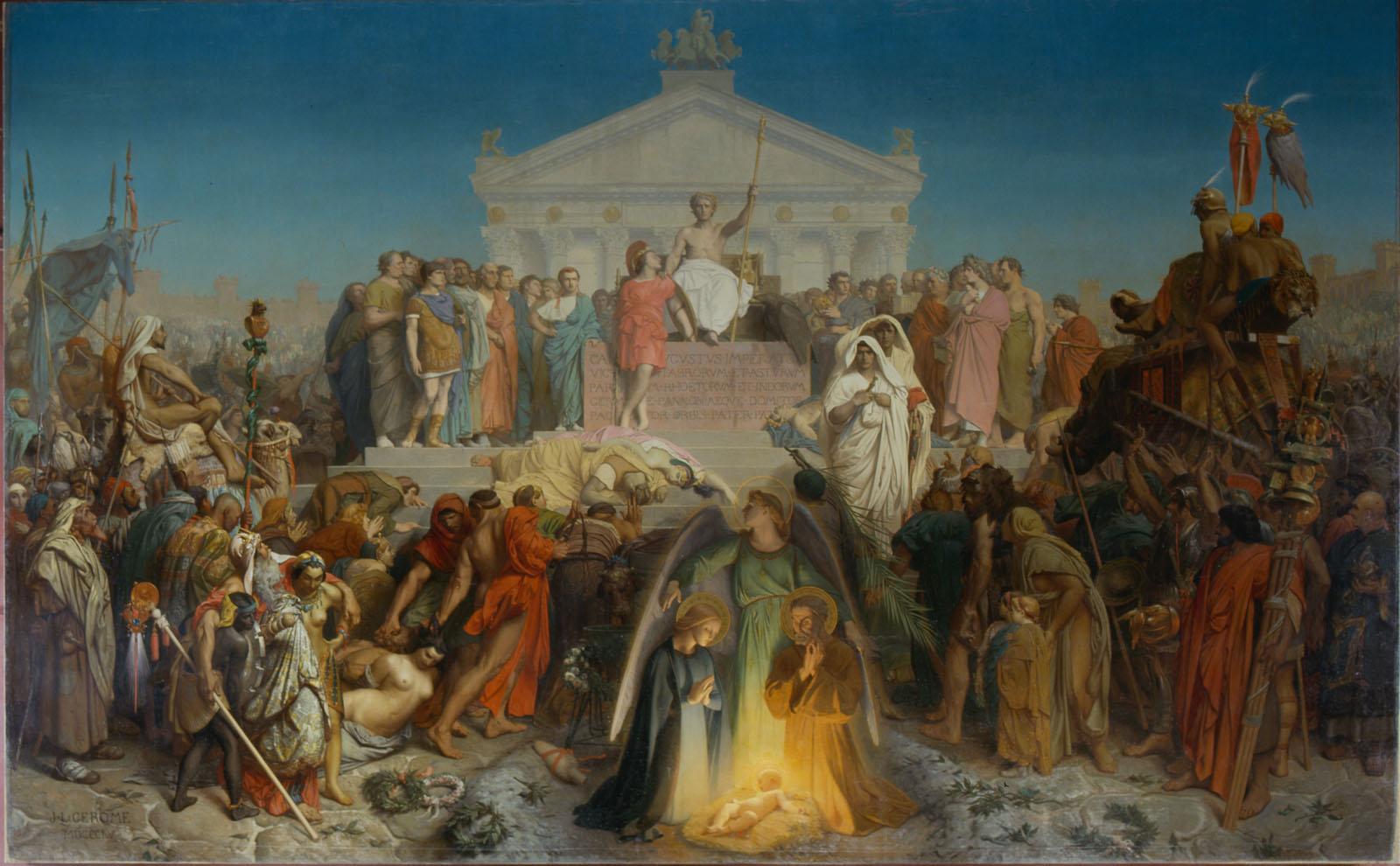
Some years ago I read Tim Whitmarsh’s study of classical atheism, Battling the Gods: Atheism in the Ancient World. There, Whitmarsh dwelt on the many Greeks who were sceptical about the gods and religious practices. That book was a reminder that atheism is not a new idea, but rather a feature of the rich intellectual world of Greek philosophy. Now, in a book aimed at general readers, Rome’s Age of Revolution: Augustus, Empire and the Making of Christianity, Whitmarsh has attempted to explain the spread of Christianity in the Roman Empire during the first three hundred years of its existence. Many historians, both Christian and secular, have done the same, but Whitmarsh’s thesis is particularly interesting and original.
As the title suggests, there is no doubt that Augustus, the first Roman emperor, who ruled from 27 BCE to 14 CE, created a lasting revolution in political and administrative affairs. Augustus promulgated his image in statues across the empire and his Res Gestae, his many ‘achievements’ written by himself, was successful propaganda. As Whitmarsh emphasises, Augustus also put in place an extensive road network, one which was enlarged by his successors. The new network of roads ensured that a religious ideology could spread through the empire. But was this the case for Christianity? Rather than Christianity being opposed to traditional pagan religion, Whitmarsh argues that it drew on many elements of the new imperial system—its literature and ideas as well as its roads. The New Testament was written in Greek, and so accessible to the literate elite.
Whitmarsh accepts that ‘in the first two centuries CE, Christians grew in number, but they remained few and posed no collective threat to the empire: they were rarely mentioned by their pagan contemporaries’. Yet he argues that the nature of the religion was shaped by the elements of this ‘Augustan revolution’ and contains a rich seam of classical and Christian literatures which had an influence on each other. Christianity ‘adopted exactly the same forms of expression: rhetoric, philosophy and the novel’ and so gained a foothold among the many cultures of the empire, a riposte to Tom Holland’s Dominion, which argues that Christianity itself transformed the ancient world.
One philosophy which Whitmarsh highlights is Stoicism, attractive to Greeks and Romans alike. Stoicism taught that there was a universal brotherhood of humanity; Christianity echoed this. There were many Christians who were influenced by Stoic principles, the apostle Paul among them. Whitmarsh also dwells on the child mentioned in Virgil’s Fourth Eclogue: ‘The Christian idea of a saviour king who will inaugurate a new age is partially shaped by the prior model of Augustus [who was said to have been born with portents similar to Jesus in 63 BCE] as a world saviour’. He argues that the concept in the Fourth Eclogue was developed from Jewish messianic sources and so provides a link to Christianity.
Having initiated his argument, Whitmarsh turns to Christian writers who were responding to this new age of revolution. He divides Christians into four groups: charismatics, experts, bibliophiles, and zealots, with a chapter to each. Whitmarsh draws on his immense knowledge of the sources to make many original comparisons. He believes the apostle Paul was especially influential: ‘I like to think of him as a dynamic performer, closer to some of the more flamboyant orators of the period’—and typical of contemporary Greek philosophers. (Perhaps Paul’s personality and letters are used too extensively—they are prominent in three of the four chapters on Christianity.) In the chapter on ‘Experts’, he has a useful section on Clement of Alexandria and Origen, one of the most brilliant early theologians (who only later in the book is mentioned as having been declared heretical). Both Clement and Origen drew heavily on Greek philosophy and so reinforce Whitmarsh’s argument. (But was the Augustan revolution primarily based on Greek philosophy?)
I disagree with Whitmarsh on the death of Greek philosophy after the Roman general Sulla devastated Athens. I have attempted, in my Children of Athena, to stress that the Greek intellectual tradition—with, among others, Galen the medical man, Plutarch the philosopher and historian, and Ptolemy the geographer and astronomer—continued to produce innovative work.
To cement his argument Whitmarsh is careful to downplay conflict between Christians and the state. So in the chapter on zealots, Whitmarsh argues that the martyrdoms were ‘dramatically scaled up’ and linked to the emergence of a theological underpinning to give them power. He is sceptical about the historian Tacitus’ reference to the ‘Christians’ and he argues that the famous Passion of Perpetua and Felicity is over-dramatised. There were executions of Christians (as well as other marginals), but the Christian narratives were inflated to drive the movement forward.
The chapter on zealots is balanced by Whitmarsh’s penultimate chapter, ‘Novel Trajectories’, where he argues that the Greco-Roman novel was influenced by or was a source of Christian traditions. ‘The emergence of Christianity and the novel are intimately linked’—‘fellow travellers’, no less. The novel Callirhoe, for instance, shows no fewer than fifty-eight verbal parallels with books of the New Testament. Yet with the mass of Christians remaining illiterate, this argument can only be taken so far.
Christianity is estimated to have made up no more than ten per cent of the population by 300 CE, as Whitmarsh acknowledges, and this predominantly in the Greek provinces of Egypt, Syria, and Asia Minor. What ‘shape’ did Christianity have, then, at the dawn of the Diocletian persecution? Could Christianity even be defined at this time? Perhaps it was too diffuse (a ‘messy tangled reality’ as Whitmarsh notes) in the sense that it was only one of a variety of shifting religious cultures which drew on Jewish sources, traditional Greek civic religion, and philosophy. Even in the fourth century, Christianity faced difficulty in disentangling itself from Judaism; there were ‘Christians’ criticised for attending synagogues. Christians adopted and reinterpreted the Hebrew scriptures as their own and so Judaism may be as important an influence in shaping Christianity as the Augustan Revolution.
Perhaps Christianity took its shape in the fourth century when the emperors Constantine and Theodosius made Christianity the state religion. (Whitmarsh argues that Christianity was then ‘comprehensively rewritten’ by Eusebius of Caesarea in his Ecclesiastical History: Eusebius emphasises dramatic martyrdoms and gives them an important place in the emerging Christian ideology.) Whether this was inevitable—emperors accepting the survival of Christianity (as Whitmarsh might argue)—or whether Constantine’s new faith was a catalyst without which Christianity would never have become the state religion (the conventional view), it was in the fourth century that Constantine and Theodosius I brought order to Christianity and transformed a diffuse set of ideas, albeit one centred on the role of monotheism and the relationship of Jesus Christ to God, into a more singular, concrete ideology. Could the Augustan revolution three hundred years earlier be responsible? Possibly, though I think at times Whitmarsh overstates his argument.
Rome’s Revolution is a lively book by an expert in Greek thought and draws on a rich panoply of sources. Whitmarsh will be contested for his argument, but he has taken the high ground and has the erudition to defend it against all opponents. This is a theory of the spread of Christianity argued from a secular point of view well worth considering. Responses from scholars and theologians will be interesting.
Related reading
Did Christianity make the Western mind? by Charles Freeman
‘Do as I say, not as I do’: a review of ‘Dominion’ by Tom Holland, by Nicholas E. Meyer
How the Roman Empire became Christian: Catherine Nixey’s ‘The Darkening Age’ and ‘Heresy’ reviewed, by Charles Freeman
‘The Greek mind was something special’: interview with Charles Freeman, by Daniel James Sharp






Your email address will not be published. Comments are subject to our Community Guidelines. Required fields are marked *
Donate