
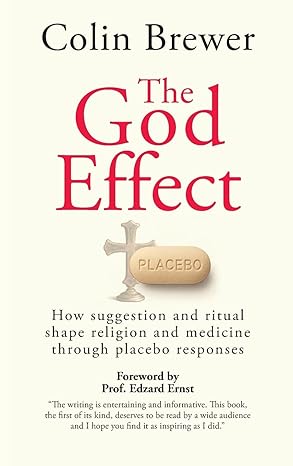
At various times over the last few years while writing The God Effect: How Suggestion and Ritual Shape Religion and Medicine through Placebo Responses, I checked occasionally to see whether anyone else had written a book about religion as a kind of cosmic placebo. As of 2 June, when The God Effect was published, nobody had. The nearest thing was a few paragraphs in an excellent book called How God Works by Professor David DeSteno. He is an expert in the psychology of religion and he confirmed that mine is the first and so far the only book-length discussion of the topic. I originally wanted to call it God is the Greatest Placebo, but one editor was worried that any religion-critical title referring to the phrase ‘God is the Greatest’ (Allahu Akbar) would upset Muslims.
Perhaps one reason why nobody else has written much on the topic is that having qualified in 1963, I am one of the rapidly diminishing survivors of the last generation of doctors for whom prescribing placebos without telling our patients was a normal medical practice—and often a very useful one. Many patients feel unhappy if they leave a consultation without a prescription, even when no drug is likely to have any specific effect on their symptoms. Prescribing a placebo meant that at least the side-effects of real, active drugs were not added to their existing troubles. It also made it easier for the doctor to wait and see how the condition developed if the diagnosis was not clear, as is often the case even now. It was also much easier when tablets and capsules were dispensed in bottles labelled simply ‘The tablets’ or ‘The capsules’. Only in the 1970s did it become routine to put the name of the drug on the label, but it was still possible to tell the dispensing pharmacist to withhold that information. By the 1980s, however, the name of the drug had to be visible, and all its possible side effects had to be spelt out in an information sheet compulsorily included in all packaging. It was all part of the new and generally commendable idea that doctors should be completely open with their patients, but it had the predictable effect of considerably increasing the incidence of side effects once patients had read about them.
In consequence, doctors who qualified after about 1975 have little or no idea of just how powerful placebos can be. Placebo-controlled trials may tell them about placebo effects in general but today’s graduates are now rarely able to observe placebo effects in specific patients. Even more rarely do they learn how easy it is to increase placebo effects by using appropriate words, images, and other devices known to everyone working in marketing and advertising. Ironically, the only members of the healing professions who can still get away with using placebos without telling their clients are the practitioners of Complementary and Alternative Medicine (CAM). Numerous placebo-controlled trials show that nearly all CAM treatments have no effect beyond their placebo potential, but most CAM practitioners refuse to accept that. Like our present monarch, homoeopaths and acupuncturists believe against both logic and controlled trials that homoeopathy and acupuncture—to name only two examples—are wonderfully and specifically effective treatments for many diseases.
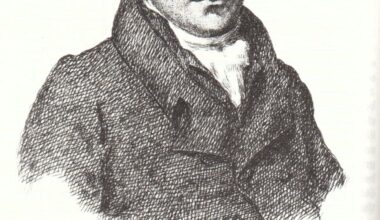
Another reason for writing the book was something that I read in a humanist anthology while still at medical school. It was the story of Jean Meslier, a French priest in the time of Louis XIV who was much loved by his parishioners in the tiny village of Étrépigny near the current border with Belgium. An early agrarian socialist before the term was used, he annoyed the rapacious local squire by complaining about his exploitation of the peasantry and was consequently sent off to Rheims for a month of re-education. Yet when he died, he left by his deathbed a 500-page manuscript saying in effect, ‘I never believed a word of it. You’re on your own. There is no God and the Bible is a load of nonsense. P.S. Monarchy sucks too’. He was, in effect, a placebo priest. Meslier knew what his fate would be if he confessed his unbelief while still alive. Today’s unbelieving priests no longer fear the flames or the scaffold, except in Islamic countries, but they do fear losing their job and the free or cheap housing (and social prestige) that so often goes with it. Some of them dare not even tell their spouses, let alone their parishioners, but an online organisation called The Clergy Project enables priests who have lost their faith to meet with other apostates. It has several hundred members, mainly in the USA, and, as with Meslier, their parishioners don’t seem to notice. If they do tell their parishioners, the parishioners don’t necessarily ask them to leave. In Britain, the Sea of Faith Network, founded by former Anglican priest Don Cupitt, is designed more for priests (and parishioners) who have left their churches and who are seeking less rigid approaches to spirituality, rather than those still in post.
Just as placebo medicines lack any active therapeutic ingredient, so a placebo priest lacks what ought to be the crucial active ingredient of a real priest, namely a belief in the relevant deity. Fortunately, for most adherents of most religions, the rituals of the faith are much more important than its doctrines, just as until about 1920, the rituals of medicine were much more important to patients than what they (and their doctors) knew about the contents of medicine bottles and the underlying causes of their diseases. In all healing encounters, whether with shamans, priests, CAM practitioners, or orthodox physicians, the rituals of the encounter are still crucially important. Whether the patient believes in the religious or medical theory behind the healing can still be less important than the impressiveness and impact of the ritual. That is just as well because until about 1920, almost nothing that doctors prescribed had any useful pharmacological effect on the course or outcome of most illnesses.
Indeed, in the middle of the nineteenth century, the Anglo-American physician Sir Oliver Wendell Holmes famously remarked that if the whole pharmacopoeia were thrown into the sea, ‘it would be so much the better for mankind and so much the worse for the fishes’. The unusually sceptical seventeenth century physician Thomas Sydenham—‘the English Hippocrates’—understood that reality very clearly, writing: ‘The arrival of a good clown exercises a more beneficial influence upon the health of a town than of twenty asses laden with drugs’, and, ‘I confidently affirm that the greater part of those who are supposed to have died of gout, have died of the medicine rather than the disease.’ In the same century, the diaries of Samuel Pepys reveal how much better he felt after using a placebo made of animal parts.
After the Spanish colonisers of South America brought quinine to Europe, it was used for malaria, which was unusually easy to diagnose because although its cause was unknown, the duration and periodicity of the attacks of ‘tertian’ (3-day) and ‘quartan’ (4-day) fevers are very characteristic. However, it was also widely prescribed for all other fevers, on which it had no effect. Opium, used for thousands of years, was good for pain and also reduced diarrhoea and coughing, but it hardly ever made the difference between life and death. It had very little effect on the massive diarrhoea and fluid loss associated with cholera, epidemics of which regularly killed many thousands of people in Britain and many millions elsewhere. Only clean water supplies eventually defeated cholera and other water-borne diseases. Yet paradoxically, many people had great faith in doctors despite the fact that most of their medicines were useless at best and toxic at worst—as they also did (and do) in priests despite the evidence, discussed in The God Effect, that even if there is a god, it is not one that listens to prayers of intercession. Even more paradoxically, respect for doctors seems to have declined lately, despite the list of truly effective drugs having grown exponentially since the production of insulin in the 1920s meant that there were no more wards full of children and teenagers who would nearly all soon die of diabetes.
Many people evidently believe that taking part in religious rituals will protect them against a range of misfortunes, including illness, or will cure their illnesses and even save their lives if they become ill. The rituals range from private or communal prayer, through baptism and other initiation ceremonies, to physically and emotionally demanding pilgrimages and frenetic dancing. All religions encourage this belief, but the Roman Catholic Church is the leader. Among the most popular and frequently occurring saints are the ones who are claimed to have wrought miracles of a therapeutic nature. But until the mid-nineteenth century, when chemistry and the dye industry enabled pathologists to identify diseased tissues under the microscope, most of the alleged diagnoses were very far from clear. In any case, it’s a fortunate fact of medical life that, thanks to inborn natural defence mechanisms, most illnesses disappear spontaneously; otherwise Homo sapiens (and all other living organisms) would not have survived at all. Doctors and saints whose aid was invoked at such moments got the credit that should have gone to Mother Nature, or to placebo effects. In The God Effect, I document the corruption that is endemic in the saint-making process, as well as in much of Chinese medical research. An important 1998 scientific review of the latter problem was tellingly entitled: ‘Do certain countries produce only positive results?’ And a 2015 Lancet editorial noted that ‘fabrication, falsification, plagiarism, and unattributed ghost-writing threaten to overshadow China’s achievements’.
I wish I had come across the phrase ‘Eminence-Based Medicine’ (as opposed to ‘Evidence-Based Medicine’) before the book went to press, but The God Effect documents the then Prince Charles’s disgraceful campaign to sabotage the world’s first university department founded specifically to evaluate the claims of CAM dispassionately. Initially, he welcomed the appointment of Dr Edzard Ernst as its chair because he expected that his research team would support the royal family’s long-standing support and patronage of homoeopathy and his own long-standing embrace of CAM. Prof Ernst had worked in a German homoeopathic hospital (the founder of homoeopathy was German) and seems, when he was appointed, to have regarded it as at least potentially effective. However, the more his department discovered that placebo and non-specific effects accounted for almost all the improvements that followed CAM treatments, the more Prince Charles and his courtiers tried to undermine him. Eventually, his department was closed down. As King, Charles continues to promote alternative medicine and has appointed a CAM-supporting physician as head of the palace medical household. Unsurprisingly, after this experience, Prof Ernst has renamed his target and now blogs about SCAM—So-Called Alternative Medicine. He has also kindly provided a foreword to The God Effect.
The phrase ‘non-specific effects’ needs some more explanation because there are actually two facets to placebo effects in both religion and medicine. One, which we might call the ‘pure’ placebo effect, reflects the parishioner’s faith and belief in a specific holy relic or ritual, such as prayer or pilgrimage, on the one hand, and the patient’s faith and belief in a specific drug or procedure, such as surgery or radiotherapy, on the other. Non-specific effects are caused by all the other things that usually accompany both medical treatment and specific religious prayers and rituals, to be discussed shortly. In medicine, both types of placebo are so powerful a factor in the outcome of treatment that most drugs and devices and even some surgical procedures have to be compared in blinded trials with an equivalent placebo before they can be regarded as being truly effective. ‘Blinded’ means that patients don’t know whether they are receiving a placebo or the real thing; otherwise the results would be biased by expectation or ideology. ‘Double blinded’ means that the people independently evaluating the treatment don’t know either, and for the same reasons. The placebo must mimic the specific treatment as much as possible. For surgery, that means making only a very shallow incision in the placebo group. Lasers can be switched on or off without the patient or assessor knowing. Ideally, placebo medication should produce side effects, such as a dry mouth, that mimic the side effects of the active drug but have no effect on the disease process. Again, that makes it more difficult for both patients and doctors to guess which wing of the trial patients have been allocated to and thus bias the results—in either direction.
Many promising drugs and surgical procedures are rejected because they do not actually perform any better than placebo equivalents. Until recently, the treatments of Complementary and Alternative Medicine were never subjected to proper blinded control trials. Now that they have been (though often not by CAM practitioners), it is clear that nearly all CAM treatments have no more effect than placebos—but those placebo effects can be very powerful. Many people feel better after acupuncture, but controlled trials using a special non-penetrating needle that patients could not distinguish from the real thing showed that the non-penetrating needles did just as well. In blinded studies, it also doesn’t matter whether the needles are inserted into what ought to be the right places according to the theory of acupuncture. An additional reason for doubting all that supposed ‘Oriental Wisdom’ is that it didn’t prevent most Chinese emperors and Dalai Lamas from dying young.
Non-specific effects particularly include what one might call the ‘sales talk’ of healers, which is the degree of expectation, belief, and hope that the provider of the specific component induces in the patient or parishioner, whether it is deliberate or serendipitous. In medicine, that includes a good bedside manner. I am sure that there is a clerical equivalent and just as the architecture, music, smells, bells, and vestments of elaborate religious rituals add to their effect for most parishioners, their medical equivalents are the distinguished consultant in a well-tailored suit, the number of tests and x-rays ordered, the length and attentiveness of the consultation, and the presence of gleaming diagnostic equipment that bleeps and flashes reassuringly. However, placebo and non-specific effects are very individual and personal things, and what reassures one patient may disturb another. (Why are all these doctors and machines here? Does that mean I’m very ill?) Similarly, while many religious sects favour pomp and circumstance, others prefer simplicity and plainness. Good doctors, like good priests, must adapt their sales talk to suit the individual.
It is obviously important that placebo and active groups receive not only indistinguishable real or placebo medication but also the same sales talk and the same amount of time and attention, delivered in the same setting by doctors and nurses with the same bedside manner. If the drug in question has much larger effects than the placebo—for example, antibiotics vs placebo in bacterial pneumonia—the inevitable differences in bedside manner may not matter much, but they can and do matter when the specific effect is small. That may explain why in trials that are carried out in several centres, not all of them get the same results. Non-specific effects are particularly important and powerful in psychotherapy, where the style and personality of the therapist and the quality of the doctor-patient relationship are by far the most important factors—and usually much more important than the therapist’s specific technique and ideology.
Trying to ensure consistency in bedside manner in a group of people who inevitably have different personalities (not to mention differences in first language, physical beauty or otherwise, and tone of voice) may require a degree of insincerity or even of thespian skills (much the same thing, arguably). Fortunately, placebo research also shows that insincerity can be very therapeutic. One of the more amusing bits of research that I came across was a study showing that when 20 minutes of scripted, impersonal, and insincere sales talk was added to the standard consultation (‘this treatment has given very promising results’, etc, accompanied by a reassuring hand on the patient’s shoulder and ‘20 seconds of meaningful silence’) it significantly improved outcomes in a controlled trial of real and sham acupuncture. Sincerity, as the old joke goes, is important—and that’s why we have to learn to fake it.
Another old joke that has an important part in the book goes like this. Two men are in a train, sitting opposite each other. One man is tearing sheets of paper into small pieces and throwing them at intervals out of the window. (When I first heard this joke, trains had windows that could be lowered like those in a car.)
First man: Why are you doing that?
Second man: Because it keeps the elephants away.
FM: But there aren’t any elephants within thousands of miles.
SM: Yes. It’s very effective.
Placebo effects in medicine and their equivalents in religion are the elephant joke writ very large, but instead of elephants, they are supposed to keep away disease and misfortune.
The ordinary sceptical, questioning approach that is the basis of the scientific method was, rather unusually for the early 1960s, part of the curriculum at my medical school. The God Effect therefore turns a sceptical eye on the claims of psychoanalysis, the Samaritans, antidepressant manufacturers, and electro-convulsive treatment as well as on CAM and religion. Originally, it had chapters on Alcoholics Anonymous, psychotherapy in general, and ME, or Chronic Fatigue Syndrome, but it was getting too long. However, it manages to include a demolition of the porphyria theory behind Alan Bennett’s play The Madness of King George III. It notes that a doctor was the first British atheist to come out of the closet and into print and covers placebo effects in war, weather, sport, gastronomy, and politics. It is more anti-dogma than anti-religion and ends with a suggestion that doctors and clerics can learn useful things from each other’s practices. I’m particularly pleased that The God Effect is endorsed by a senior clergyman as well as by the country’s best-known neuropsychiatrist.
POSTSCRIPT
Just after finalising this article, I noticed my old student days Penguin edition of The Venerable Bede’s A History of the English Church and People, written in 731 CE, and opened it at random. Chapter 7 of Book 2 is headed ‘The prayers of Bishop Mellitus put out a fire in his city’. It recounts how
One day the city of Canterbury was set on fire through carelessness and the spreading flames threatened to destroy it.… As the raging flames were sweeping rapidly onwards, the bishop, trusting in the help of God where man’s skill had failed, ordered himself to be carried into the path of its advance. In the place where the flames were fiercest stood the Church of the Four Crowned Martyrs, and hither the bishop was borne by his attendants where by his prayers this infirm man averted the danger which all the efforts of strong men had been powerless to check. For the southerly wind, which had been spreading the conflagration throughout the city, suddenly veered to the north, sparing the places that lay in its path: then it dropped altogether so that the fires burnt out and died. Thus Mellitus, the man of God, afire with love for Him, was enabled not only to preserve himself and his people from spiritual powers of evil by his constant prayers and teaching, but also to protect them from bodily harm.
I rest my case, m’lud. As any philosopher will tell you, post hoc cannot be assumed to mean propter hoc and anyway, the translator’s introduction records that in 686, a plague attacked a monastery and ‘swept away all the choir monks capable of maintaining the regular services of the church with the exception of the Abbot himself and one boy reared and educated by him’. Like the wind, God is very unpredictable.



1 comment
Wonderful article!!!
Just a correction regarding Father Jean Meslier (born in 1678 and died at age 55 in 1733).
The document written by Jean Meslier is his will!!!
It is a 63-page document, not 500…
He wrote three handwritten copies (and, according to rumors at the time, the Vicar General of Reims is said to have seized the third copy).
You can download a scanned copy of this will as a PDF file from the Gallica digital library website of the BNF (National Library of France):
https://gallica.bnf.fr/ark:/12148/bpt6k71566z
You can download this PDF document and even order a printed “book” version for about twenty dollars.
The “Testament of Jean Meslier” is the first truly atheistic text.
The arguments he presents in his “testament” are those of someone who has studied the subject in depth for over 40 years, down to the finest details, and his arguments are extremely powerful.
Best regards, and great article (we’re from the same generation, and the placebo effect was well recognized by doctors of our generation through the famous concept of “somatization”…)
Your email address will not be published. Comments are subject to our Community Guidelines. Required fields are marked *
Donate