

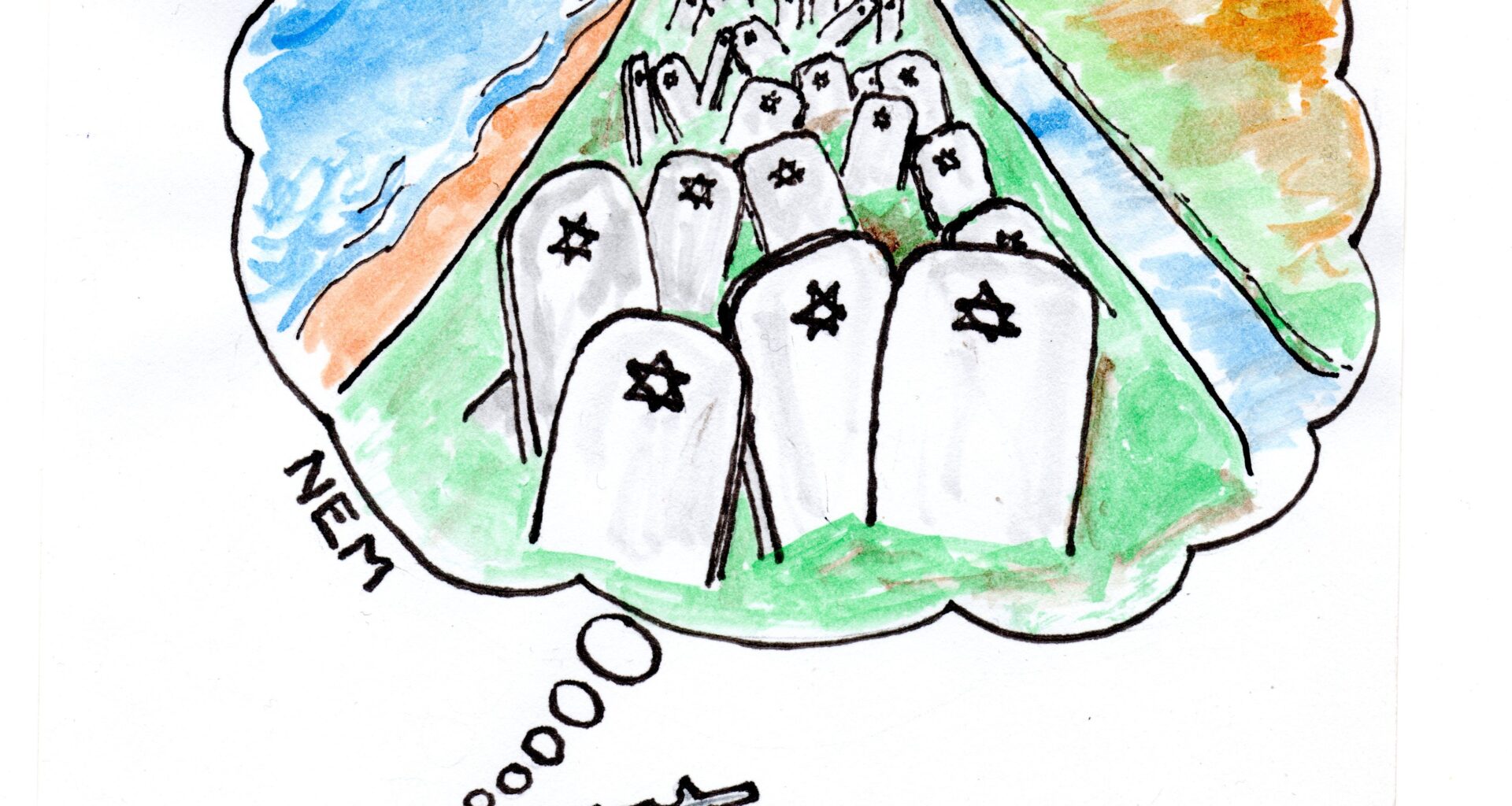
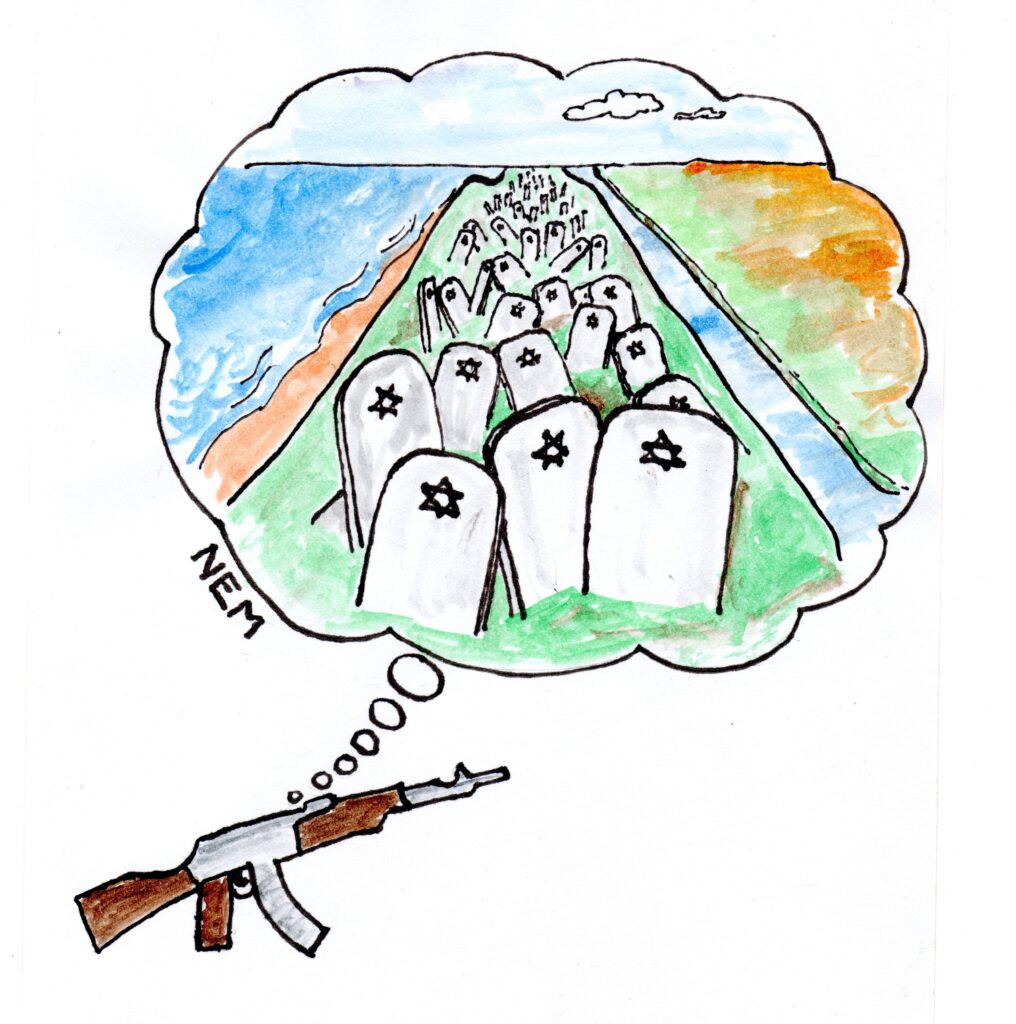
‘We don’t know what else we can do!’ a woman in Gaza exclaimed to a foreign television crew—and apparently nobody there thought of the one suggestion that would have been helpful under the circumstances. The footage that showed her was circulated worldwide, maybe a year into the war in Gaza (the latest one, the one that began with the Hamas attack on Israel on October 7, 2023). The following is what might have been proposed. ‘How about doing this: that kidnapped person you keep locked up in a room in your house—or that your brother-in-law is keeping locked up, or your cousin—how about freeing him? Have you thought of trying that?’
(In the event, the longest-kidnapped persons spent a total of two years, plus eight days, in foetid captivity. That applies to those who were not murdered, intentionally or through accumulated mistreatment, during those years; as regards those who were, the last body was not recovered by Israel until January 2026).
The interviewed woman was referring, of course, to her wish for an end to the death and devastation generated in the counterattack launched by Israel, which had two aims. To try to free the captured people, and to seek to destroy the Hamas organisation that had kidnapped them, in addition to the grisly murders and rapes it committed at the same time. Every non-combatant death in war—on either side—is woeful, the tragedy being far worse when it is children who are killed. (Actually, the death of combatants, too, in the spasms of organised barbarity that come under the name of war, is a tragedy.) While all war is hugely regrettable, the wars centring on Israel are worse in that they could be avoided by just one step: stop attacking Israel. Another way to say that is: tolerate the presence of Jews, under their own rule, in your neighbourhood. (In the case of the Iranian ayatollahs who have a bee in their turban about Israel, they aren’t even neighbours.)
Maybe the above proposed suggestion to the despairing woman in the Gaza video is unfair to her in particular. She might have been one of the Gazans, believably said to exist, who keep their opinions to themselves because they live in fear of Hamas, but would themselves prefer to drop the whole anti-Israel thing, and get on with their lives. Impossible to know if she was or not. What is factual is that after Israel in 2005 evacuated Gaza and invited the inhabitants to do just that, additionally offering assistance in their development, Gazans, by vote, elected to be governed by Hamas.
It is likewise factual that when terrorists managed to set off bombs at Jerusalem bus stops or Tel Aviv bar mitzvahs, Gazans danced in the streets and passed out sweets in celebration. This was widely reported around the world at the time, but instead of people being shocked, it was merely seen as a quaint Middle Eastern folk custom. After all, it was Jews that were being targeted and killed; business as usual.
And another fact: it is exceedingly hard to think of a single other country in the world (Bhutan, perhaps?) that (a) having been subjected to terrorist attacks decade in, decade out; (b) knowing where the attacks originate, and that it is right next door; and (c) possessing sufficient military means (that eliminates the candidacy of Bhutan, which does not have an air force), would have shown the degree of restraint exhibited by Israel before it finally said, this is it—we will no longer restrict ourselves to circumscribed tit-for-tat reprisals. This time we are going all out to root out the terrorist organisations for good, and if international opinion instead of congratulating us is outraged, that is too bad—it is anyway locked against us no matter what we do or do not do.
(It is equally hard to think of any other country, anywhere, that could have come under endless decades of attacks by foreign armies and terrorist groups without the setting up of, in effect, a military dictatorship to meet the threat. Also it may be mentioned that Israel would have been wiser to proclaim a somewhat lesser aim—that this time it would hand the terrorists a blow that would make them think much harder the next time they contemplate an October 7-like attack. Full extirpation, even if it were militarily attainable, would be of no use because new generations of terrorists will in any case arise as long as the Jew-hatred exists.)
The next-to-last paragraph shows up the shameless hypocrisy of the Western governments—among the most notable cases being those of Ireland, France, and Spain—that furiously condemned Israel over Gaza. Can you imagine (history may provide some guide) the dainty way Europeans would react if they were rocketed from a nearby country for decades? Their citizens kidnapped, raped, and slaughtered? Would they be restricting themselves to the search for ‘a political solution’, as they, notably France, have loftily demanded?
There is also the question of the increases in aid and humanitarian access demanded for Gaza during the fighting. Try also to think of other countries than Israel that would allow any aid at all, let alone fuel, to reach an enemy territory in wartime. Did Britain with Europe during the Napoleonic Wars? Did the Allies with Germany during the World Wars? Of course not, but Israel did with Gaza. (Only not enough to satisfy the high double standards of the Western nations, with the UK, France, and Canada in the forefront on this). Similarly, Israel had, over the years, taken ill and injured Gazans into its hospitals, knowing full well that many, once nursed back to health, would thank Israel by returning to Gaza to pick up Kalashnikovs against it.
It needs to be underlined over and over that Palestinians are entitled to their own fully established and peaceful nation (like Israel, for that matter). Just as it needs to be forever repeated—because it never seems to sink in—that Palestinians have had their own state ever since 1947, by a UN decision (again, like Israel). Except that they have refused that UN compromise (which was one of the wisest decisions the UN has ever made), because they want it all. All, although it was all right if other Muslims occupied land that corresponded to the Palestinians—as Jordanians and Egyptians did from 1948 to 1967. That did not trigger any bombings and kidnappings.
Another ‘imagine’ exercise. Imagine Hamas had any intention of sparing its fellow Gazans the awfulness of war, once it became clear that, this time, Israel was determined to conclusively extirpate it. While it would be fanciful to expect it to come out and surrender, it could have copied the PLO guerrilla movement, when it embarked for Tunisia, Algeria, and so on in 1982. (It could have asked the ‘international community’ to protect it as it was doing so; surely the French would have rushed to give it cover, and the Irish would gladly have contributed an LÉ patrol vessel or two.) But then, sparing other Palestinians was never Hamas’s intention. Inducing tragic Gazan suffering helps it in winning uninformed enemies for Israel.
Because if one thing is clear, it is that the one war that has always been won hands down by the ‘no-Jews-here’ Palestinians is the propaganda war. In this, Israel has displayed a lack of skill and, particularly, a lack of serious interest, being all too aware of what was mentioned above—majority international opinion is committed against it regardless. Majority int. op. is quick to excoriate anything genuinely bad or that it may, with fine partiality, regard as bad, but anything good will fail to perceptibly move the needle in Israel’s favour.
To expand on another thing mentioned above, to criticise Israel is a Jehovah-given right, if a smidgen of levity may be introduced in the present context. The criticism’s legitimacy or credibility may nevertheless be undermined if it is found to follow a malicious agenda, and for this, a litmus test exists. Here is one tenable definition of anti-Semitism, in its traditional sense of anti-Jewism, excluding other Semites. Anti-Semitism is the sentiment that makes a person get more worked up over something done by Jews than by the same thing, or even something worse, done by others. Not that anyone is obliged to devote precisely equal time to all ills in the world. But if there is a distinct pattern of such overconcentration of ire on that specific target, the definition applies.
So that goes for the huge numbers of people for whom the mere word ‘Israel’ acts like the proverbial red rag to a bull, and ‘Gaza’ like ‘the need to liberate Jerusalem’ did to medieval crusaders—at the same time giving little or no thought to this century’s war in the Congo (maybe 5 million people killed) and Sudan (up to 2 million). People are routinely killed in Iran, not as a dreadfully unfortunate byproduct of combat but in official murders (‘executions’) for reasons like expressing dissident opinions or ‘blasphemy’. Where are the protest actions by the students and all the others who wax splenetic over Israel?
Given that they are activists, not passive people, their silence in that regard is scandalous; meanwhile, they bandy the word ‘genocide’ about in regard to Gaza without an idea of what a genocide really amounts to. Admittedly, most of them have shown themselves to be not only stunted as thinkers and ethical decision-makers, but ignoramuses who wouldn’t know Zola’s J’accuse from a Jacuzzi. Or care, which is worse. But there are also professors, supposedly well-informed politicians and artists, and the like in their number. Genocide is what they aim for with their adopted slogan ‘From the river to the sea!’—turning Israel into what the Nazis called Judenrein, cleansed of Jews. A fair preview of how that process would unfold is afforded by the gruesome level of mayhem on that October 7 practised by the hero of anti-Semites worldwide, Hamas.
Total, real genocide is what Israel would have suffered at any time since it was born, if it had lacked the ability to prevent its enemies from doing it. It needs to be understood what Israelis mean by the post-Holocaust commitment, ‘Never again’. Obviously it is impossible for Israel to block every conceivable rocket attack, infiltration, bombing, knifing, kidnapping, and so on by its hydra-headed enemies. What it can hope to do, in addition to setting up physical and electronic defensive measures, is to forestall as many attacks as it can by assuring retribution for each, with an occasional bid to finally destroy a given terrorist group—a grisly logic imposed by those very foes surrounding it.
This is not what Israel was created for. It was founded in the hope of establishing an egalitarian, socially conscious country which would spearhead progress in the area, one which would offer cooperation with the Palestinians and other Arabs around it. Only to be swiftly kicked in the teeth. That leads to the next point to be made: that this is another area in which its enemies have long ago won. They worked so hard at destroying that dream along with everything else Israeli, that they succeeded in forcing the country to instead become an armed camp. Generation after generation of Israeli youths, who would have been happy to concentrate fully on further improvements in agriculture all around the region or medicine around the world, were forced into grim fighting for the nation’s survival.
Sadly, such an experience can hardly fail to harden a number of the people involved—that is part of the destruction of the Israeli dream for itself—and indeed it is remarkable that this has not happened to a much greater extent. If it had, Gazans, among others, would have noticed the difference. As it is, Israel has a history of investigating and punishing soldiers who go berserk. Not a perfect history—but a history notwithstanding. Compare that with enemies for whom indiscriminate killing and destruction is actually the policy. Not that Israel’s high-moral-ground critics would pause to make the comparison.
Every blow Israel’s enemies have struck has only fortified the more extreme assertive elements in Israeli society that initially were less numerous and powerful than they consequently became. Take the issue of Israeli withdrawal from the West Bank. It still should get out—for one reason, that it is the ethically correct thing to do. But it has to be admitted that Israel’s experiences after disengaging from Gaza hardly promote such a decision. Israeli settlers who feel empowered to disgracefully push Palestinians around in the Bank act in direct consequence of the political climate engendered by the forever war Israel has found itself in. The Israeli ultra-rightwing is fiercely disliked by many Israelis themselves and Israeli supporters abroad. Its might was paradoxically forged by the Palestinians.
Some of the people who vituperate Israel take the line that they are ‘not’ turning the victims into the villains, as is done by the virulent condemnation of Israel for daring to counterpunch in Gaza. And that they are ‘not’ acting on muddled notions of ‘imperialism’, or simply channelling angry rebelliousness against something smacking of authority, as many of the blissfully clueless pro-Palestinian campaigners are. Boycott Israel! Strangle its ability to fight! (By the same token, do the same to Ukraine for fighting back against Russia.) The people in question say, instead, that they do respect the country’s right to defend itself, but that the force it has exerted in Gaza was disproportionate. If they were responding to the latest in a lifelong series of attempts to assassinate them and their whole nation with them, they would teach Israel lessons in proportionality.
But sanctimonious hypocrisy aside, they do pose an interesting point for debate.
Disproportionate to what—to the exact level of murderousness of the October 7 onslaught, or to the accumulation of attacks of which it was the culmination? No two ways about it: every single civilian death in the counterattack is horrific. Meanwhile, is the latter’s magnitude disproportionate while it has not sufficed to achieve what it set out to do—if terrorist cells, which that force was deployed to flush out once and for all, remain out there? Was the deliberate Allied bombing of civilians in cities in Axis and Axis-occupied countries disproportionate? Maybe; standards have since changed. If so, for everybody—or for Israel? Israel, by the way, was a pioneer in pinpoint counterattacks as opposed to carpet bombing.
To circle back to the original question, what else can Gazans do (those, that is, who do not eagerly look forward to another bloody round), to avoid more suffering? It will be dangerous, and may not work, but the next time they catch hints from their brother-in-law and their cousin that another attack is in the works, they can attempt to dissuade them.
For the sake of all concerned, Israelis and the Palestinians themselves, good luck to them in that.
Related reading
On Israel, Hamas, and Refusing the Binary, by Maryam Namazie
Golders Green, antisemitism, and the right to criticise Israel, by Rahila Gupta
Iran-Israel, and beyond: the religious perspective, by Nicholas E. Meyer
Israel’s war on Gaza is a war on the Palestinian people, by Zwan Mahmod
Is the Israel-Palestine conflict fundamentally a nationalist, not a religious, war? by Ralph Leonard
An Islamic (mis)education about Israel, by Hina Husain
Religion and the Arab-Israeli conflict, by Kunwar Khuldune Shahid
Young, radical and morally confused, by Gerfried Ambrosch






Your email address will not be published. Comments are subject to our Community Guidelines. Required fields are marked *
Donate