Books From Bob’s Library is a semi-regular series in which freethought book collector and National Secular Society historian Bob Forder delves into his extensive collection and shares stories and photos with readers of the Freethinker. You can find Bob’s introduction to and first instalment in the series here and other instalments here.
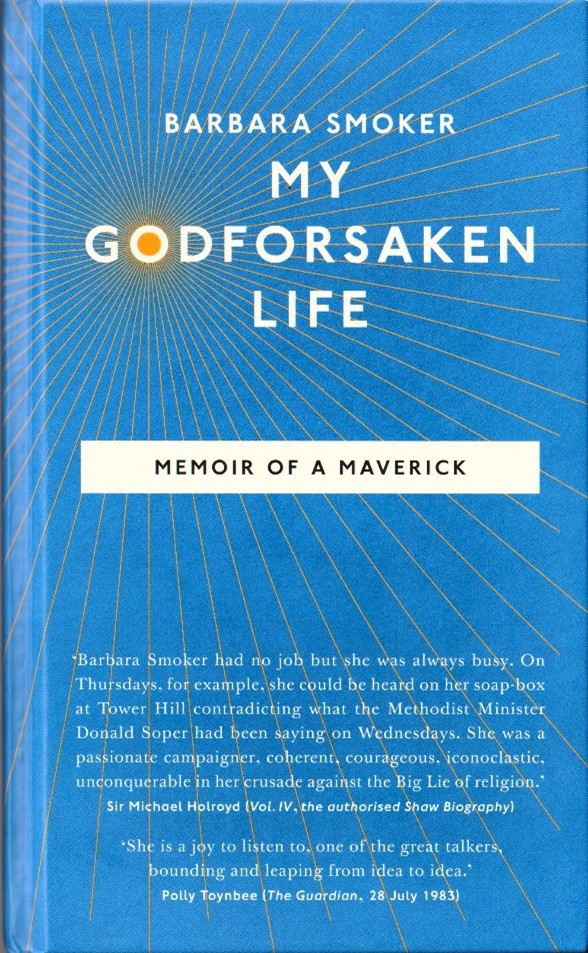
This small, autobiographical volume, published in 2018, is different from others reviewed in this series as it is about somebody I knew and admired—and sometimes despaired of (occasionally all at the same time). It is also a charming, funny, well-written, and telling account of the long and unusual life of a remarkable, determined, and brave woman. ‘Charming and funny’ are unusual descriptors for freethought books, which serves to make this one stand out.
It is worth summarising Barbara Smoker’s account of a characterful life. She was born into a south London family of devout Roman Catholics, the second of six children, five of whom were girls, on 2 June 1923. The family was sufficiently affluent to be able to afford school fees and nurtured children of determined and independent views. Barbara admits that she once considered becoming a nun, and indeed one of her sisters did, eventually becoming the progressive Principal of an Approved School. Another became a magician, going on to become the first woman to be elected to the council of the Magic Circle.
At the age of 19, Barbara enlisted in the Women’s Royal Naval Service (the Wrens) in preference to working in a munitions factory. She served out the war as a wireless telegraphist in South-East Asia.
With characteristic panache, Barbara claims that she became an atheist at precisely midday on 5 November 1949 when she concluded that the Catholic claim of papal infallibility was impossible. This was no sudden conversion, rather a tipping point for a young woman harbouring increasing doubts.
On her return to civilian life, she undertook secretarial training, which she later often found useful in supplementing her income. However, her main occupation was that of a campaigner. As she writes, ‘My life has had its full share of spice’ and ‘I enjoyed reading, writing, broadcasting and generally throwing my weight about’. Organisations to benefit from Barbara’s drive included the Shaw Society, the South Place Ethical Society, the Campaign for Nuclear Disarmament (CND), the National Council for Civil Liberties (now Liberty), and the Voluntary Euthanasia Society (now Dignity in Dying), of which she became chair. She also campaigned for the abolition of the death penalty, the legalisation of abortion, and prison reform.
Most significant of all, though, was her involvement with the National Secular Society (NSS). Barbara was elected President of it at its 1972 AGM and served for 24 years, a term rivalled only by NSS founder Charles Bradlaugh and his successor G.W. Foote and exceeded only by the longest serving President, Chapman Cohen (34 years). She became President at a time when it was unusual for women to lead campaigning organisations, even those such as the NSS, which have always promoted women’s rights.
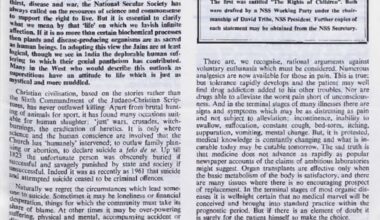
During her time as President, Barbara was a regular Freethinker contributor. Her articles were characterised by her sharp wit and ability to coin a phrase. Among the issues attracting the lash of her pen and tongue were Billy Graham’s ‘Festival of Light’, Lord Longford’s report on pornography, Mary Whitehouse and her campaigns against TV ‘filth’, and the 1976 Gay News blasphemy trial. A collection of her Freethinker essays was published under the title Freethoughts in 2002, and many of her arguments and warnings remain troublingly relevant nearly a quarter of a century later.
She consistently campaigned against church schools and was an early opponent of the establishment of Islamic ones. On one occasion, she wrote of how a Muslim community in Hackney and a Hassidic community in Stamford Hill both denied girls scientific education and integration with others. In 1989, she stood in front of a demonstration of Muslims calling for the death of Salman Rushdie with a simple placard bearing the words ‘Free Speech’, and she remained firm even when physically attacked. At the same time, she endeavoured to warn politicians (mainly Labour ones) of the ‘danger of their expedient appeasement policy towards Islamic fundamentalists’. For this, she was surprised to find herself denounced as a racist and antisemite by Ken Livingstone.
Barbara claimed that during her presidency, she conducted not less than 2,000 secular funerals, as well as officiating at many other non-religious ceremonies. She also authored several books, including Humanism (an introduction for secondary school students), which reached a seventh edition in 2017. It remains the largest-selling book on the subject in the UK. She frequently visited university campuses to debate with the religious. Such occasions were often feisty—a characteristic Barbara seemed to relish and, possibly, deliberately provoke.
One innovation Barbara recalls is her introduction of ‘De-Baptism’ certificates, obtainable from the NSS, which led to her being interviewed on BBC Radio 4’s Woman’s Hour. Less amusing is the story of her house fire in December 1995. Endeavouring to fill her paraffin heater while it was lit, it burst into flames, and she claims that when she threw a fire blanket over the heater, that burst into flames too. The house burned to the ground. Barbara was not insured and had to be rescued by Lewisham Council, who allocated her a council flat where she lived out her days.
Barbara writes of the politicians she knew. Michael Foot is described as ‘my favourite politician of all time’. He was often a guest at NSS events and was inclined to quote Barbara in Tribune, which he edited. She recalls attending a memorial meeting to his ‘most beautiful wife’, Jill Craigie, where a ‘lovely’ eulogy was given by Barbara Castle. Amusingly, she adds that Cherie Blair was also present, ‘thankfully remaining silent’.
Barbara failed to be re-elected NSS President at the 1996 AGM. She puts this down to socialist support for her opponent, Dan O’Hara, Barbara describing herself as a radical liberal, like Charles Bradlaugh. Others recall differently. By 1996, the NSS was in a parlous state. It had a tiny membership, and management and administration were chaotic. Reflecting Barbara’s interest in a wide range of progressive causes, campaigning lacked focus and depth. Many thought change was long overdue.
All that was to change with the appointment of Keith Porteous Wood as General Secretary (later Executive Director), which brought about a much more professionalised and focused approach. Since then, membership has grown hugely, as has the NSS’s influence and prestige. Keith worked first with Denis Cobell as President and then with his (Keith’s) partner, Terry Sanderson. Generously, Barbara acknowledges these developments in her book, describing the new leadership as ‘dynamic’.
Barbara remained active within the NSS until her death in 2020. Whenever she was able, she attended NSS events and the AGM and never lost her sense of humour or sparkle. Those who met her rarely forgot the experience, and they often recall it to this day with a wry smile. The NSS gave her a lifetime achievement award in 2019 to honour her role in the movement.
Barbara was a character and strong personality in the best sense, whose contribution to the NSS and progressive causes should not be underestimated. In the concluding words of her prize-winning poem ‘Living Relay’, reprinted at the end of her memoir:
‘Yes, each has been and each has gone; yet … each a torch has handed on.
Many of Barbara’s articles, talks, and poems can be found via this link. You can also look up her writings for the Freethinker in our historical archive.
Your email address will not be published. Comments are subject to our Community Guidelines. Required fields are marked *
Donate