

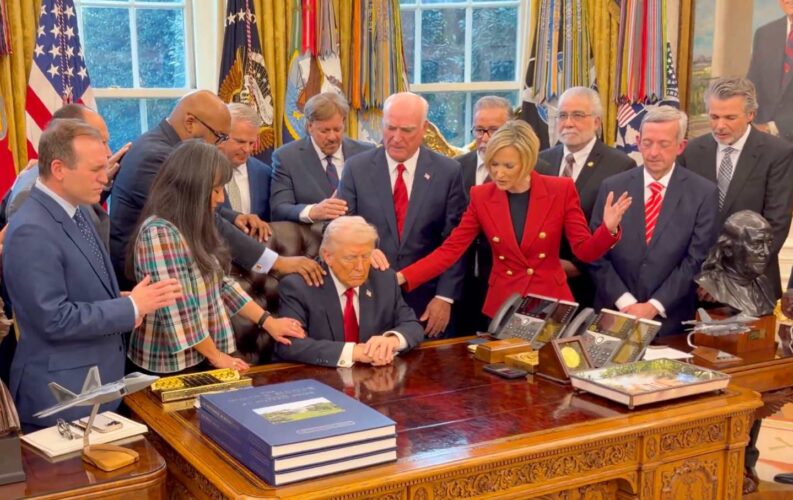
There’s something very wrong with this picture.
It’s not what you might have been thinking, though. There’s something definitely wrong with the Megalomaniac-In-Chief, of course. Many things, in fact. Sexual assault. Likely patron of sex traffickers. Total contempt for justice, democracy, and human rights. Authoritarian, dictatorial, and arguably fascist ambitions. Wanton and enthusiastic ignorance of climate change and science in general. Champion of billionaires, racism, sexism, heterosexism, homophobia, transphobia, and xenophobia. Failed policies (even by the failed standard of orthodox economics), incompetence, inveterate lying, corruption, nepotism, war, and genocide. To name but a few. In short, the M-I-C can be seen as an excrescence of capitalism, of oligarchy, of racism, of malignant narcissism.
But no, I’m referring to religion. Religion is what strikes me as very, very wrong with this picture.
I suppose, particularly if you’re a devout believer in a religion yourself, you may want to chalk up the sycophants and supplicants in this picture as bad apples, exceptions, usurpers of something good, right, and true. Do yourself a favour and erase that chalkboard for a moment. Step back and think about it.
I’d like those of you tempted to think this way to entertain the notion that your assumptions about the inherent goodness or ‘truth’ of religious stories are also wrong.
The stories are the thing.
They’re just that—stories. None of us seems to have any problem viewing the ancient Greek or Egyptian pantheons as stories—wildly imaginative, crazy stories. If you’re a believer in a particular religious story, you probably don’t have any difficulty understanding other, different religious stories and traditions this way—as products of the human imagination.
But that’s all any of them are—wild, crazy, very human stories. Think of them as some of the most enduring, popular fantasy and supernatural fiction of all time. I understand if this may offend you at the moment. Hear me out.
There is no ‘truth’ to ascribe to religious stories, because long ago, they veered away, they metamorphosed like Ovid’s wondrous gods and animals, away from being stories of people in times and places, to being stories of people and places infused with the divine, laced and powdered with gods and the supernatural. They were no longer stories about people, but stories about fictive worlds full of gods. Even the people in them became divine. These were the times when Egyptian pharaohs and Roman emperors transformed themselves into gods, attempting to write themselves into religious stories. Ludwig Feuerbach described all this as a process of projecting all the most amazing things about humans onto fictional divinity—our power to create, to love, to hate, to inflict violence, to forgive, to reconcile, to survive and endure.
There is no shred of truth or reality in the idea of a sacred revelation, a divine muse, a prophet’s direct line to God. There are no angels, spirits, demons, saints, or eternal deities to supplicate ourselves to. There are no chosen people, because there is no God to have chosen them. There is no promised land, because there is no divine source of a promise. Humans chose themselves. Humans promised themselves. Humans made up these stories. Humans can choose not to believe in them.
As such, the amazing diversity of stories associated with religions—from those of ancient Mesopotamia, Mongolia, Africa, the Indus Valley, Mesoamerica, and the place many Indigenous people call Turtle Island in reference to a story (it is better known as North America)—is a part of our shared cultural heritage, a treasure trove of literature. All of these stories, every single one of them, whether they feature gods like Innana and Enki, Zeus and Hera, Yahweh/God/Allah, Shiva, Buddha, Vishnu, Anansi, Nanabozho, and all the others one could list, or whether they feature divine or divinely-inspired/infused humans, are all precious, amazing, creative stories. They should all be treasured as the shared literary inheritance of humankind.
But none of them is true.
This is because they are stories. If you have a hard time seeing it from this point of view, I hear you. I was once in the same position. I once believed fervently and seriously in the imagined truth of a religious story, to the point that I became a candidate for Christian ministry. Eventually, and painfully, I found my way out of a lifetime of belief. It was hard. It caused my family and community pain and confusion. But after it all, I was free. Free to write my own story unencumbered by an internalised, imagined divine panopticon aware of and judging my every thought and move, free of an imagined providential will in control of my destiny. For a time, I was resentful of what came before, but I’ve had time to think about it.
There’s no point legislating against religious belief. That’s like trying to force people not to read and enjoy stories. That would be a very stale, inhuman world. We are the stuff of stories—it’s how we see the world. We make art, we tell ourselves stories, we create beautiful and terrible things, to help us understand our place in the world. To outlaw or ban religious stories would be ridiculous and pointless. However, I’m inviting you, I’m pleading with you, to consider none of them true. I’m inviting you to pull back the curtains of religion and look out of the windows of our minds at the world as it is, without the gauzy film of religiosity shrouding it from our vision.
We don’t need religious stories. We can just have stories.
I got some amazing noise-cancelling earbuds as a gift this year. When they’re on ‘quiet’ mode, they practically cut out the ambient noise around me, making it easier to concentrate. Think of religion as that ambient noise. If we were able to tune it out, we’d be better able to concentrate on the world around us, which is full of very, very human stories, human longings, human love, human depravity, human hopes, human fears.
The fervent belief in the ‘truth’ of religious stories is what makes that disturbing picture of the M-I-C being prayed over possible. I grant you that there may be a few simple entrepreneurs in this group of detestable self-styled ‘evangelists’—men and women out for a buck, who believe more in profit and self-aggrandisement than in any other story. They’re in perfect company with the M-I-C. Let’s assume, however, that they do believe they are praying to a God—the Christian trinity of God/Jesus/Holy Spirit—to attempt to confer His Blessings on their President.
What a farce. It would be laughable if it weren’t so odious and so dangerous. If you haven’t seen the video of the M-I-C’s official ‘spiritual advisor’ and head of the White House Faith Office, Paula White-Cain, offering a deranged stream of consciousness glorifying the war on Iran, you should. ‘Strike and strike and strike’, she intones theatrically in an ecstatic mantra, before speaking in tongues. Was this before or after an Iranian elementary school for girls was bombed by US forces during the school day, killing 168, I wonder? Was a fanatical Christian US military commander reminding his soldiers at the same time that their commander-in-chief is the agent of God—directing them on a divine mission to usher in the promised apocalypse and the Second Coming mentioned in the book of Revelation, perhaps?
White-Cain has also said that ‘to say no to President Trump would be saying no to God’, characterised Black Lives Matter as the ‘antichrist’, and sold blessings to the credulous for cash.
She is in that picture, laying a hand on the M-I-C. She’s the one in the red jacket, right in front.
With all the prayers and blessings said and done, it’s the ascription of ‘truth’ to the religious story of Christianity that makes this picture possible.
Please, just think about it. There is no divine warrant for war, genocide, billionaires, and unchecked climate change. There are only human ambitions, human hate, human fear, and human greed. There is no divine title for land guaranteed by a divine scripture, because there isn’t any divine scripture. There is no such thing as a text with a connection to the divine, because the divine is a product of the human imagination. When you look at what a devout believer calls a sacred scripture, you’re looking at a messy, translated, wildly imaginative human text.
There is no divinity to pray to. Rather, pray to yourself, pray to reflect on the love you have in your families, the fellowship you have with your friends, in your community, with one another, with nature. We are in this together; we need each other. We don’t need to believe religious stories are true to care for ourselves, each other, and the planet—or to create yet more beautiful art and stories.
There is no divinity exerting control over your destiny, in control of the universe. That’s an amazing story, but it’s just that. There’s nothing ‘out there’, above or beyond us, to pray to.
If we can see that, we’re free. Free to oppose all of the execrable ideas and policies that this President, his enablers, and his ilk offer us. Free to steer ourselves away from tyrants, hate, greed, and fear, toward different seas and shores of interdependence, sharing, love, and respect.
Free to write our own, better stories.
Related reading
Christian nationalism threatens democracy. Secularism protects it. By Stephen Evans
White Christian Nationalism is rising in America. Separation of church and state is the antidote. By Rachel Laser
Review: Jonathan Rauch, ‘Cross Purposes: Christianity’s Broken Bargain With Democracy’, by Patrick Seamus McGhee
The Fourth of July and the Battle for America’s Soul, by Daniel James Sharp
How Trump will reshape America’s global role in his image, by Matt Johnson
American democracy will soon turn 250. Freethought can reinvigorate it. By Patrick Seamus McGhee
‘Project 2025 is about accelerating the demise of a functioning democracy’: interview with US Representative Jared Huffman, by Daniel James Sharp
Donald Trump is an existential threat to American democracy, by Jonathan Church
Judeo-Christian religionists cannot ‘liberate’ Muslims (or Iran), by Kunwar Khuldune Shahid
A Republic on Fire: ICE’s Reign of Terror, by Ron Fischer







Your email address will not be published. Comments are subject to our Community Guidelines. Required fields are marked *
Donate