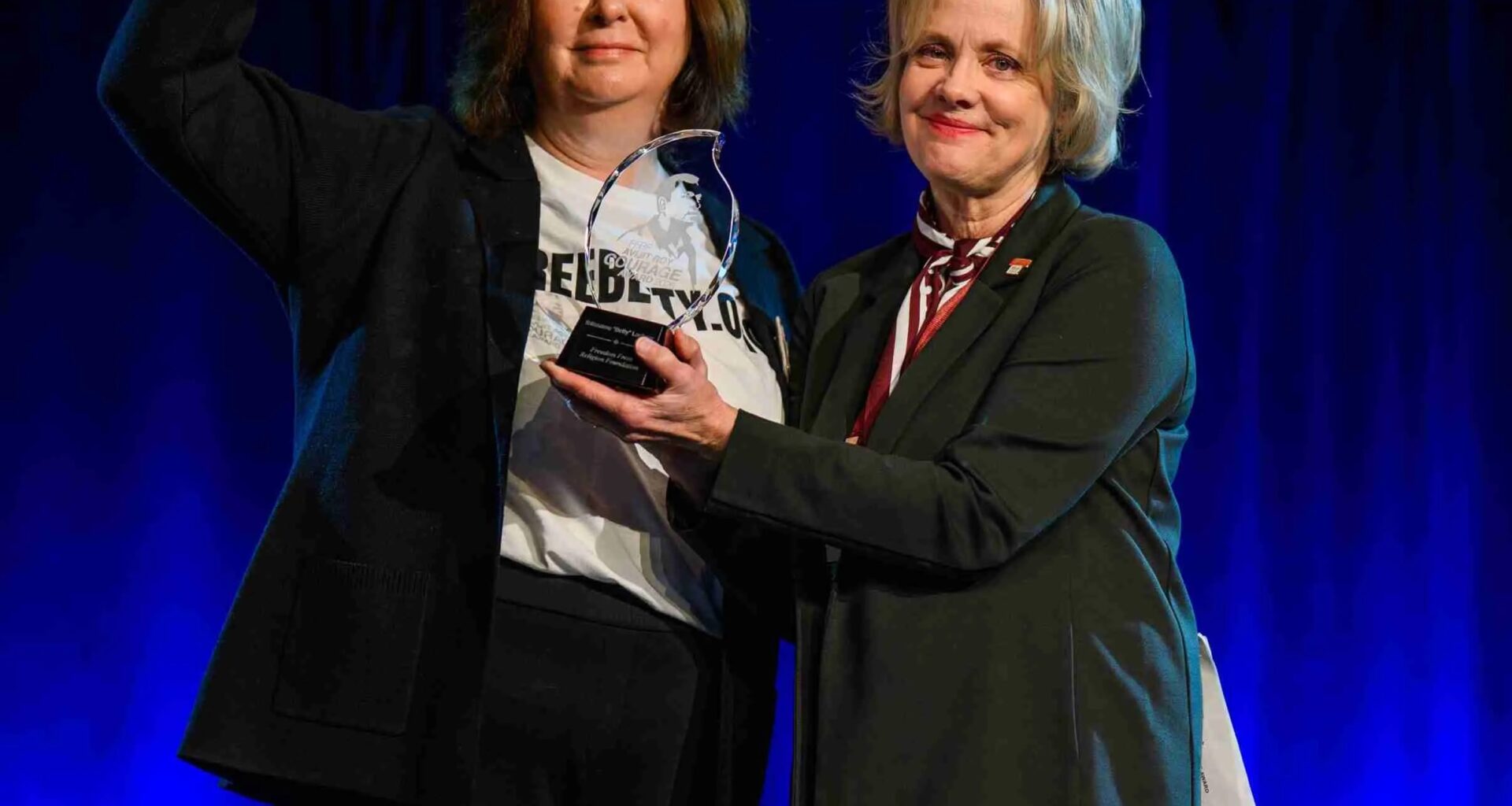
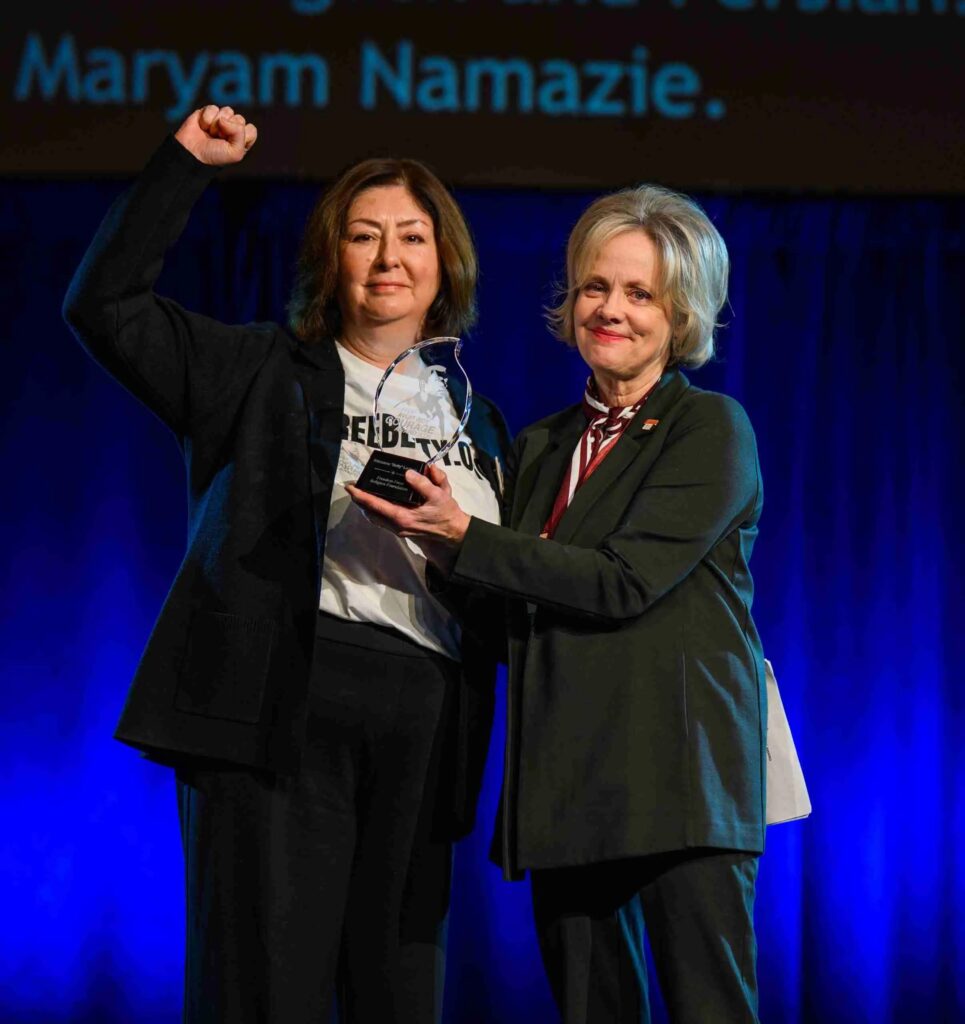
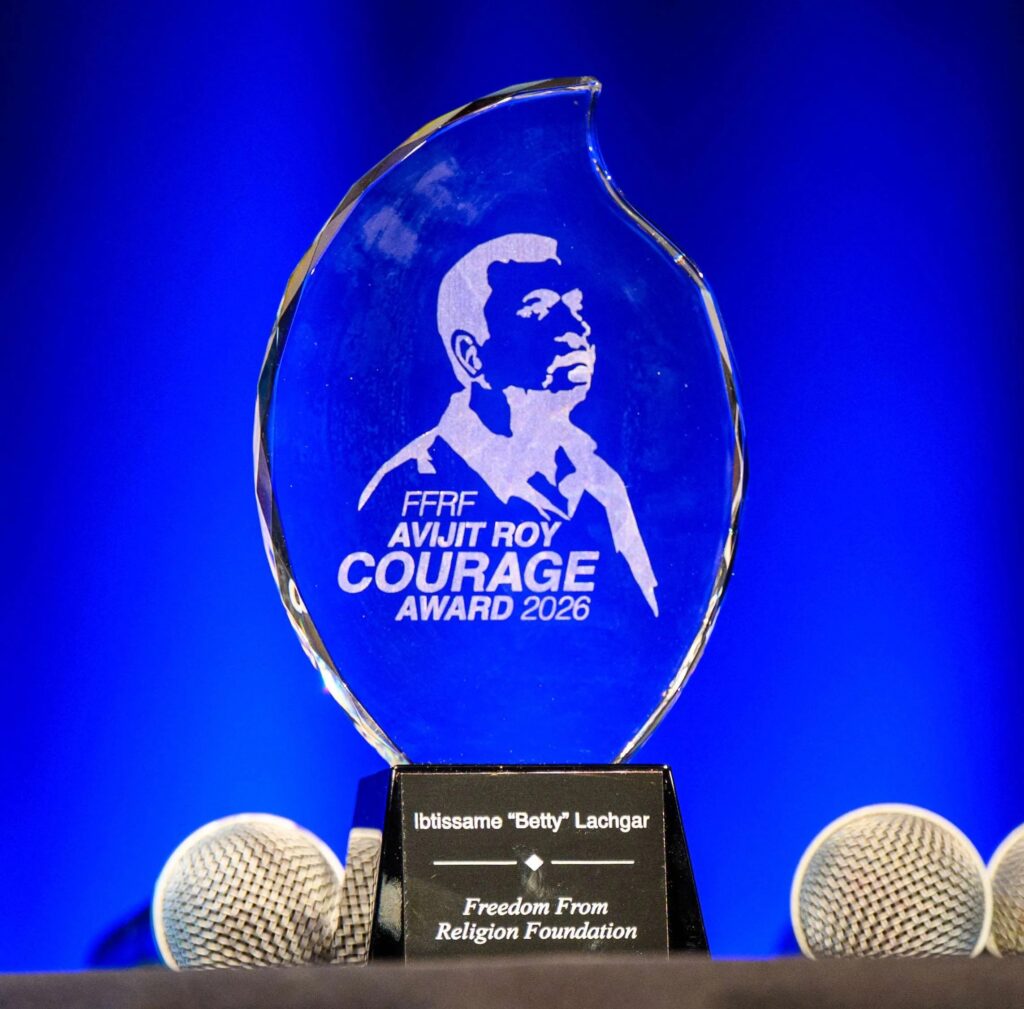
The following is Maryam Namazie’s speech accepting the Avijit Roy Courage Award on behalf of Ibtissame Betty Lachgar at the Freedom From Religion Foundation (FFRF) Convention in Milwaukee on 17 October 2026. It has been lightly edited for publication.
Ibtissame Betty Lachgar should be free. Instead, she is in prison in Morocco.
On 10 August 2025, ten police officers came to her home to hand her a summons. She left with them without her medication and without a lawyer. She has yet to return home.
It is while still in prison that Betty has been awarded the Avijit Roy Courage Award.
There is something especially powerful about Betty receiving an award named for Avijit Roy. Avijit was a Bangladeshi-American atheist writer who spent his life challenging religious fundamentalism and defending the right to think, question, and dissent. For that work, he was murdered by Islamists on the streets of Dhaka in 2015.
Betty belongs unmistakably in that tradition.
Betty is a feminist, atheist, psychologist, and rights activist. She co-founded MALI, the Alternative Movement for Individual Liberties, in Morocco in 2009. For more than sixteen years, she has fought for women’s rights, abortion rights, LGBT rights, freedom of conscience, and individual freedoms despite the threats.
Civil disobedience has always been central to her politics. She has deliberately brought into public view things that women are told should remain private, shameful, unspeakable.
In May 2025, Betty wore a T-shirt bearing the words ‘Allah is lesbian’ at a conference in London. She had first worn it in 2022 in solidarity with two Iranian lesbian women who had been sentenced to death. The slogan was deliberately provocative, drawing on an older radical slogan that imagined God as female, Black, communist, and lesbian.
Betty was sentenced to thirty months in prison under Article 267-5 of the Moroccan Penal Code, for a T-shirt she wore outside Morocco. Thirty months in prison for a T-shirt.
Article 267-5 is not an ancient blasphemy law inherited from another century. It was introduced in 2016 by the Islamist Justice and Development Party, the PJD, when Mustapha Ramid was justice minister, to restrict what can be said about Islam. The PJD later lost power. But the law stayed.
And when Betty’s photograph became viral on social media in 2025, Ramid, by then a former justice minister, publicly demanded that she be prosecuted under the very law introduced during his time in government. Years later, that law was used to put Betty in prison.
She has now been in prison for more than a year. In addition to being a travesty of justice, her imprisonment has become a humanitarian emergency.
Betty survived Ewing sarcoma, an aggressive bone cancer, when she was twenty. Since then, she has lived with a prosthesis replacing the bone in her left arm. That prosthesis was due to be replaced in France in September 2025. Instead, she remains in prison without access to the surgery she desperately needs.
According to her lawyer, Ghizlane Mamouni, the prosthesis has now come completely loose. Betty has suffered a fracture and has lost almost all use of her arm. The metal of the prosthesis is now pushing through her shoulder.
FFRF helped bring in their member Dr Neil C. Vining, a board-certified orthopaedic surgeon, to review Betty’s medical records. He warned that without treatment she faces a ‘catastrophic complication’, including infection, sepsis, amputation or death.
Ghizlane Mamouni puts the urgency very simply: ‘Her sentence runs until 2028. And her body may not wait that long.’
Betty lives with searing chronic pain. She has described sleeping on concrete with blankets as a mattress, unable to find comfort sitting or lying down. For the pain, she is given only paracetamol.
And yet her activism has not ended inside prison. Her sister, Siham Lachgar, says: ‘Even in prison, she continues her fight by helping and supporting her fellow female inmates.’
Her imprisonment has not silenced her. These are her own words from prison: ‘Although I am detained, I remain revolutionarily free, faithful to my feminist values and principles.’ She adds: ‘Women’s rights and freedoms are neither a favour nor a privilege.’
Betty is not an isolated case. Defending her means defending all those who face blasphemy and apostasy charges.
There is 23-year-old Najmeh Amini, who has been sentenced to death for blasphemy over social media posts in Iran. And Doaa El-Houni, who was arrested in Türkiye where she was seeking refuge, forcibly returned to Libya, and detained there after being accused of ‘spreading atheism’. Her whereabouts are unknown.
In many countries, blasphemy and apostasy laws still mean social exclusion or prison. In nearly a dozen countries under Islamic rule, blasphemy and apostasy are punishable by death.
These laws do not exist in isolation. They are part of wider political projects that seek to give religion power over society.
Whether it is Islamism, Christian nationalism, the Hindu Right, the Jewish Right, or Buddhist Right, the more political power fundamentalists gain, the more rights they deny; the more they censor and silence.
I saw this happen in Iran, where I was born. Religious despotism did not arrive all at once. It came incrementally, and women were its first target. Control over women and their social reproduction is one of the ways religious power establishes control over society itself.
Of course, people have every right to religion as a private matter, however absurd. I have always said that religion should come with a health warning, like cigarettes. It can kill you. Especially when it enters the state, the law, education, and public policy. Then we are no longer talking about private belief. We are talking about political power.
And political power reveals itself most clearly in what happens to those who refuse it. The countries may differ, but the system of control is the same: if you leave, if you speak up, if you challenge religion, you will pay the price.
And that control is often sanitised and disguised as offence. The state is offended. The community is offended. The family is offended. And offence becomes a justification for punishment. Apparently, Allah is the greatest and most merciful, until his fragile sensibilities are offended.
One of the most effective tactics to silence dissent is to present criticism and blasphemy as violence and harm while actual threats, harm, and violence are excused as justified reactions to offence. Offence is often deemed to be more important than murder.
How many times have we heard, ‘What did you expect?’
Betty received thousands of death and rape threats. Yet she is the one who is shamed and judged. She is the one in prison.
Also, criticism of Islam is not an attack on Muslims. Blasphemy is not violence. Apostasy is not violence. Murdering, imprisoning, or threatening people are violence.
And criticising Islam and opposing Islamic fundamentalism are not racism. It is not anti-racist to excuse fundamentalism because Muslims are a minority here. It is racist to assume that those of us from Muslim backgrounds are all religious, conservative, or represented by fundamentalists. That Sharia is in our DNA.
This erases the women, atheists, ex-Muslims, the dissenters, and LGBT people, including believers, who say: You do not represent me. So the choice between opposing racism and opposing fundamentalism is a false one. We have to oppose both.
The more fundamental question is: who gets to define the terms on which we live? Religious authority? The state? The family? The community? Or do we get to define those terms for ourselves? And this is why women’s blasphemy matters so much.
The ex-Muslim woman commits two heresies. She rejects God. And she rejects her assigned social function. Because the patriarchal family depends upon women reproducing more than children. Women are expected to reproduce religion itself: its morality, its norms, its ideas of modesty and respectability, its idea of a woman’s place.
So when a woman refuses, hierarchy is threatened. Power is threatened. The idea that a religion assigned at birth can have a permanent claim over us is threatened. Freedom of religion means nothing if it does not include the freedom to criticise or leave religion.
Feminism transformed sexual politics by insisting that consent must be ongoing and revocable. The same principle matters here: what was assigned to us at birth without our consent cannot bind us for life.
The right to leave Islam is analogous to the right to withdraw consent.
Being ex-Muslim is not another compulsory identity. It is a political assertion of the right to leave one. And that right does not stop at the boundary of the state. Religious coercion is often enforced where domination is least visible: inside the family, inside the home, inside what society calls private. Whether coercion comes from the state, the family, or the community, the effect is to make dissent dangerous and often invisible.
That is why public apostasy and blasphemy matter. Apostasy makes hidden dissent visible. Blasphemy makes sacred authority contestable. These are not merely symbolic. They expand what is imaginable.
And this is why solidarity matters. Repression seeks to isolate the dissenter and make others believe that silence is safer. Solidarity breaks that isolation. It tells the dissenter: You are not alone. Others will stand with you.
And when dissent is defended, it becomes harder to isolate the dissenter and easier for others to speak. FFRF has helped keep Betty’s case visible, amplified demands for her release, and brought international attention to the danger to her health.
The Avijit Roy Courage Award is part of that solidarity. And so is the Free Betty Coalition, bringing people together across borders around one demand: Free Betty Now.
Women’s blasphemy is threatening because it is an act of refusal. The woman who was supposed to reproduce the existing order refuses to reproduce it. The woman who was supposed to defer to sacred authority judges that authority for herself. And in doing so, she exposes something power does not want us to see: the existing order is not natural. It is not inevitable. It is not permanent. It can be changed.
And that is the power of Betty’s refusal.
To religious authority, to the fundamentalist, to the despotic state, to every power that claims authority over a woman’s life, it says: You do not get to define the terms on which I live.
The struggle to blaspheme is a struggle for the right to be fully human.
And fully free.
See the video of Maryam’s speech and an introduction to the award by Annie Laurie Gaylor at the FFRF Convention here.
More than 387,000 people have already called for Betty’s release. If you have not signed the Avaaz petition, please join them.
‘Hurriya’ (‘Freedom’) is a new song for Betty, produced by Simhala Foundation in collaboration with the Free Betty Coalition, Lee Garrett, and Betty Lachgar herself. Lee is the legendary Motown songwriter who co-wrote ‘Signed, Sealed, Delivered I’m Yours’ with Stevie Wonder, among other songs. The song can be ordered on iTunes. We want to help Hurriya reach the charts and, through the song, bring even more attention to the campaign to free Betty.
For more information, visit the Free Betty website.
Related reading
Image of the week: ‘Allah is lesbian’ (#FreeBetty), by Daniel James Sharp
Freedom of expression lives where offence begins: In defence of Ibtissame Betty Lachgar, by Maryam Namazie
Free Betty Lachgar! A joint letter from the Free Betty Coalition, by Daniel James Sharp
Women’s Blasphemy and the State, by Maryam Namazie




Your email address will not be published. Comments are subject to our Community Guidelines. Required fields are marked *
Donate