
While the history of the Israel-Palestine conflict did not begin on 7 October 2023, that date certainly marked the beginning of the realignment of forces in the Middle East (or West Asia, to use a less Eurocentric name), although none of us could have predicted the depth and breadth of it. Led by the most virulently right-wing government in Israel, cheered on by the maverick bully in the White House, and buoyed up by their military successes, Israel blitzed Hamas and Hezbollah into the ground, occupied further chunks of Syria and Lebanon, and is currently seeking to disembowel Iran. The world watches, horrified at the impunity with which a biblical fantasy, Eretz Israel (Greater Israel), is being reconstructed—and at its own inability to intervene.
I am not about to regurgitate mainstream commentary on these realignments. Rather, I want to draw attention to a small progressive women-led society which stands to be a casualty of the clash of these authoritarian, fascist titans: the little-known women’s revolution in Rojava, Northeast Syria. Little-known in its last 13 years of existence, and little-known as it stands on the brink of annihilation. The threat it faces today deserves widespread attention and solidarity because it represents that ‘other world’ that we have all hankered after.
It came into existence during the last realignment of forces in West Asia, the ‘Arab Spring’ in 2011, which turned out to be temporary because the powers-that-be made sure to defoliate the green shoots of real democracy. Although universally seen as a failure, the Arab Spring produced a power vacuum in Syria that allowed Rojava to establish itself in 2012 while Bashar al-Assad was preoccupied by the civil war down south.
At least since the early years of this century, the Kurds of Syria had been implementing Abdullah Öcalan’s (their political leader) template for a free Kurdistan. This is not a nation state carved out of the four countries—Iran, Iraq, Syria and Turkey—which encompass Kurdistan, but autonomous self-administering regions within these borders. Despite there being no danger of secession, Democratic Confederalism, the system the Kurds want to implement, has been treated with suspicion in all four nation states, which are, as ever, anxious that the Kurds want to break away.
In Turkey, from 2016 onwards, President Recep Tayyip Erdoğan has repeatedly destroyed the co-mayor system (one man and one woman) that the Kurds had voted in through Turkish elections in Southeastern Turkey by imprisoning many of the mayors and replacing them with his own people. Iran’s relationship with its Kurdish minority is marked by cultural marginalisation, political exclusion, periodic armed conflict, and heavy securitisation. In Iraq, the Kurds did manage to set up an autonomous region after years of suppression and genocide by Saddam Hussein, the Kurdistan Regional Government, although its establishment was resisted by the central government of Iraq. But it is tribalist and pro-capitalist, and it collaborates with Turkey against Kurdish interests.
Bashar al-Assad had been equally repressive towards the Syrian Kurds, denying them their identity, their language, their culture, and even citizenship. But under the radar, the Kurds had been setting up domestic violence networks, dispute resolution mechanisms, Kurdish language classes, local assemblies with rotating leadership, etc., which would transform into the communes of Rojava whilst civil war raged in the rest of Syria. The liberation of women was woven into the fabric of Rojava; every thread vibrated in the attempt to achieve that freedom.
As I have written elsewhere, Kongra Star, the Rojava women’s umbrella organisation, fired a substantial legislative torpedo into patriarchal practices, which led to the banning of child marriage, forced marriage, female genital mutilation, and polygamy and the criminalisation of honour killings and violence and discrimination against women, including any attempt to stop a woman marrying of her own free will. Women, regardless of their marital status, were given the right to custody of their children until the age of 15. A woman’s testimony was declared equal to that of a man. Women were given the right to equal inheritance. Sharia courts were disbanded—an incredibly enlightened move, considering that the UK tolerates their existence.
Neighbourhood communes, run on the co-presidentship rule, set up health, education, conflict resolution, and economic committees with equal representation of both sexes, which elect representatives to the next level—regional town councils—all the way up to the overarching People’s Council, responsible for coordinating the whole of Rojava. Parallel to this is a women-only structure which has the right of veto over any policies proposed by the mixed-sex structure should they be deemed not to be women-friendly.
All of these practices are scaffolded by Abdullah Öcalan’s construction of women as the vanguard of the revolution. Öcalan proposes that women’s domestication amounted to the first enslavement in history, which made the subsequent enslavements of other people conceivable. He argues that women’s biological differences have been used as justification for their enslavement. Society treats women not merely as a biologically separate sex but almost as a separate race, nation, or class—the most oppressed race, nation, or class.
Öcalan went so far as to assert that women’s freedom is more precious than the freedom of the homeland. Unlike most revolutionary movements, which aim for system change, Öcalan believes that it is equally important to change mindsets. He would ask women activists if they had killed the man in their heads. Education at all levels, at all ages, and aimed at both sexes, is key to the success of this project. Even in the comparatively short training period given to those entering the Rojava defence forces, which include both mixed-sex and women-only sections, just as much time is spent on discussing patriarchy, the history of Kurdish oppression, and the new democratic model of society as on arms training. It is all about building a new society, not just armed struggle.
Öcalan is also very clear about the role of religion in the oppression of women. In the pamphlet Liberating Life, Öcalan advances his ‘three sexual ruptures’ theory of women’s enslavement and eventual liberation. The first rupture, or turning point, was the rise of patriarchy when Neolithic times ended and ‘statist civilisation’ arose; the second sexual rupture was the intensification of patriarchy through religious ideology, when ‘[t]reating women as inferior…became the sacred command of god’; and the third rupture is yet to come, the end of patriarchy, or as Öcalan puts it, ‘killing the dominant male’, which is about reshaping masculinity so that it no longer defines itself in relation to its power over women.
This is what we stand to lose in the recalibration of Syria. The ideology driving the Syrian Transitional Government (STG) led by Ahmed al-Sharaa, who overthrew Assad at the end of 2024, has much in common with that of ISIS. Women’s rights feature nowhere on the agenda. Sharia courts are back. To the West, with its lip service to gender equality and democracy, this does not matter because al-Sharaa is opening Syria up to capitalist exploitation. Even before he was formally confirmed as President of the Transitional Government, his first foreign visit to Saudi Arabia signalled his willingness to open Syria up to global investment.
With the blessing of the US, al-Sharaa’s army has been attacking Kurdish areas since January 2026 with a brutality reminiscent of ISIS and has recovered almost all the territory that the Rojava administration had acquired after it defeated the ISIS ‘caliphate’ in 2019—much of it incorporating vast stretches of desert but most notably at least 60 per cent of Syria’s oil and gas reserves.
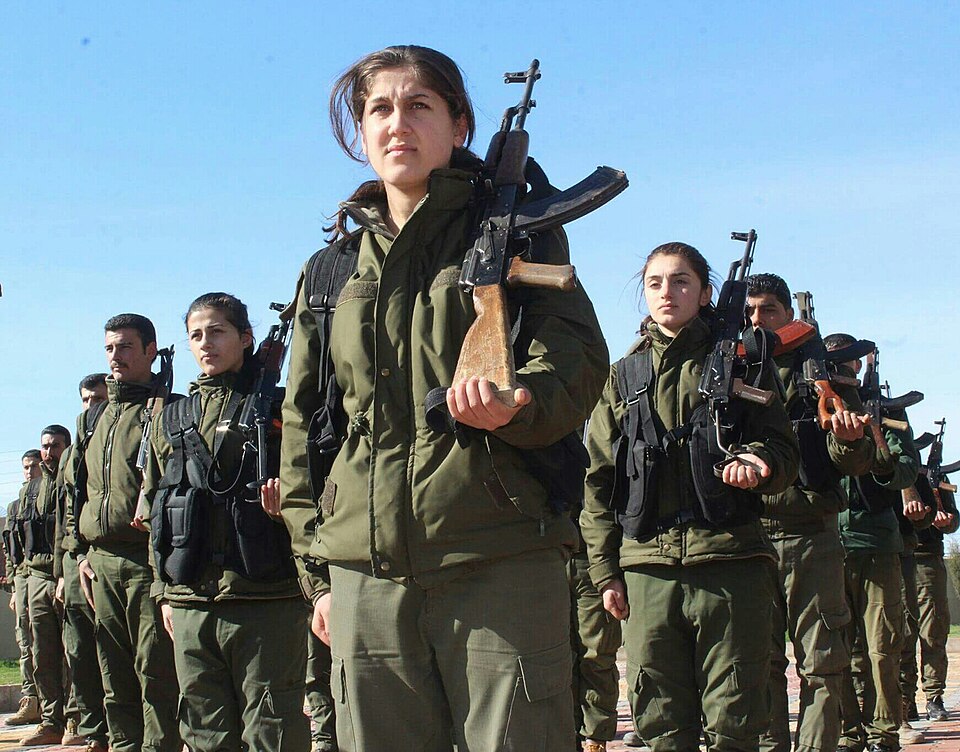
At the moment, according to an internationalist volunteer with Kongra Star, Anya (not her real name), who has been in Rojava since 2023, the Rojava revolution continues with its system of education, justice, and democratic governance. But the agreement signed on 29 January between the main Kurdish fighting force in Syria and the central government may erode those gains. The hope of a federal system, allowing the Kurds autonomy over their areas, was not fulfilled—and was not likely to be while Turkey loomed large in the background. Turkey’s agenda has always been the decimation of the Rojava project for fear of it contaminating its own Kurdish population with ideas of a democratic revolution. Ahmed al-Sharaa’s rise to the presidency was partly engineered by Turkey, which saw him as someone they could do business with.
The agreement conceded two issues to the Kurds: their defence forces would be absorbed into the Syrian national army as whole units and they would have the right to nominate their governor, although their co-presidentship principle was not accepted. Nour al-Din Ahmad Issa, the new governor, is steeped in the ideology of Democratic Confederalism, which means the possibility of quietly adhering to its principles remains a live option. Unofficially, the governor may share power with a woman.
The women’s defence units are refusing to lay down their arms even though they will not be accepted as a unit in the Syrian army. Anya was hopeful that ongoing dialogue could bring about change in the STG’s approach. For example, negotiations are taking place on the composition of the internal security forces. The STG wanted it to be a men-only outfit, the Kurds insisted that women should be involved, the STG conceded that it could be opened to married women (!) only, and the Kurds demurred and finally won the principle of women being allowed to join the security forces.
For the moment, the women’s revolution is still alive. Anya says they are fighting for what they have won, for they have the most to lose. ‘Once they have smelled freedom, they cannot go back.’
The baton passed by the Rojava women’s revolution to the Woman Life Freedom movement in Iran—ignited by the 2022 killing of Mahsa Jina Amini—may yet be carried forward into something more transformative. The current war against Iran may offer some opportunities. The media has been inundated with reports of Donald Trump hoping to arm the Iranian Kurds to fight the regime. The Americans are loath to put boots on the ground, as it would be deeply unpopular at home, so this is a real possibility. But the Kurds have been betrayed many times in the past, most recently in Rojava, where the US did not use its influence to ensure Rojava’s autonomy, even though it was Rojava’s defence forces that sacrificed more than 11,000 people in the successful fight against ISIS.
According to Hussein Mamo, London-based representative of the Syrian Defence Council, the defence ministry of Rojava, the Kurds will not engage in military action without solid political guarantees of protection by the US. The Kurds are monitoring the situation closely, but to fight the regime would be suicide, especially with a ‘guarantor’ as fickle and unreliable as Trump.
The situation in Iran is not comparable to Syria in 2012 when Rojava was established. Assad was in a weaker position, unlike the Iranian regime, which has a large, well-resourced, brutal, and religiously fervent security force in the IRGC (Islamic Revolutionary Guard Corps) and Basij (volunteer paramilitary force under the IRGC). There is no vacuum yet in Rojhelat, Eastern (Iranian) Kurdistan, like there was in Rojava.
One faction of the Iranian Kurds, under the leadership of PJAK (Free Life Party of Kurdistan), which is ideologically aligned with Abdullah Öcalan, runs a similar governance structure to Rojava, with women at the forefront, in its headquarters and training bases in the Qandil mountains in Northern Iraq. Amir Karimi, Co-Chair of PJAK, claimed that they had operational structures within Rojhelat ‘in close contact with the people’, although the area is saturated with the IRGC.
The Epstein files have shown us undeniably that the world order has been corroded by the nexus between patriarchy and high finance, a corrupt global elite that objectifies and trades in women’s bodies despite all the progress we have apparently made in winning rights for women.
We are also seeing across the world the rise of the far right, whose identitarian politics oppose migration in order to preserve ethnocultural purity. We see this being brutally played out in the US with ICE agents picking people off the streets and deporting them based on skin colour and accent. This is why Öcalan came to oppose the nation state: because it ends up relying on the violent enforcement of social homogenisation. By contrast, Democratic Confederalism is grounded in diversity, as we have seen in Rojava. There is almost nowhere on this earth where racial purity survives. We need to embrace diversity, not kill it.
Rojava opened up our imaginations to what it is possible to achieve. As I was writing about the achievements of Rojava, I was unconsciously writing in the past tense. I went back over every sentence and changed it to the present tense. We need to commit ourselves to the future tense with confidence.
Related reading
Iran: On Power, Inheritance, and the Disciplining of Women’s Bodies, by Maryam Namazie
For Mahsa Jina Amini and Woman, Life, Freedom: Summoning an Age of Humanity in an Age of Hate, by Maryam Namazie
Verses of Life: A Review of ‘Woman Life Freedom: Poems for the Iranian Revolution’, edited by Bänoo Zan and Cy Strom, by Daniel James Sharp
It is time to recognize sex apartheid as a crime against humanity, by Maryam Namazie
Golani’s Syria: Post-Assad nation-building hinges on resisting Islamisation, by Kunwar Khuldune Shahid
Judeo-Christian religionists cannot ‘liberate’ Muslims (or Iran), by Kunwar Khuldune Shahid
Iran: Between Bombs and Theocracy, by Maryam Namazie
The Ayatollah, Theocratic Fragility, and the Rebellion of Iranian Women, by Yamin Mohammad
The Silent Revolution Against Religious Oppression in Iran, by Siavash Shahabi
The ‘Women’s Revolution’: from two activists in Iran, by Rastine Mortad and Sadaf Sepiddasht
A Republic on Fire: ICE’s Reign of Terror, by Ron Fischer


1 comment
Thank you Rahila – I have learned a lot.
Your email address will not be published. Comments are subject to our Community Guidelines. Required fields are marked *
Donate