

Books From Bob’s Library is a semi-regular series in which freethought book collector and National Secular Society historian Bob Forder delves into his extensive collection and shares stories and photos with readers of the Freethinker. You can find Bob’s introduction to and first instalment in the series here and other instalments here.
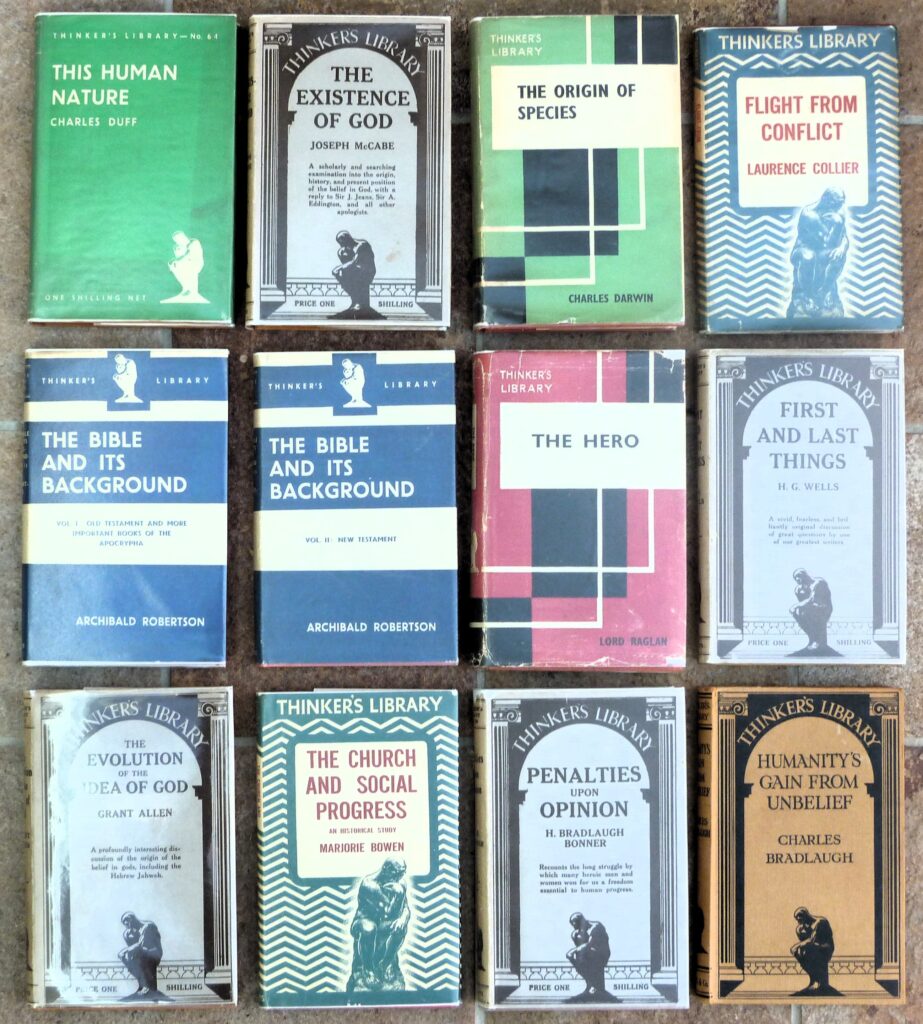
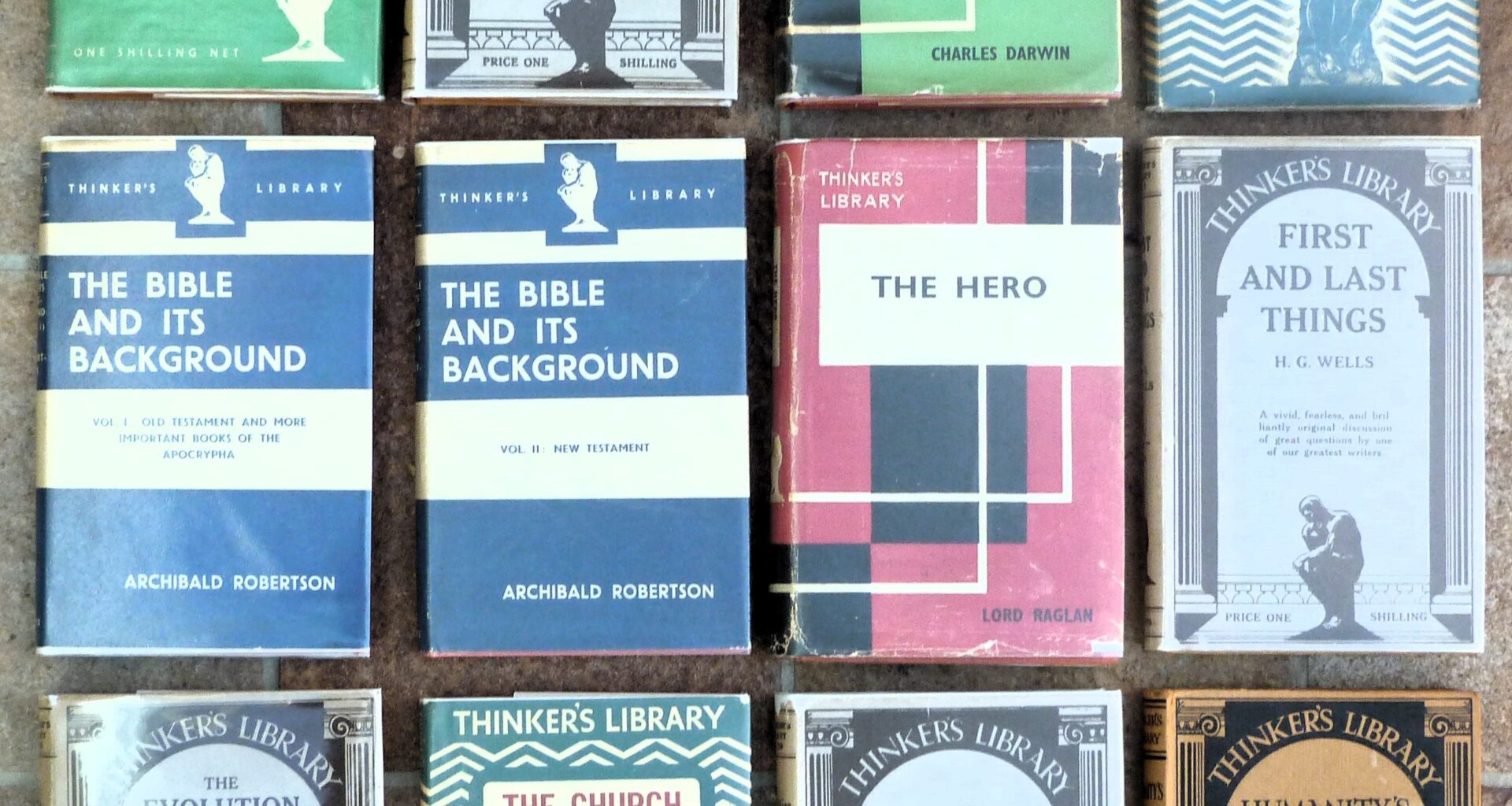
I recently had the pleasure of opening a small, tidy package from Australia containing a copy of Lord Raglan’s The Hero, complete in its dustjacket. My delight was increased by having completed my set of 140 titles in the Thinker’s Library series, published by the Rationalist Press Association (RPA) between 1929 and 1951 (The Hero was #133 in the series).
The history of freethought literature inevitably focuses on the careers of thinkers and writers. However, this is just part of the story; there were the publishers too, and it was often these publishers of heretical or infidel works who suffered the worst persecution. The likes of eighteenth- and nineteenth-century figures such as Daniel Eaton, Richard Carlile, James Watson, and Edward Truelove, to name a few, deserve to be better known and celebrated.
By the turn of the twentieth century, the publication of freethought, rationalist, or secularist works, or whatever term or combination of terms you prefer, was less hazardous, but that did not mean that established publishers were comfortable with their imprimatur appearing on what many regarded as heretical works, particularly if such heresy was intended for a wide circulation. For the religious and those held in their sway, good taste could not and did not extend to heresy or infidelity.
The Rationalist Press Association was founded in 1899, partly in response to the decline of publishing associated with the National Secular Society (NSS). There was also the desire of some, such as George Jacob Holyoake and Charles Watts, to distance themselves from G.W. Foote’s aggressive and militant freethought propaganda, which appeared in this very magazine (at the time, Foote was both editor of the Freethinker and NSS President). And there were also still scars and resentments from their disputes with Charles Bradlaugh, founder of the NSS. Bradlaugh had been dead for nearly ten years, but his heroism, personality, and achievements, and the loyalty his memory commanded, still affected the ecosystem within which freethinkers operated. This schism has proved persistent.
In his The Blasphemy Depot: A Hundred Years of the Rationalist Press Association (RPA, 2003), Bill Cooke has carried out the demanding task of recording the history of the RPA and its publisher, Watts & Co. This splendid piece of scholarship includes detailed appendices which are a rich source for fellow scholars. (I have one gripe: the title detracts from the heroism of those who went before. Nobody was ever prosecuted for blasphemy for publishing through the RPA. Plenty others had been before, though, and their headquarters better deserve the title ‘Blasphemy Depot’.)
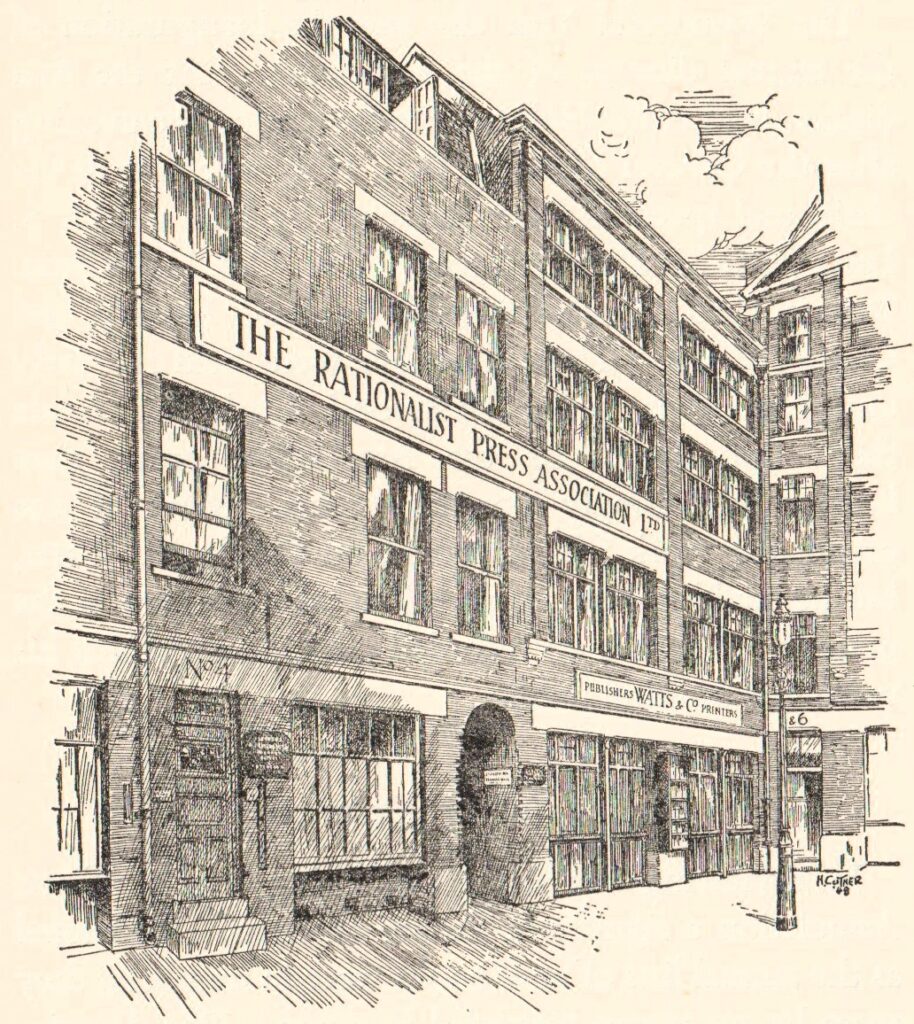
While it may be something of a stretch to suggest that Watts & Co. dominated UK freethought publishing in the twentieth century (and it will certainly not endear me to G.W. Foote & Co., publishers of this magazine!), Watts & Co. certainly published more titles than anybody else. Cooke identifies the importance of the ‘RPA Cheap Reprints’ published between 1902 and 1918, but these were paperbacks printed on paper which browned and became fragile; hence few remain in serviceable condition. The same was not true of the Thinker’s Library, and this may help account for it being remembered as the RPA’s premier series and lasting legacy.
Although several individuals were involved, Frederick Watts (grandson of RPA founder Charles Watts) and Archibald Robertson were key contributors to the Thinker’s Library concept. Cooke notes that sales were helped by Percy R. Chappell, who was Publicity Manager of W.H. Smith as well as being a Director of the RPA. Chappell was always referred to as Dudley Grant in his capacity with the RPA; as Cooke points out, being identified with expressing any form of freethought continued to involve risk in the interwar years.
The books were small hardbacks, 17 x 11 cm, and were first priced at an affordable shilling (5p). They were bound in brown clothette with a grey dustjacket. The covers of the first books in the series featured the author’s name and the book’s title with a brief description of the contents on the dustjacket. Both the front board and dustjacket incorporated a Doric column design, thus referencing the free thought of the ancients. An image of Rodin’s The Thinker featured towards the foot of the cover; what could be more appropriate?
Overall, the books were sturdy, attractive, and printed on good quality paper with a comfortable font size. The design would change several times over the years, driven by changes of fashion and out of necessity, the latter arising, for example, from the imposition of wartime economy standards and paper shortages. However, the dimensions of the volumes remained constant, and The Thinker almost always featured. Doubtless the attractive design was one of the keys to the success of the series. Many readers would have collected all or many titles, and this is evidenced by the manufacture and sale of a special bookcase for storage. Anybody knowing the whereabouts of one should let me know.

Nine titles appeared in the first year, several of which had previously appeared as Cheap Reprints. H.G. Wells authored two of these, First and Last Things (#1 in the series) and A Short History of the World, which was to have the distinction of being the best seller of the series. It sold over 250,000 copies, going through several revisions and impressions.
In the early years, titles were exclusively reprints, some abridged, but with the passage of time, original titles were to feature. The range of topics is demonstrated by the publisher’s grouping of titles under subject headings. These were General Philosophy, Psychology, Anthropology, General Science, Religion, History, Fiction, and Miscellaneous. Adam Gowans Whyte, in his 1949 book The Story of the R.P.A., 1899-1949, quotes comments from the Church of England’s 1945 report, Towards the Conversion of England, as the ultimate, if perverse, tribute to the series:
No evangelism can have wide success against the continual glut of cheap scientific books written on atheistic principles…The little books are regarded as intellectual. We must remedy the situation in which the working man, wishing to learn a little about biology, economics or geology, always finds that the cheapest (or only) literature is by an atheist…We must attack on the enemy’s lines of communication.
It seems strange that such aggressive rhetoric is generally regarded as the province of atheists. Nevertheless, the effusion chimes well with comments once made to me by that stalwart of the freethought movement and former Freethinker editor, Bill McIllroy, who told me that in his opinion no series did more to advance the cause of rationalism in this country than the Thinker’s Library.
Most of the titles have stood the test of time, although those dealing with purely scientific topics have dated in the light of modern research. One embarrassing exception is Sir Arthur Smith Woodward’s The Earliest Englishman (1948) with a foreword by Sir Arthur Keith, which explained and celebrated the discovery of Piltdown Man. Just five years later, after Smith Woodward’s death, Piltdown Man was exposed as an elaborate fraud with concomitant damage to Smith Woodward’s reputation, although he emerged as gullible, not complicit. Copies of The Earliest Englishman are among the most difficult to find.
At the start of this essay, I mentioned that I sourced the final missing volume in my collection from Australia. I would add that the reach of the series is well illustrated by other items in my collection, which feature bookseller’s labels from South Africa, Brazil, New Zealand, Australia, and Canada. Oddly, the USA doesn’t feature. Perhaps this is a coincidence, or perhaps the Thinker’s Library was never marketed there?
There has been some controversy over whether all 140 titles were ever actually marketed. Some suggest that #138, Charles Darwin’s On the Origin of Species (First Edition Reprint), was never published. Incorrect; I have one.
Given its success, one must ask why the series ended and eventually went out of print. Inevitably, some titles, particularly scientific ones, became dated and were superseded. Perhaps with the growth of formal further and higher education, the appetite for self-education declined. Of course, the burgeoning of alternative media to the printed word has played its role. Finally, the growth of societal rationalism, and the decline of cultural resistance to it, has meant that ‘mainstream’ publishers have become inclined to publish rationalist and scientific works wherever they were judged commercially viable. In that sense, the Thinker’s Library was a victim of its own success.
Bill Cooke paid gracious tribute to the series in his book, cited above, and it seems fitting to end with his words:
Looking through the titles of the Thinker’s Library helps dispel the many prejudices about rationalists that have slowly accumulated. Where prejudice sees ‘Victorian rationalism’ and agnosticism we find a hundred years’ worth of varied ideas and outlooks. Where prejudice sees only superficial optimism, we find optimism and deep melancholy. Where prejudice sees dull didacticism we find novels, poetry and light relief. Where prejudice sees uncritical scientism, we find science valued and questioned, as we find mythology valued and questioned. Where prejudice sees stifling conformity to a brutalising reason, we find conflict, pluralism, variety and choice.
Seconded!
Related reading
Books from Bob’s Library #3: Richard Carlile’s ‘The Republican’ and ‘Every Woman’s Book’, by Bob Forder
Richard Carlile, a LOOSE CANNON
Charles Bradlaugh and George Jacob Holyoake: their contrasting reputations as Secularists and Radicals, by Edward Royle
Freethought and birth control: the untold story of a Victorian book depot, by Bob Forder
Why bother with H G Wells in the twenty-first century? By Bill Cooke
Wellspring of spot-on forecasts: a review of ‘H. G. Wells and the Twenty-First Century’ by Bill Cooke, by Nicholas E. Meyer
Priest and Freethinker: The Double Life of Joseph Turmel, by Michael Lloyd-Jones
Joseph McCabe, Emanuel Haldeman-Julius, and ‘The Black International’, by Michael Lloyd-Jones







1 comment
This is a fascinating piece by Bob Forder. The ‘Thinkers Library’ was a diamond-mine of a series and remarkable for its range of topics. It was an international success but its apparent absence from the U.S. may be related to the fact that the radical and freethought publisher Emanuel Haldeman-Julius had already in 1922 used the name ‘Thinker’s Library’ as a marketing device to package an odd assortment of 30 of his Little Blue Books – $1.95 for the set.
Your email address will not be published. Comments are subject to our Community Guidelines. Required fields are marked *
Donate