

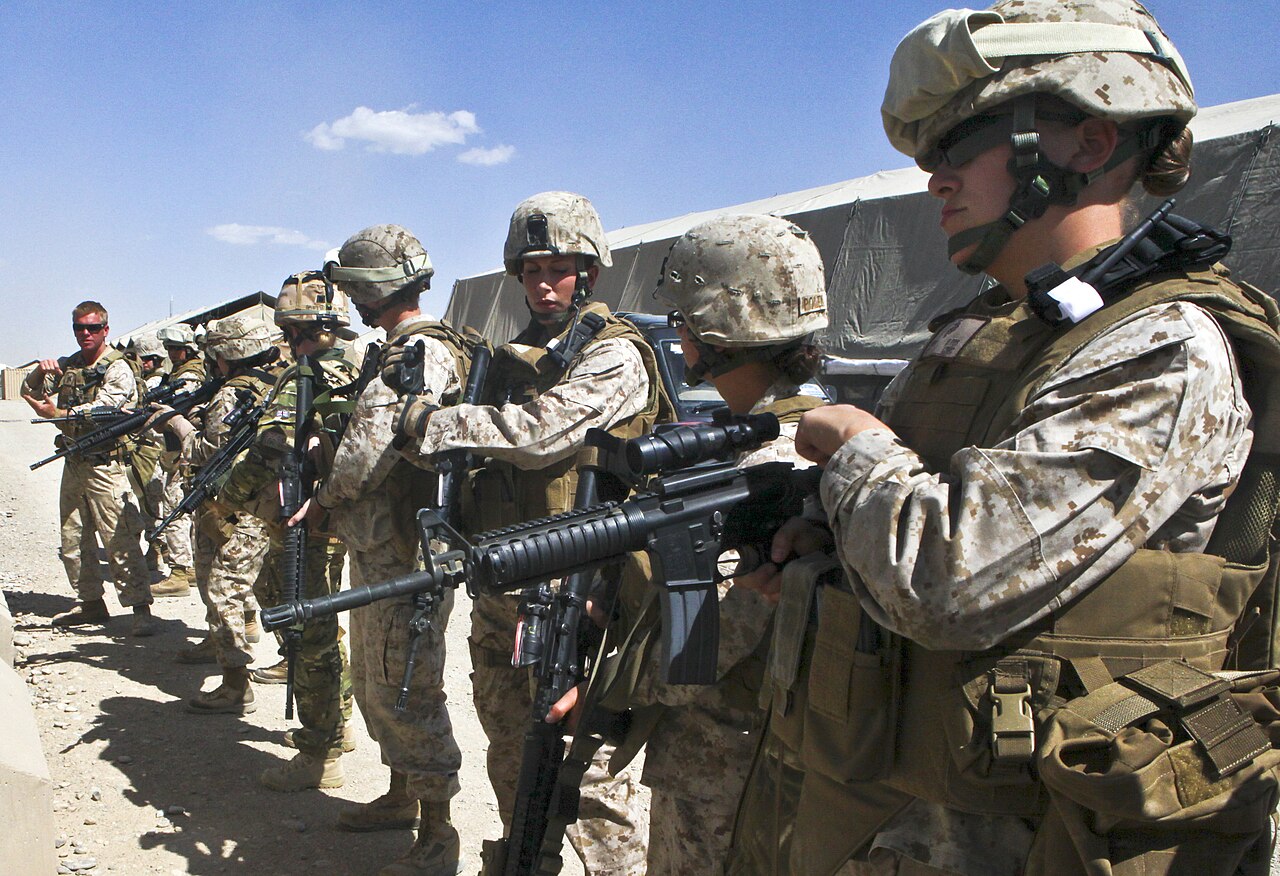
There has long been a debate amongst feminists about whether or not women should even participate in certain patriotic institutions like the military. After all, the military is the primary means of warfare and colonialism for any country, including—and perhaps especially—Britain. How can the emancipation of women from patriarchy or the fight for equal human rights be achieved by aiding and abetting the imperial plunder and rape of foreign nations and peoples?
For example, on 18 October 2023, the UK abstained from a vote on a UN resolution which would have called for ‘humanitarian pauses’ amid Israel’s genocide in Gaza. Given that the IDF is guilty of systematic gender-based violence against Palestinian women and girls, this was particularly galling for feminists. Meanwhile, the resolution was vetoed by—a woman! Specifically, the former US ambassador to the UN, Linda Thomas-Greenfield. Participation in this sort of thing is presumably not what Mary Wollstonecraft had in mind when she wrote to vindicate the rights of women.
On the other hand, one could make the argument that participating in and reforming such institutions is necessary, precisely in order to reduce, perhaps even entirely prevent, such harms. Or at the very least, it might be said that by not reforming such institutions, they are allowed to become dystopian breeding grounds for jingoism, racism, sexism, and violent conceptualisations of manhood. And for better or worse, the idea of reforming institutions has been the dominant modus operandi of many a progressive, liberal, and left movement in Britain and other Western countries for decades. ‘Make the military woke’ could be the catchphrase of such reformers.
Perhaps this is why, in their recruitment strategies, the Ministry of Defence (MOD) has in recent years focused less on ‘God, King, and country’, Dulce et decorum est pro patria mori-style appeals, and instead portrayed the military as a place to improve your mental health, give you self-confidence, provide you with technical and practical skills useful in other professions, etc. In other words, they give benign utilitarian reasons geared toward self-improvement, rather than ideological and emotional ones, for joining the military. One could say that the MOD have started to adopt a ‘woke mindset’ when it comes to recruitment. Which is perhaps progress of a kind. And a feminist case might be made that young women benefit from now being able to access such opportunities, especially if they have few other economic prospects.
One could also legitimately argue from a national security standpoint. Just look to theocratic imperialist irredentist Russia, led by the blood-soaked tyrant and war criminal Vladimir Putin, who believes himself to be the Second Coming of Peter the Great and a pseudo-modern-day Czar. Not to mention the Russian Orthodox Church being a megaphone for all Kremlin propaganda (hardly a surprise; there has never been a dictator in Russian history that the church did not justify or collude with), justifying the genocidal colonisation of Ukraine as a ‘war against Satanism’ in the form of degenerate gay liberalism. Then there is the totalitarian techno-surveillance state of the Chinese Communist Party (CCP) and its murderous dictator Xi Jinping, who are conducting a genocide against the Uyghur Muslims of the Xinjiang province of western China, not to mention the 76-year occupation of Tibet or the routine threats of ‘re-unifying’ democratic Taiwan ‘either peacefully or militarily’ to China under the imperialist One China Policy.
All of these are genuine national security threats, and surely demand mass recruitment of British youth, including women, into the military. However, a recent investigation by Georgia Scott of ITV News sheds some light on why young people, especially women, are not, and maybe should not be, enthusiastic about joining the military.
For many years now, the British military has been a systematically misogynistic institution. And this has created a rape culture within the British military that has left hundreds of lives permanently shattered.
In Scott’s report, various servicewomen provided horrific testimonies of being sexually assaulted by their male colleagues; many of them have had their identities hidden to protect their privacy as well as protect them from reprisal. One woman, under the pseudonym of Abby, recounted being raped at least a dozen times: ‘I’ve been raped by 12 different people multiple times and sexually assaulted. I’ve lost count, honestly.’ From this, we can safely assume the true number was in the high double digits. One assault left her with severe head injuries. And as if all that was not enough, she was slut-shamed afterwards as a ‘slag’ and seen as ‘easy’; putting aside the disgraceful and dehumanising nature of that bile, it helped to increase the incidence of rapes against her. She was treated as a nuisance and ignored by senior officers when she reported being attacked, and they even punished her by refusing to fix the lock on her door—presumably in the knowledge that she would be raped again. Just one of her attackers was convicted in a military court and fired; she eventually gave up reporting her abusers, so shoddy and unresponsive was the military justice system.
Abby’s is just one of many brutal cases. Even when they aren’t assaulted, many women in the military face dehumanisation and bullying. Jen Day was left with traumatic brain injury and PTSD after being injured by a bomb in Iraq. When she returned home to join a parachute regiment, she faced abuse by egotistical male soldiers who defined their manhood solely by being physically stronger than women. Their relentless bullying led to Jen abandoning a career that she loved in disgust.
Most cases never reach a military or civilian criminal court due to institutional insouciance and complicity from senior officers whose job it is to report said crimes up the chain of command. Victims become so fatigued trying to report complaints that they give up altogether until they quit or are discharged with PTSD—not from fighting al-Qaeda or ISIS, but from misogynistic abuse, rape, and institutional denials of justice. Victims are condemned to a life of permanent trauma. Abby said that, after her experiences in the military, ‘I can never trust men really ever again.’
Tony King of the University of Exeter was tasked with performing an audit of the treatment of women in the military in 2022. He interviewed hundreds of soldiers; the MOD didn’t make his report public until 2025. He is featured in Scott’s report. He found that there is, among other things, a phenomenon of ‘door knocking’ late at night. He found that, often after drinking, male soldiers would knock on the doors of women to solicit sex from them in an aggressive manner. In other words, try to rape them. Women were seen as pieces of meat, and their attackers felt entitled to do whatever they wanted to them.
The frequency of such incidents helps to show that there aren’t just a few bad apples; there is a pervasive misogynistic culture, and the fish seems to rot from the head. One woman, ‘Sophia’, told ITV News that a male soldier once knocked on her door and assaulted her when she opened it. Afterwards, she refused to open her door again. On another occasion, when a man knocked and she didn’t answer, he shouted, ‘Why don’t you just [fucking] put out?!’ Nobody intervened, indicating mass awareness of this kind of rape culture as well as mass complicity in it. Much earlier in her career, she recounts that, when she was a teenager, she and some fellow recruits were locked inside a room with an instructor—’a well-known person in the forces’—and prevented from leaving until one of them performed oral sex on him. One girl did so, so that they could escape.
Sophia said that the abuse, if anything, got worse as her career advanced, demonstrating that the victims are not just among the lower ranks and that career advancement is no protection against abusers, who seem to be everywhere in the British military. Abby, Jen, Sophia, and countless other women were (and are) trapped in a culture of systemic bullying, silence, and sexual harassment or worse, in which they were systematically denied justice by senior officers. Constant harassment and assault, followed by a complete lack of accountability, led to many women feeling hopelessness, suffering from survivor’s guilt, and engaging in suicidal ideation.
These are just a few examples from the report and King’s findings. There are many more, and other reports, investigations, and news items corroborate the existence of a systematic, institutionalised misogynist rape culture within our military. Some cases have even led to the suicide of victims abused and then denied justice. To give just one particularly horrifying example, just months after a ‘landmark’ report found that more than half of female assault victims in the military don’t report abuse due to a total lack of trust in the military justice system, 19-year-old Jaysley Beck was sexually assaulted by a superior officer, 39-year-old Michael Webber. This was in July 2021. Not long after, during October-November, another superior officer, Beck’s direct supervisor, Ryan Mason, launched a massive campaign of stalking and harassment against her, sending her nearly 5,000 inappropriate WhatsApp texts in the space of about a month and tracking her constantly.
Beck feared a ‘backlash’ if she reported Webber’s assault, according to a friend, but she bravely reported him anyway—only to be treated with scepticism and disdain. She became so disillusioned with the system that she didn’t even think it was worth reporting Mason. This relentless, psychotic harassment, plus the trauma of Webber’s assault, made Beck fearful and miserable. She suffered from panic attacks. And then, in December, abused and abandoned by the system, she hanged herself.
And how did the military respond? Beck’s mother, Leighann McCready, accused the army of making ‘empty promises to her’. And what happened to the psychopaths who tormented her? After the assault, Webber was made to write a letter of apology to Beck, concluding which he shamelessly concluded with the words, ‘my door will always be open’. He was then promoted. In the end, he received just six months in a civilian prison. He is now a free man.
Mason escaped even this paltry level of ‘justice’. He left the military after Beck’s suicide, was never prosecuted, and is also a free man. As for the superiors who covered up the assault and harassment and who let Beck down so completely, just days ago they were found not guilty by a military court of mishandling the case.
Once more, this was not an isolated incident. Larkhill Camp, where Beck was stationed, was swarming with abusers and full of their victims. Very few victims reported their experiences of assault and harassment, reflecting the total absence of trust in the military justice system. It is hard not to seethe with anger at the horrors meted out to Jaysley Beck by those abominable men and the absolute failure—no, the outright complicity—of the institution she dedicated herself to.
According to the MOD’s own figures, around 12.1% of armed forces members are female as of April 2026, and a November 2025 report found that around two-thirds of them experienced ‘at least one sexualised behaviour in the last 12 months compared to 34% of males.’ Despite making the right noises, little progress has been made by the MOD in combating this behaviour. Perhaps they think that ‘woke’ recruitment adverts are enough to assuage the fury of the public that rape culture has been de facto legalised within their military? Benign and banal ad campaigns are far easier than prosecuting rapists, anyway.
The pathetic platitudes and pitiful promises of politicians and MOD officials offer no help at all to the victims. Thankfully, victims receive some solace elsewhere—from family, friends, and charities like Salute Her UK. Tellingly, and sadly, Salute Her is more in demand than ever; they are contacted, on average, by a new victim each day.
In the ITV report, Emma Norton, a solicitor who has represented many women assaulted in the military and the Director of the Centre for Military Justice, critiques the ‘internal military systems which are not independent, are not staffed with people with the requisite skill or training to deal with people who have experienced sexual violence or sexual harassment.’ Norton says that even the Defence Serious Crime Unit (DCSU), founded in 2022 as a supposedly independent unit to investigate crime within the military, ‘has [often] not worked in practice’, with senior officers attempting to influence ongoing investigations to prejudice the outcome against the victim.
In 2025 there were 85 reports of rape within the military, yet only six of the accused were found guilty. Perhaps you might think that if those 79 other reports were adjudicated and found not to be worth pursuing, or went to trial and the accused were found not guilty, we must simply accept the result. Except that, as we have seen, the process is tainted from the outset, and, what’s more, in military court, the verdict is decided by a board of serving military members rather than a randomly selected 12-person jury. The MOD assures us that there is a detailed process by which conflicts of interest are prevented—but why not avoid the possibility of conflicts of interest completely? Not to mention that the process of secret court proceedings with secret evidence and secret witnesses does not inspire much confidence in the credibility of military court proceedings vis-à-vis public disclosure or accountability. The military effectively investigates itself. Lone victims are set against an entire apparatus of patriarchal solidarity.
Most of the reports of rape, sexual assault, harassment, bullying and misogyny are not necessarily coming from female soldiers from a minority background. Only 12.8% of the military is non-white. It is primarily working-class white women that are being systematically beaten, raped, gang raped, slut shamed as ‘slags’, and denied justice. So where are the right-wing defenders of ‘our women’, so loud when it comes to, for example, rape gangs consisting of Muslim men? Well, military women are being victimised predominantly by white men. This explains why, all the way from Reform to Restore and the Homeland Party, the right has chosen to ignore this issue. They cannot attach a xenophobic, nativist, ethno-nationalist narrative to it, nor can they be seen to be attacking an institution at the very heart of patriotism in this country.
We should also not forget that the military is also systemically racist as well, which explains why it contains so few non-whites. We know this from the ghastly case of Kerry-Ann Knight, the literal poster girl for black female soldiers, who suffered from racist abuse as well as sexual harassment to the point of having to leave the army altogether. When she tried to report the sexual harassment and racism, she was discouraged and stonewalled in reporting the abuse and was actually accused of incompetence and having a mental illness. The Army initially refused to give her financial compensation, and only after public backlash did it do so and issue an official apology to Knight. If she had not had the foresight to take secret recordings of male soldiers threatening to sexually harass her and actually harassing her, as well as threatening to lynch her and put her in a hot box, etc., and if there were no brave colleagues who came forward as witnesses despite the possibility of reprisals affecting their careers, then she would have been left to languish like so many other victims.
Why is there not a bigger outcry against such abuse in the military? From social media comment sections, people seem to be more offended by claims of sexual assault and racism than sexual assault and racism themselves. Too many people are unable to accept evidence which tarnishes the prestige of such patriotic institutions as the military. Their deliberate blindness, and in some cases their complete lack of concern, is pathetically narcissistic. It is also an insult to the victims.
Emma Norton suggests that the armed services complaints process needs to be made independent of those branches of the armed services themselves. Victims demand that there is a systemic culture change starting from the top. If successive governments are serious about inspiring the youth to serve their country and help to defend Britain from the numerous national security threats that we do indeed face, then they must start by admitting the existence of the problem in the first place. Then they must take concrete steps, actioning suggestions and plans like Norton’s.
The 2019 Wigston Review advised the creation of an independent investigative mechanism, a ‘Defence Authority for Culture and Behaviours’, as the MOD simply cannot be trusted to investigate itself. But rather than taking such a step, the only thing the MOD has done to address the issue of systemic rape and sexual assault is to mouth platitudes, make empty promises, issue fig-leaf mea culpas, and engage in smoke-and-mirrors avoidance. None of the Centre for Military Justice’s recommendations has yet been implemented.
Only when this problem is resolved can we even begin to increase recruitment numbers to the level required to, for example, repel a hypothetical Russian invasion of Britain or a Chinese invasion of Taiwan—both more likely geopolitical scenarios than at perhaps any other time in recent history. The institutionalised misogynist rape culture of the British military today should be seen as a direct national security threat in itself, in other words. Perhaps if the plight of the victims is not enough to inspire decisive action, that thought will.
Unless the British military is purged of this infestation of abusers and rapists, and the system that lets them get away with it, the barracks of our nation’s armed forces will continue to be more akin to rape camps than to boot camps.
This article is dedicated to the memory of Jasyley Beck (2002-2021).




Your email address will not be published. Comments are subject to our Community Guidelines. Required fields are marked *
Donate