Jump to Comments
A day late and a dollar short, as the old saying goes. Yes, it is the fifth, rather than the Fourth, of July. But before setting down some reflections on the 250th birthday of the United States of America, I wanted to hear what the current president, simultaneously the most American American and the least American American of all time, had to say.1
Also in my defence, the Fourth could very well have been the Second, for it was actually on 2 July 1776 that the Continental Congress declared that ‘these United Colonies are, and of right ought to be, free and independent States’. On the fourth, the Congress approved the final draft of the Declaration of Independence, and the fourth would, in time, become the Fourth.
No less a figure than John Adams predicted that 2 July would be the immortal date:
The Second Day of July 1776, will be the most memorable Epocha, in the History of America. I am apt to believe that it will be celebrated, by succeeding Generations, as the great anniversary Festival. It ought to be commemorated, as the Day of Deliverance by solemn Acts of Devotion to God Almighty. It ought to be solemnized with Pomp and Parade, with Shews, Games, Sports, Guns, Bells, Bonfires and Illuminations from one End of this Continent to the other from this Time forward forever more.
As I think I recall correctly, my old professor of American history, Frank Cogliano, once said of this prediction that Adams was, as ever, so close to and yet so far from being right. The point remains, though: 4 July 1776 was not predestined to become Independence Day. Various dates both before and after could legitimately have ended up capitalised. Indeed, it was on 5 July 1776 that the Declaration was first printed for dissemination and signing. So one could argue that the Fifth is as valid a date as the Fourth, or any other, to mark the occasion. Such is my defence for this delayed reflection, anyway.
But back to Donald Trump. His speech yesterday was predictably pathetic, bombastic, self-absorbed, and, to use the parliamentary language the president is so fond of, full of shit. Appropriate then, that heatwaves and thunderstorms were the order of the day, for the republic is burning, on the edge of apocalypse. Some choice excerpts:
After 250 years, unlike so many others in the world, in this country we have freedom of speech, freedom of religion, equal justice under the law, although I wasn’t treated that well. But we won’t get into that. (Couldn’t resist, I suppose.)
And as our Declaration of Independence tells us, we are all made in the image of one Almighty God. (It doesn’t say that.)
We rebuilt our military and my first term, we use it a little bit in our actually, I should say third term, but I won’t do that because I don’t want any controversy. (Eloquent as ever.)
Not exactly Jefferson’s First Inaugural or the Gettysburg Address, but who am I to judge? After all, I am a foreigner, and President Trump doesn’t much care for the opinions of foreigners.2 Indeed, critical foreigners are at risk of being denied entry to the States these days (so much for Donald Trump as free speech champion). And this was a speech delivered in a very tired voice by what looks like a very tired old man, so perhaps we ought not to worry too much about those unconstitutional yearnings for a third term or the authoritarian, ‘enemy inside’ asides sprinkled throughout. But no, that would be too easy. As the American politicians Richard Gephardt and Timothy Wirth have recently argued, the US is undergoing a ‘rolling coup’:
Unlike what might be recognized as a coup with tanks in the streets, this is not the seizure of power on a single day but the methodical construction of an apparatus designed to identify, arrest, prosecute, and if necessary forcibly suppress Americans whose only offense is opposition to this administration, by an executive who has openly declared that opposition itself is the enemy.
Why aren’t more Americans seeing this? Because each step has been incremental. Each has been framed in the legitimate-sounding language of national security or law enforcement. Each was paired with a reassuring denial: We are not deploying the military domestically; we are not declaring an emergency over elections; we are not coming for citizens.
Congress, paralyzed and outnumbered, has not mounted a serious institutional response. Some press has reported stories about the pieces but not on the whole dangerous picture.
The first job of any coup is to make the recognition of it seem premature. That is the trap. By the time recognition is no longer premature, the moment to resist has already passed.
This intervention is extraordinary, and terrifying. Read the full thing if you remain sceptical about the claims made by those of us still too often dismissed as suffering from ‘Trump Derangement Syndrome’.
But as I said, I’m a foreigner, so why should I care? What to the foreigner is the Fourth (or Fifth) of July, if it isn’t too presumptuous of me to adapt Frederick Douglass?3 Apart from anything else, what happens in America matters everywhere else because America is so powerful. That would be reason enough for a foreigner to take an interest. But more than that, I am a partisan of the ideals of the American Revolution(s), which have been misunderstood and misrepresented many times over, by the left as well as the right, and by nobody more than Donald Trump and his fans.
I refer, of course, to the ideals of Young, Allen, Paine, Jefferson, Madison, Douglass, Assing, Lincoln, Ingersoll, Debs, Rustin, Baldwin, and so many others: the champions of the secular, democratic, radical America which takes its Enlightenment foundations seriously. That America was founded on radical and atheistic ideals is the alternative, truer narrative than the one most Americans are familiar with. It is certainly truer than the lies of Trump and his ilk that America is a fundamentally ‘Judeo-Christian’ nation, whatever ‘Judeo-Christian’ means.
Thankfully, Trump was lighter than usual on that narrative in his Fourth of July speech, but it was present nonetheless, in all his references to the Almighty, especially in the plainly Christian nationalist line ‘And our destiny is written by God’. To return to a point made above, the Declaration of Independence does not say ‘we are all made in the image of one Almighty God’; a careful reading shows that ‘Nature’s God’ and the rest are, as the philosopher and historian Matthew Stewart might put it, essentially atheistic invocations.
Here, then, is some recommended reading on the radical, atheistic origins of America. Perhaps one or more of these books would make a good gift for any right-wing fundamentalists in your life. Come to think of it, they would also make wonderful gifts for any left-wing haters of America in your life. Both groups misunderstand and despise America, in their own ways, and despite their protestations on one or both counts. Anyway, to the books: The Founding Myth: Why Christian Nationalism is Un-American by Andrew L. Seidel (2019), Nature’s God: The Heretical Origins of the American Republic (2014) and An Emancipation of the Mind: Radical Philosophy, the War Over Slavery, and the Refounding of America (2024), both by the aforementioned Matthew Stewart, and Gordon S. Wood’s classic The Radicalism of the American Revolution (1991). (Though I don’t think Wood appreciated, or would go along with, the ‘atheistic’ aspect of the thesis so much.)4
Then there is the deep, abiding connection between American and British freethinking radicalism, starting with Paine and continuing to the present. G.W. Foote, founder of the Freethinker, was a friend and ally of D.M. Bennett, founder of the American freethought journal The Truth Seeker, both of which are (obviously) still going strong (and still collaborating) today. Please do check out the latest edition of The Truth Seeker, which marks 250 years of Paine’s Common Sense (and thus also of America).
We could do with a bit more of that freethinking, internationalist solidarity in these dark days for the republic—and the world. This Fifth of July, let’s remember the true, or at least the better, America. When I said that Donald Trump is the most American American ever, I meant that pejoratively, for he is the encapsulation of all the worst stereotypes about America: he is crass, and boorish, and ignorant, and ugly, and dangerous. But he is the least American American ever, too, in the best possible way: he knows and feels nothing of the foundational American spirit, which, yes, was marred by slavery and many other moral and political failures, but which was also genuinely radical and emancipatory (and the revolution it effected is still unfinished).
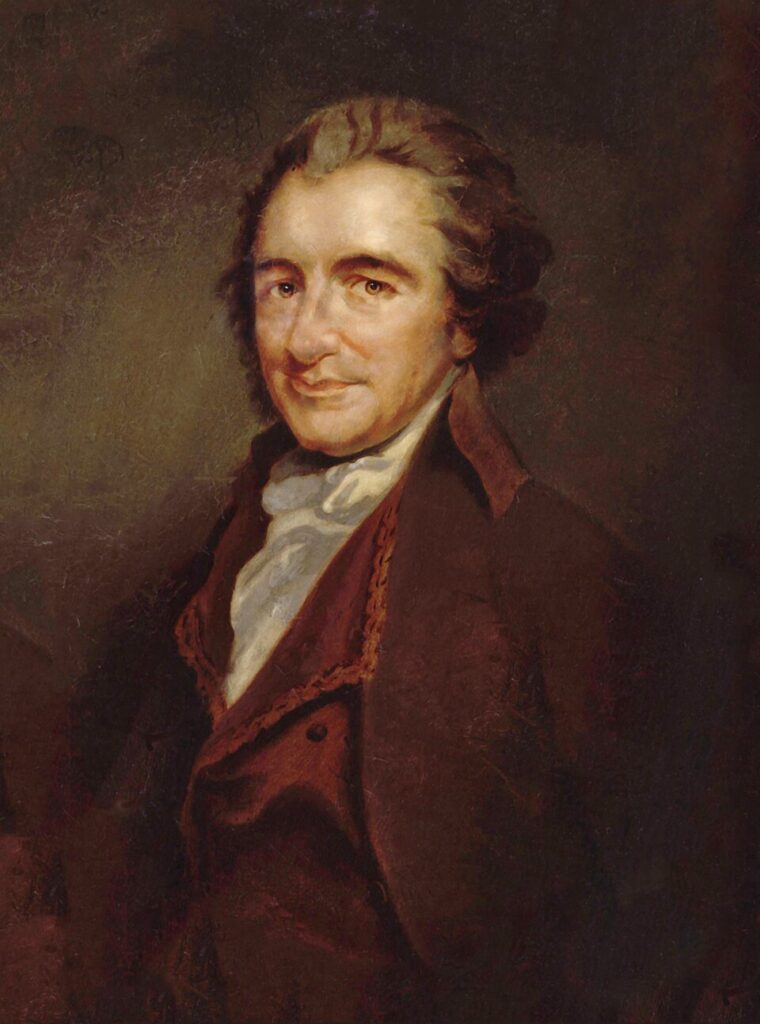
Now is a good time to return to the words of the two great democrats of America’s youth, who never stopped championing the ideals of 1776. I speak, of course, of the two Thomases: Paine and Jefferson.
I have lately been perusing the wonderful new Princeton University Press edition of Paine’s collected writings, a project backed by the equally wonderful Thomas Paine Historical Association. As Scott Cleary, one of the editors, put it during our recent Freethought History Webinar on the project, Paine did not, contrary to the usual narrative, sink into obscurity and drunkenness and illness and oblivion upon his return to America from France in 1802. He continued to take part in the turbulent politics of the young nation, and often used his trusty old quill to defend the legacy of ’76. In 1807, just two years before his death, he wrote:
Men of all nations can unite upon the ground of principle but not of place. The founders of the Republic, the men of 76, created a system of government, the representative system; and whoever is not in allegiance to this system as well in principle and theory, as in form, is a FOREIGNER whether born in America, or in Europe, or in any other part of the Globe.
A nice blast for the universalist spirit of 1776, this. And I don’t think I need to spell out the relevance of these words to some of what I said above.
Not so incidentally, this paragraph comes from a defence of immigrants against those who would, for political reasons, deny them their rights. In the course of this short piece, Paine also says that ‘except the Indians every man in the country is a foreigner or descended from foreign stock’. Paine, one of the founders of Enlightenment modernity, speaks to us still.5
The Fourth of July is the birthday of both America and also the date on which the author of its Declaration of Independence died. Shortly before his death, Thomas Jefferson had to turn down an invitation from the mayor of Washington, D.C., to attend a celebration of the Declaration’s fiftieth anniversary. In what turned out to be his final letter, Jefferson wrote:
May it be to the world, what I believe it will be, (to some parts sooner, to others later, but finally to all,) the signal of arousing men to burst the chains under which monkish ignorance and superstition had persuaded them to bind themselves, and to assume the blessings and security of self-government. That form which we have substituted, restores the free right to the unbounded exercise of reason and freedom of opinion. All eyes are opened, or opening, to the rights of man. The general spread of the light of science has already laid open to every view the palpable truth, that the mass of mankind has not been born with saddles on their backs, nor a favored few booted and spurred, ready to ride them legitimately, by the grace of God. These are grounds of hope for others. For ourselves, let the annual return of this day forever refresh our recollections of these rights, and an undiminished devotion to them.
250 years on, and many, perhaps most, people are still stifled under those monkish chains. They continue to manacle themselves and others. Thus also does Jefferson still speak to us, this Fifth of July.
John Adams died on the same Fourth of July as his old frenemy and successor as president (and latter-day friendly correspondent). His last words were ‘Jefferson still lives’. A salute to a surviving American titan? Irritation at being outlived by his onetime bête noire? Both? Neither? Who knows? In any case, Jefferson did not still live. He had died a few hours earlier, unbeknownst to Adams.
And yet, of course, Jefferson does still live. As does Paine, whose democratic radicalism and open disdain for organised religion Adams detested. With reference to Paine’s anti-Christian classic The Age of Reason, Adams once wrote:
I know not whether any man in the world has had more influence on its inhabitants or affairs or the last thirty years than Tom Paine. There can no severer satyr on the age. For such a mongrel between pig and puppy, begotten by a wild boar on a bitch wolf, never before in any age of the world was suffered by the poltroonery of mankind, to run through such a career of mischief. Call it then the Age of Paine.
One can still smell the sulphur! But the backhanded compliment is telling. Once again, Adams was so close to and yet so far from being right. This is still the age of Paine, Jefferson still lives, and for all of the flaws and the failures of America, the spirit of ’76 is still worthy and still radical. And despite the current counterrevolutionary attempt to suppress, distort, and coopt it, it endures. Yes, after all, the American Revolution is an ongoing concern.
Happy Fifth of July.
- Please note that parts of this article are taken or adapted from an article I have written for a future issue of the excellent American journal Free Inquiry, where I am a senior editor. I highly recommend its latest issue, which celebrates the Fourth of July.
↩︎ - Not even, I suppose, Scottish ones, despite his own Scottish heritage. Certainly, Donald Trump is one of my nation’s worst exports to the world, for which it has my apologies.
↩︎ - Douglass’s famous Fourth of July speech was delivered on the fifth—so that’s another defence for my own tardiness!
↩︎ - See also my interview with Stewart and our Freethought History Webinar of 5 July 2026 in which he was the guest speaker. And here’s a good quote from Nature’s God while we’re at it: ‘America’s resurgent Christian nationalists do not merely misread the American Revolution, I think; they betray it.’ That was written in 2014, remember. Stewart’s books on America are ones I can’t recommend enough. They are deeply researched and beautifully written, and they trace the influence of Epicurean radicalism and atheism upon the American revolutionaries by way of Giordano Bruno, Spinoza, John Toland, the Earl of Shaftesbury, and many others.
America enacted and radicalised this ancient countercultural tradition, and, as Stewart writes, this is a tradition that has faced counterrevolutionary attacks ever since, from the slavers of the nineteenth century through the architects of Jim Crow and the anti-liberal moral crusaders of today—all of whom were and are largely faith-based, so to speak. Trump(ism) and the rest are just the latest manifestations of what can correctly be called this very un-American spirit.
One even more extreme example suffices: the Christian fascist Nick Fuentes is on record as praising the Taliban for its adherence to strict religious values. Certain wings of the American right are, to greater or lesser extents, and sometimes implicitly, sometimes explicitly, hostile to the Enlightenment origins of their nation. And Fuentes’s perverse ecumenicism is not, despite appearances, a contradiction. Nor is it new. Remember how the world’s faith leaders united to condemn Salman Rushdie in 1989?
↩︎ - Also included in the Princeton edition is a letter the editors believe Paine sent to Jefferson in 1808, in which he attacked slavery to the slaveowner’s face, referenced the anti-slavery passages written by Jefferson for inclusion in the Declaration of Independence and later excised, and which, say the editors, ‘marks the first American call for reparations’. Allow me to also recommend Matt Johnson’s excellent essay for Quillette about Paine and the American revolutionary tradition.
↩︎
Related reading
The Fourth of July and the Battle for America’s Soul, by Daniel James Sharp
Review: Jonathan Rauch, ‘Cross Purposes: Christianity’s Broken Bargain With Democracy’, by Patrick Seamus McGhee
US feeling cross: a review of ‘Cross Purposes’ by Jonathan Rauch, by Nicholas E. Meyer
What Would Hitchens Think? by Zwan Mahmod
A Republic on Fire: ICE’s Reign of Terror, by Ron Fischer
Donald Trump, Christianity, and the need to write better stories, by Adam Davidson-Harden
The White House’s ‘Banger Memes’ Are Damaging Democracy, by Matilda Gladwell
The Conspiracy Zone, by Paul Fitzgerald
The assassination of Charlie Kirk, by Fariborz Pooya
How Trump will reshape America’s global role in his image, by Matt Johnson
The end of American idealism, by Matt Johnson
American democracy will soon turn 250. Freethought can reinvigorate it. By Patrick Seamus McGhee
The radical atheism of the American revolutions: interview with Matthew Stewart, by Daniel James Sharp
Donald Trump is an existential threat to American democracy, by Jonathan Church
Donald Trump, political violence, and the future of America, by Daniel James Sharp
White Christian Nationalism is rising in America. Separation of church and state is the antidote. By Rachel Laser
The Left-Liberal Tradition: Or, How Liberalism and Socialism Can be Allies, by Matt McManus
Robert G. Ingersoll: The Great Forgotten Orator of Reason and Liberty, by Tom Malone
US Election 2024: Yet Another Farcical and Costly Contest, by Zwan Mahmod
US Election 2024: On ‘Lesser Evilism’, by Ralph Leonard
‘Project 2025 is about accelerating the demise of a functioning democracy’: interview with US Representative Jared Huffman, by Daniel James Sharp
Books From Bob’s Library #1: Introduction and Thomas Paine’s ‘The Age of Reason’, by Bob Forder
Books from Bob’s Library #2: Thomas Paine’s ‘Rights of Man’, by Bob Forder
The rhythm of Tom Paine’s bones, by Eoin Carter
Faith Watch, February 2024, by Daniel James Sharp
Faith Watch, March 2024, by Daniel James Sharp
Christopher Hitchens and the long afterlife of Thomas Paine, by Daniel James Sharp
Introducing ‘Paine: A Fantastical Visual Biography’, by Polyp, by Paul Fitzgerald
Reproductive freedom is religious freedom, by Andrew Seidel and Rachel Laser
Secular conservatives? If only…, by Jacques Berlinerblau
Image of the week: ‘The world is my country, to do good my religion!’, by Bob Forder
The Antisemitism Awareness Act will mean the demise of free speech in America, by Kunwar Khuldune Shahid
Satan Will See You in Court: A Florida Battle for Religious Freedom, by T. ‘Chaz’ Stevens
Is Democracy Overrated? The Vacuity of Curtis Yarvin and His ‘Dark Elves’, by Jonathan Church
Against the ‘New Theism’, by Daniel James Sharp
Can the ‘New Theists’ save the West? by Matt Johnson
Two types of ‘assimilation’: the US and China, by Grayson Slover
What has Christianity to do with Western values? by Nick Cohen
Image of the week: ‘Trumpburster’, by Paul Fitzgerald
Image of the week: ‘Top Trumps’, by Paul Fitzgerald
Can Christianity Save Atheism? On Žižek’s Christian Atheism Cringe, by Ralph Leonard
Escaping Ideology with Jonathan Church: Freethinker editor Daniel James Sharp in conversation
Image of the week: The Scopes Monkey Trial of 1925, by Daniel James Sharp