

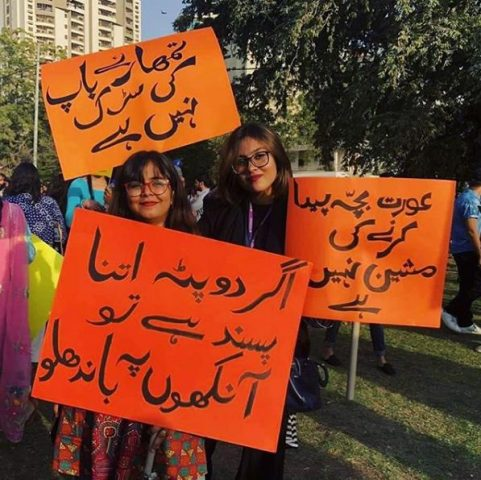
In Pakistan, Aurat March (Women’s March) takes place each year on International Women’s Day (8 March) in the country’s most prominent cities, such as Islamabad, Lahore, and Karachi. This annual feminist socio-political demonstration calls for the complete emancipation of all women residing in Pakistan facing injustices and oppression in every form they manifest. Infamous for its confrontational stances on topics such as patriarchy and the deep-rooted misogyny in Pakistani culture, it has forced people to break the pervasive silence on hitherto unspoken matters, such as marital rape, forced conversions, underage marriages, paedophilia, religious extremism, and domestic violence.
Aurat March has had a huge impact on Pakistani society and has been controversial since its inception in 2018. Many see it as akin to something out of a Thucydides Trap: a phenomenon that will upend the established order. Pakistan is incredibly hostile towards women and gender minorities, and the general populace, whose morality and self-identity are rooted in fundamentalist interpretations of religion, is not keen on listening to voices differing from the patriarchal mainstream on these issues. The clergy and the conservatives, wary of being trampled over by a mounting tide of young feminists, instinctively resist any questioning of the gendered order decided by them for the whole country.
Thus, every year, as the days pass with quick succession and 8 March draws nearer, Pakistani social media brims with the buzz of bigots’ bedlam. Men, infuriated by the insouciant mockery of traditional socio-religious roles, and women, taking offence to the ‘sanctity of womanhood’ being attacked as ‘oppressive’, taunt the feminist activists who dare to resist patriarchy. Photos of protest placards with unconventional slogans become a hot topic on X/Twitter, and the arguments rumble on as the day approaches.
***
I am a female high school student in Pakistan, and this year would have been my first time participating in Aurat March. After weeks of trying to convince my mother to let me march, she finally agreed. It was an hour-long drive from my house to the location where the march was going to be held, and because my mother had to run a few errands before she dropped me off at the march, we left home early. The march was due to commence at 1 pm, but it was, unfortunately, almost 2 pm by the time we arrived, and there was not a single protestor in sight. I got out of the car, and I caught a glimpse of a group of women staring at me. I decided to approach them, and before I could get past the customary greetings, they told me that they were there for the Aurat March and asked me whether I was a protester as well. I told them I was.
As they were talking, I began feeling like something was amiss. Normally, people would bring banners and posters with them to the march, but none of the six women surrounding me had a single one. Wary, I slowly turned around and began walking back towards the car. I noticed from the corner of my eye that the women began trailing behind me. The moment one of them grabbed me, panic surged through me, and I called out to my mother, but by then it was too late. I could feel her fingernails clawing into my skin as she pulled me towards a van where other protestors had been detained. They all had the most solemn expressions on their faces and sat tensely on the narrow benches with their arms crossed in front of their chests.
My mother had remained seated in the car while I approached the group of women. The undercover police personnel forced open the car door and hauled her out. The vehicle was unlocked, with all four of its windows rolled down, and she was given no opportunity to secure her own car. She repeatedly tried to explain that she had committed no offence, that she had no criminal intentions whatsoever, and that she was only present because she had accompanied me, her daughter, to the march. She pleaded with them to allow her, at the very least, to lock her car before being taken away.
All of this was futile. The police searched her and the car and took her car keys, her phone, and my digital camera into their possession. When she was brought into the van, she was visibly distressed, and the woman sitting beside her patted her back in consolation. A female cop came inside, asked whether any of us had a phone on us, and stated that if we ‘knew what was best for us’, we should do exactly as instructed. Soon she realised that none of us had a phone on us, so after lingering for a few moments, she left. Some time later, two more women were put in with us, one of whom was very visibly pregnant.
One after the other, we introduced ourselves and began talking, trying to understand what was going on. The elderly woman introduced herself as Rukhsana Rasheed and told us she was a senior feminist activist, a member of Women’s Action Forum who had been involved in feminist work for many decades. She gave us a breakdown of the whole situation and what we could expect from the authorities if we were to be interrogated. Two people began sobbing.
A woman, who told us she was 21, said that she had arrived at 12:15, way before the march was scheduled to begin, and she had been all alone when police officers surrounded her. She said the cops had pulled her by the hair and struck her with batons before taking her into custody. Another detainee, a student affiliated with the Islamabad-Rawalpindi chapter of the Progressive Students Federation, recounted how she had been grabbed by her clothing and dragged all the way to the prisoner van. When she attempted to resist, she too was beaten with batons.
Suddenly the van began moving. It took a few quick turns and then drove straight ahead. It stopped for a minute and we stood up from the seat to look out from the little barred window for any hints as to where we could be. The first time we saw nothing. The next time the van stopped, we saw a church in what seemed like a barren plot of land. The next again time, we had arrived at our destination: G-7 Women’s Prison.
The cops tried to grab our arms and take us inside, but Ms Rukhsana told us all to hold hands and form a chain and enter together. The cops made fun of her and tried to get us to break away, but we wouldn’t let go. The cops led us inside, into a dimly lit corridor. On the left side were two ‘lock up’ rooms where other protesters had been detained, alongside Afghan refugees and beggars. As we were put into one of these rooms, the protesters inside began yelling, ‘Do not come inside, no matter what. Leave immediately!’ But the cops had already locked the door.
The Senior House Officer entered the room soon after and yelled at the cops to body search us—and if there was resistance, they were to tear off our clothes and parade us outside, completely bare. My mother tried to calm the officer down, but she shouted at her to shut up, so my mother went silent. We were cornered and had to go through the full body search. I was the first one they finished searching and was sent back to the front of the room.
A protester, whom I later learned was named Shabana, asked how old I was, and I told her I was 16. The girl next to me, from the Progressive Students Federation, said she was 17. Shabana became furious and shouted at the cops that she would not allow minors to be detained here under any circumstances. After the searches were finished, one of the cops opened the door to send us further into the prison, but the organisers and volunteers formed a human wall to prevent us from entering. The cops managed to break them apart and closed the door after we were thrown inside a cell.
The cell had a horrible stench. The floor was marred with suspicious stains in hues of bright vermillion and various shades of brown. It was a small room, into which were bundled about 40 people when I arrived. The doorless bathroom had no running water and no soap. Just outside the bathroom was a dustbin overflowing with garbage, and you could hear the buzz of flies and other insects buzzing as they whirred their tiny wings, flitting through the cell, circling the dustbin and the bathroom entrance.
We confronted the cops about their abusive behaviour towards us thus far. The skin near the corners of their mouths went taut, and they smiled in glee as all sorts of insults and taunts rolled off their tongues.‘Is this the freedom you always marched for, the freedom to stay in prisons? We will show you what true freedom feels like’. Outraged, we all stood up and chanted feminist slogans at the top of our voices. We sang revolutionary songs and recited the poems of Faiz Ahmad Faiz, a prominent leftist poet of the post-partition era. Resisting like this helped us to stay in high spirits.
During our time there, we also talked about the political landscape of Pakistan with regards to human rights and freedom of speech, what it meant for us, as progressive-minded folks, to live under a brutal theocracy, and what the future of resistance might look like. Detention for protesting was a tough situation to find myself in, but the people I was imprisoned with made the experience tolerable. We would listen to one another, comfort each other, tell one another that things would be alright and that there was nothing to be worried about.
With the organisers was a lawyer, who told us she had come to the prison as the legal representative of her client, Ms Tahira Abdullah, who is a very prominent human rights activist in Pakistan, but that the cops had incarcerated her as well, despite seeing her lawyer and national identity cards. Many others who had not even gone to march had also been imprisoned. These were the family members of imprisoned protesters and organisers who had wanted to see whether their loved ones were alright but got caught up in the mess themselves.
It wasn’t long after we were thrown into the cell that the media began arriving. A journalist entered the corridor in which our cell was located, and we sighed in relief. The journalist’s phone rang, and when she answered it, the Senior House Officer screamed in anger that she had a phone on her. They pinned the journalist’s arms and pulled at her hair before dragging her out. We were all taken aback and began booing the cops in frustration. The cops kept on bringing more and more people into the cell, and soon there were around 80 people inside, mostly protestors, with some Afghan refugees and beggars.
The way the cops treated the latter was nothing short of dehumanising, and seeing the innocent child beggars choking on their sobs as they languished on the squalid floors of that deplorable cell made the situation all the more heartbreaking. I talked to a few of these children, and they told me their tales of having what little money they had earned throughout the day being stolen from them when they were taken by the police. The police looted poverty-ridden children, they told me—rummaged through their clothes and pocketed every single penny with their pudgy fingers.
You would think these children would be in distress. Surely they, the oldest of whom couldn’t have been a day over 8, far away from their parents inside a small cell with strangers, would be perched somewhere in the far corner of the cell with their heads in their hands, consumed by worry. But no. They were teeming with such joy! They spoke of being safe from the torrid heat of the sun, of sleeping under a fan, of having timely suppers, and of having a place to rest, no matter how temporarily.
There was not enough room for everyone to sit down, and there came a time when it was too hard to breathe, almost to the point of suffocation. As the hours wore on and the number of occupants under the corrugated roofing increased, the air in the cell acquired this foul, putrid quality and grew heavier. It became harder to draw a steady breath with each passing minute, until people were reduced to drawing breath in small, shallow pulls against the heat and suffocation.
Pregnant women and exhausted protesters began to look visibly ill in the crush and leaned against the stained masonry or crouched along the skirting beneath the grilles. Some were fighting the swelling waves of nausea, others said the room had begun to spin around them as they struggled to catch a full breath. We hammered the iron lattice of the cell door again and again with our fists to attract the attention of the cops standing outside in the corridor—to no avail. It was only after one protester began screaming that a pregnant woman was struggling to breathe and would collapse if she were not taken out that the officers finally unlocked the door and allowed her to take a brief walk through the premises before ushering her, almost immediately, back into the same crammed cell.
The hours went by very slowly, and by the time night rolled in, a lot of the protesters were depleted of all energy and just patiently waited for news of what was to come next. Around 10 pm, an official informed us that we had to make a pledge before we would be released. We, the protesters, rose to our feet and voiced our opposition, but the Aurat March organisers urged us to prioritise our safety, sign the pledge, and get it over with so we could go home. So, one after another, we were called outside, and taken to a room where we had to sign a paper that stated that we had incited the police into action by our unruly conduct, and that by violating Section 144—a legal provision that, when activated, as it had been, barred citizens from organising or joining any gathering of four or more individuals, including demonstrations and protests in the city—we had committed a grave offense.
I asked them why I was being made to sign this when I hadn’t even had the chance to take part in the march, but I received no response. It is important to note that even though I went to Islamabad to attend the protest, I, and others, had not breached Section 144 since we were arrested individually and not in clusters. No protester had quarrelled or attacked the police, nor had they incited others to act violently at any time before, during, or after being arrested. In short, the officers’ invocation of the law was based on complete fabrication. (Later, Aurat organisers were to ask the Human Rights Commission of Pakistan to investigate this matter.)
My mother urged me to hurry, and after it was over, we were released. We called a taxi to take us back to our car and then drove back home in silence.
***
The state’s present hostility toward the Aurat March should not be mistaken for a sudden excess of authority or an unfortunate lapse in democratic practice. It belongs, rather plainly, to a lineage of control that has shaped Pakistan’s political life for decades. General Zia-ul-Haq’s brutal military regime introduced the Hudood Ordinances in 1979. These, which, among other things, Islamised the law around women’s rights to their detriment, are widely regarded as one of the gravest attacks on the autonomy of women in contemporary Pakistani history.
It was in response to these that progressive, feminist collectives of activists and poets such as Women’s Action Forum took to the streets of Lahore in 1983 in protest. Their resistance was met with tear gas, and they were beaten with police batons—and they too were charged under Section 144. Unfortunately, despite some changes in the law since 1979, the position of women in Pakistani society has not improved.
Amidst such brutalities, women artists, poets, and activists were not deterred and continued to organise resistance against the military junta. Such resistance, before, during, and after the Zia regime, resulted in the penning of some excellent resistance poetry, such as Hum Gunahgar Auratain (We Sinful Women) by Kishwar Nahid and Chadar aur Char Diwari (The Veil and the Four Walls) by Fahmida Riaz.
The present reliance on Section 144 to justify arrests and dispersals carries an unmistakable semblance to the methods once employed under martial law.But self-expression is the absolute manifestation of human intelligence. Because we are defined by our thoughts, the ability to articulate them through language and speech is inseparable from our humanity. The right to speak one’s mind is therefore not a subsidiary freedom but the progenitor of all others, including freedom of religion, conscience, and belief, and the right to political participation.
Theocracies and authoritarian regimes like Pakistan have a history of punishing freethinkers and dissenters who voice opinions that do not align with the stances of the general populace and the establishment. They use censorship, violence, and social reprisal to silence these opinions. Such suppression leads to a halt in societal progression and results in a homogenous political and cultural sphere with no diversity or varying perspectives.
There is no justification for a democratic state, which Pakistan purports to be, to curtail the rights of its citizens to assembly. Where the dictatorship guised its oppressive rule under the rhetoric of morality, the contemporary state prefers to utilise the more legalistic jargon of ‘public order’, ‘security’, and ‘protocol’. The ostensibly objective language used by cool, considerate men holding key authority positions may, on the surface, appear to be a manifestation of paternalistic concern, yet the sophisticated polish does little to conceal the familiar objective of silencing all forms of dissent, often violently.
Pakistan’s political transformations have altered the outward form of authority far more than its authoritarian instincts. The marching woman unsettles these instincts not because she threatens disorder, but because she refuses the quiet compliance upon which so much of the sociopolitical arrangement still depends. Seen in that light, our brief detention was another moment in a protracted struggle in which women have insisted, again and again, that citizenship cannot be rationed according to gender and that a voice raised in protest cannot forever be treated as an illegitimate disturbance to the natural order of things.
Related reading
From the streets to social change: examining the evolution of Pakistan’s Aurat March, by Tehreem Azeem
A True Reflection of Pakistan: Review of ‘Paying the Price’, by Muneeb Qadir, by Sonia Nigar
Trampled Rights: The Tragic Stories Behind Blasphemy-Related Killings in Pakistan, by Shaukat Korai
The evils of feudalism in Pakistan: a personal and political narrative, by Malik Ramzan Isra
The Galileo of Pakistan? Interview with Professor Sher Ali, by Ehtesham Hassan
How the persecution of Ahmadis undermines democracy in Pakistan, by Ayaz Brohi
Surviving Ramadan: An ex-Muslim’s journey in Pakistan’s religious landscape, by Azad
Coerced faith: the battle against forced conversions in Pakistan’s Dalit community, by Shaukat Korai
Breaking the silence: Pakistani ex-Muslims find a voice on social media, by Tehreem Azeem
Is Modi India’s Zia-ul-Haq? A Clear Warning from Pakistan to India, by Ethesham Hassan






14 comments
This is devastating. No one should have to fear being detained for peacefully expressing themselves. Your courage to stand up for what you believe in and then speak about it is so inspiring. I wish everyone involved strength and safety. 🤍
This way of treating people for protesting for their rights is appalling. Women and girls get imprisoned for protesting for their rights while actual criminals walk free and even hold high positions in government. If Pakistan wants to succeed as a country, it has to stop treating social progress as a threat. Otherwise, it will just preserve the worst and most harmful social norms for future generations while the good things will be lost go time.
I did NOT know this happened and I live near aurat march route. I naively thought they just had a small amount of marchers this time
Learning about the state of women’s right and the level which both government and society will stoop down to has been shocking.
What is it that men in Pakistan are so afraid of? Is a woman wishing to be treated with respect and dignity such a threat to them that they see it fit to respond with violence? What about the women, the ones who entrapped the protestors, the one who protect their “moral values”? What is it about that status quo that makes it worth holding on to so dearly?
Maybe one day Pakistanis will realize that if they granted everyone the same rights, treated everyone with respect and dignity, then everyone could have a better life. Unfortunately they are not even short-sighted – they are blindfolded by religion, tapping in the dark, not seeing the miserable state of the room they are in and lulling themselves to comfort with this opiate.
To you, dear reader of this comment, I say this:
If you feel attacked or insulted by this, maybe take a deep look at yourself and consider the reason.
If you agree with me, then talk about this with other people; if you are a man, be a good role model and don’t let other men mistreat women; and if you are in Pakistan, perhaps support the next Aurat March.
This is horrible! Nobody should be put through hell like this for simply protesting peacefully. Nothing is ever done to combat actual horrifying crimes in the country, but a peaceful protest makes these officials and those in power seethe?
Horrifying. It is truly disheartening to see that peaceful protests receive such an unfair reaction by the police while actual crimes go ignored, the same ones that are being protested against that they could actually focus on!
Meeting peaceful protest for rights with violence should be a criminal act itself. What a horrible and humiliating display from the police, protecting the wrong people and persecuting people who desire to be granted their human rights. You’re incredibly strong and brave for your journey. Hopefully the protests help steer Pakistan to a better direction for the future.
This is so scary! This tells the horrors that women go through in Pakistan. They dont care about cases like rape, murder, abuse etc but when people peacefully protest they get so violent. Thank you aleah for raising your voice.
The way they treat peaceful protesters is actually sickening
Keel it up comrade! Fuck the police #ACAB
Thank you Soo much for writing this article,I am amazed by your courage and guts for participating and writing about the miserable reality of prisons,this article was heartbreaking genuinely.
The fact this happened is not surprising, since the inception of this country women have been subjugated and the moment they speak up they get brutalised. For a country that prides itself in the respect it supposedly gives to women, it sure does beat down hard on any woman who strays to far from her expected position in society. You are incredibly brave for this! and more power to you
This is horrible and inhumane. You’re incredibly strong to have endured all of that. I’m glad you made it out of that horrible situation and thank you for sharing it with us.
Realising something is amiss in that situation, the horror strikes you and then its too late. Imagine being so threatened by women and children that you do this. Taking money from children? Keeping pregnant women in horrible conditions? Threatening to parade you around naked? Anywhere else, this would be grounds for suing. It is so impressive that you all didn’t lose your nerve and didnt let those people feel like they won when you refused to stay silenced and started chanting.
Your email address will not be published. Comments are subject to our Community Guidelines. Required fields are marked *
Donate