

This is an edited version of a piece by National Secular Society (NSS) President Keith Porteous Wood which was originally published on the website of the NSS on 9 July 2025. It has also been updated to include developments involving the archbishop of York and Sarah Mullally becoming archbishop of Canterbury. It is republished with the NSS’s permission, but its current form is the responsibility of the author and the Freethinker only.
With the recent confirmation of Justin Welby’s successor as archbishop of Canterbury, now seems a good time to look back at his shameful record on child abuse in the Church of England.
It was probably too much to expect that Welby could resist any attempt to redeem himself and reinforce the impression that he was hard done by in being forced to resign in January 2025.
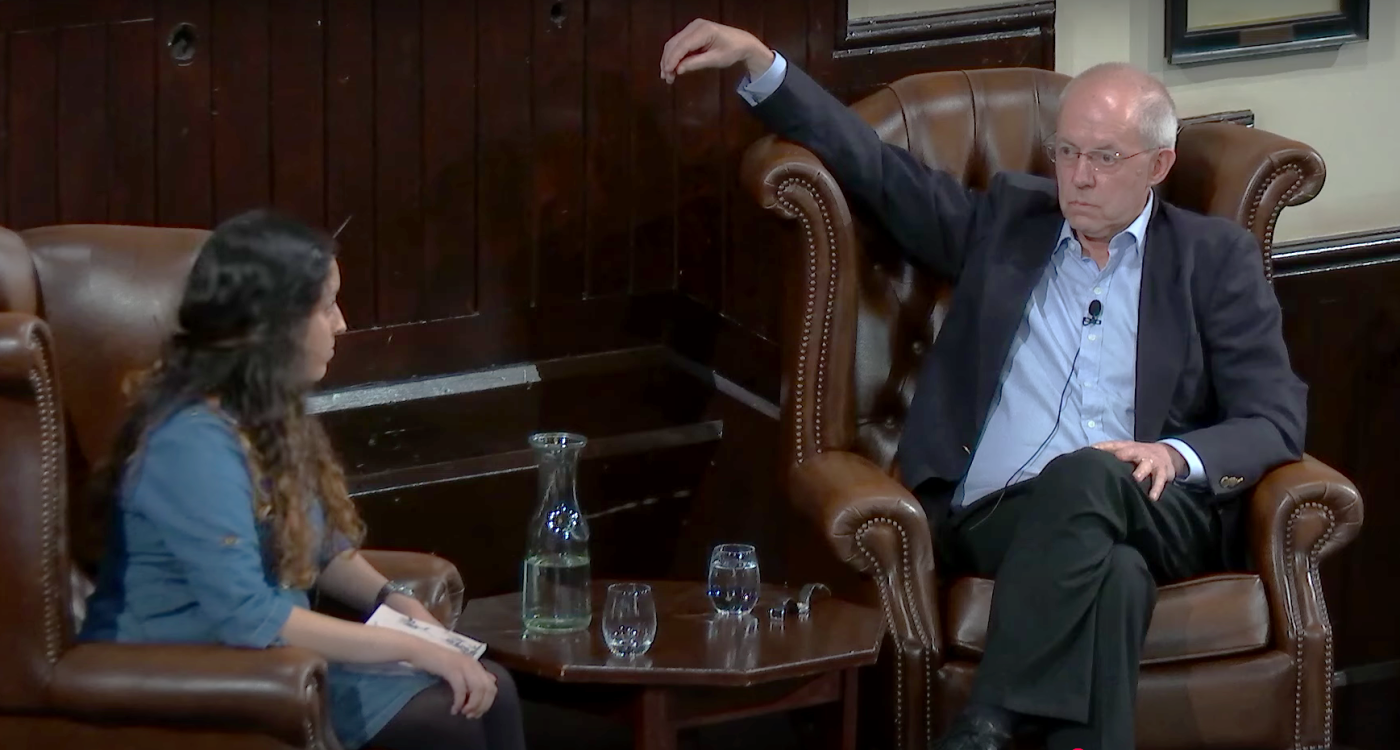
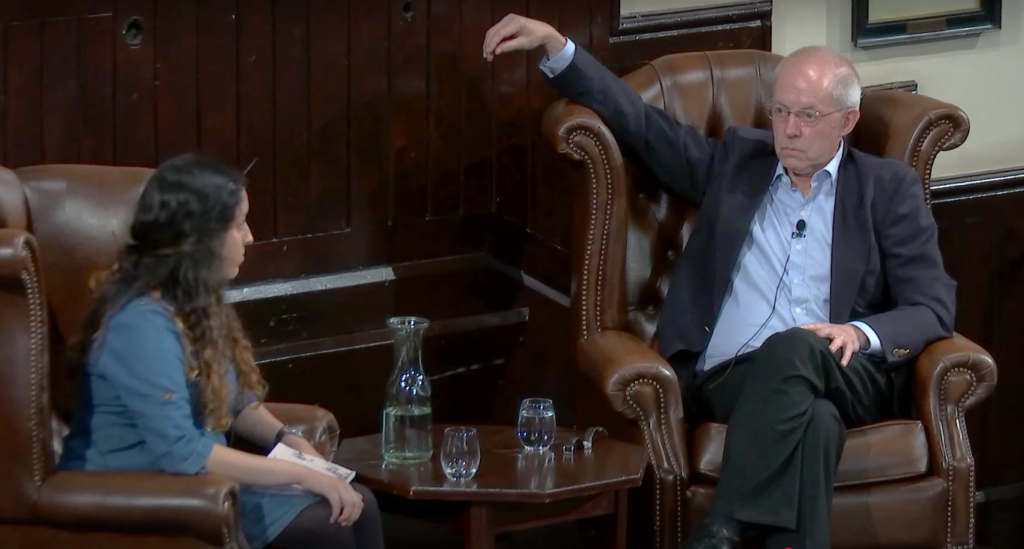
But that seems to be the tenor of what he said last year during a talk (pictured) at Cambridge Union.
As a reminder, Welby’s resignation was prompted by the hugely damning Makin report into the Church of England’s handling of the ‘prolific, brutal and horrific’ child abuse perpetrated by lay reader John Smyth, which was ‘covered up’.
But when asked by the interviewer at Cambridge Union about the report’s assertion that Smyth ‘could and should’ have been formally reported to the police to bring about justice sooner, Welby said: ‘Makin is wrong in that’.
Claiming, as Welby did, that the Makin report was ‘wrong’ on one point does not mean it wasn’t substantially correct. It is unlikely to have been published without Welby having the opportunity to make corrections to errors of fact before its publication. It is true that evidence has subsequently emerged that the police had asked the Church not to investigate to avoid prejudicing their investigation, but curiously the police didn’t seem to have done anything very much at all.
It is not to Welby’s credit that he then did nothing to follow up the apparent lack of investigation of such an important matter, and then trivialised these failings as a ‘lack of curiosity’. For such a huge issue to be abandoned was clearly in the Church’s interest and saved Welby a great deal of embarrassment.
The irony is that while it was the Makin report that led to the first resignation of an archbishop of Canterbury for around a thousand years, there were so many more perpetrators than Smyth, practically all of whom escaped justice because of the Church’s failures. As Welby has admitted, he was ‘overwhelmed’ by the scale of the problem.
For a dozen years Welby presided over a system as an adjudicator by deciding to take no further action on disciplinary complaints about bishops’ multiple failures to respond to the grievances of victims, or against those failing to report active abusers among the clergy to the police or prosecuting authorities. Those failures enabled such abuse to continue.
Having kept a close eye on this topic for over 15 years, I cannot think of an example of the Church having voluntarily gone to the police to report abuse. It seems the established Church has been prepared for decades to tolerate criminal activity on a large scale within its ranks.
Returning to the curious case of Welby’s long silence on Smyth, Canon Ruston of Cambridge (in whose house Welby lodged for some time) prepared a damning report on Smyth in 1982. Eight recipients are listed. One at least admits having received the report but never having opened it, clearly having a good idea of the horrors it contained, and I understand these were widely known in evangelical circles. The evangelical Welby, however, claims he had no clue about the abuse.
Nor, during his years as a dormitory officer at the evangelical Iwerne Trust camps where Smyth abused numerous children, did he guess what his friend Smyth had done. The unexplained banishment of his friend Smyth to Africa by Welby’s evangelical colleagues, who bankrolled Smyth’s departure and financed Smyth’s camps in Zimbabwe (where he continued to abuse children), also apparently didn’t raise suspicion in Welby’s mind. (Incidentally, Smyth was the barrister who helped Mary Whitehouse in her private blasphemy prosecution of Gay News in 1976. Religious hypocrisy—an old tale.)
There was a further report in 1993 about Smyth’s activities in Africa, which came to similar conclusions as the Ruston report. Smyth was forced by the Zimbabwean authorities to leave the country.
Makin’s review concludes that, on the balance of probabilities, it is ‘unlikely that Justin Welby would have had no knowledge of the concerns’. No journalist or survivor I have spoken to can understand how Welby could not have known. However, when more evidence of Smyth’s abuse emerged in 2013, Welby would have been in a much better position than anyone else to understand its significance.
The Smyth case is the most notorious Anglican one, but it is far from isolated. One of the worst involved former bishop of Gloucester Peter Ball, who abused a multitude of vulnerable young men for years yet evaded prison for decades.
Under the stewardship of the then archbishop of Canterbury George Carey, the Church withheld information and put pressure on the police and the Crown Prosecution Service not to act. Ball had been cautioned after admitting to gross indecency in 1993 against 16-year-old trainee monk Neil Todd. He resigned but was allowed to continue working in churches until 2010. It was only after years of persistent work from victims that Ball was sentenced in 2015 to nearly four years’ imprisonment, aged 83. Todd committed suicide, I understand unable to cope with the investigation and trial.
Yet another horrific example, partly on Welby’s watch, concerns Matthew Ineson. In frustration at the Church’s failure to take appropriate action when he reported being repeatedly raped by a priest, Ineson had to take it upon himself to report the abuse to the police, which ultimately led to the alleged perpetrator’s suicide. That should not have been an additional burden on Ineson’s shoulders, especially as the Church knew of the alleged perpetrator’s vulnerability and neglected its duty of care to him too.
Furthermore, the financial redress scheme has been inoperative for some time with no date set for its resumption. This would not be excusable even if the Church were on its last financial legs; but at the last count its available investments were around £13 billion.
These cases reveal Welby’s apparent indifference to victims, as similarly demonstrated by his tone-deaf speech to the House of Lords on his resignation, in which he cracked jokes and did not mention victims. It is also consistent with a view I have heard expressed several times that the Church is so sacred to evangelicals that abuse victims who have the temerity to speak up, however justified they are, are regarded with contempt.
Welby refused to resign over safeguarding in front of scores of journalists at a Religion Media Centre conference in 2013 in response to a challenge I made. But that was before the Makin report.
Even then, he initially refused to resign, despite acknowledging that the CofE’s record on child abuse and safeguarding has been, and still is, in a dire state.
However, faced with practically every newspaper giving the whole of their front page to condemning him, Welby had little alternative but to resign, which he then self-servingly presented as the noble choice—taking one for the team.
After leading the organisation for 12 years, Welby could no longer reasonably shrug his shoulders and blame the organisation. He was a bit too keen on claiming to have influence but no power. If it really was impossible for the most senior figure in the Church to take the correct course of action, resigning and giving the reasons was the only responsible thing for him to do.
Welby’s reputation for backing losers is unparalleled. He appointed the (still Revd) Paula Vennels to the Church of England’s Ethical Investment Advisory Group, but she left in 2020 amid mounting scrutiny over her leading role in the Post Office Horizon scandal, widely regarded as one of the biggest miscarriages in the history of British justice. She was also awarded a CBE (now returned) about which Welby would almost certainly have been consulted, if he didn’t actually propose it.
Similarly, an evangelical wunderkind much praised by Welby, canon Mike Pilavachi, had his MBE withdrawn by the King last year. Mike’s predilection was for ‘wrestling’ with vulnerable young men on his bed in his underpants. Another of those decades-long open secrets that everyone seemed to have known about apart from Welby.
I would add to this sorry list the appointment of Stephen Cottrell as archbishop of York in 2020, in which Welby must have played a leading role. Cottrell, too, has an appalling record on safeguarding.
With Welby’s resignation Cottrell became the most senior cleric in the Anglican church and decided to ‘take no further action’ over a complaint about his incoming new boss, now the first female archbishop of Canterbury, Sarah Mullally. But other complaints remain to be adjudicated on. Wouldn’t it have sent a clear sign of integrity had Mullally asked for her confirmation to be postponed until these were resolved? She has an appalling record on safeguarding, of which the aforementioned complaint is only a part. No wonder she was heckled over safeguarding at her confirmation service on 28 January.
It is far from unlikely that Cottrell will face further formal scrutiny on safeguarding matters. Maybe Mullally will return the favour by also calling for ‘no further action’. [Update from the author, 13/2/2026: A recent development has vindicated my scepticism of Mullally. Per a new National Secular Society report, in which I had no part: ‘A tribunal has rebuked the newly installed archbishop of Canterbury, Sarah Mullally…for her role in a safeguarding complaint against the archbishop of York, Stephen Cottrell… Advocate for victims and survivors Andrew Graystone said the verdicts show the Church’s “internal disciplinary system is wholly compromised”… “Last week, Sarah Mullally was effectively exonerated by Stephen Cottrell, and this week Stephen Cottrell was effectively exonerated by Sarah Mullally”, he said.’]
It looks like a horrific record on safeguarding is a job requirement in the Church! There just isn’t space here to cover everything in detail.
And so it has come to pass. Just when I naïvely thought it couldn’t get any worse, it has—to an almost farcical extent. Both serving archbishops are tainted, and at least three predecessor archbishops, Welby, John Sentamu, and Carey, have currently all been denied the right to even preach in Anglican churches.
As the bishop of Newcastle Helen-Ann Hartley bravely stated, the Church of England is an ‘old boys’ club’ where the bishops protect each other and evade accountability, as with the complete breakdown of compensation arrangements and the refusal to accept independent oversight of them. Once more the victims are being revictimized. And given that Hartley has been coerced and bullied for making that statement, it’s pretty clear that the old boys’ club culture is unlikely to disappear any time soon.
And, shamefully, neither the Government nor Parliament seem to be taking any steps to rectify any of these deep, abiding problems with the established Church.
The best thing it could do, naturally, would be to cut all constitutional ties with this ‘old boy’s club’—to separate Church and state, once and for all.




Your email address will not be published. Comments are subject to our Community Guidelines. Required fields are marked *
Donate