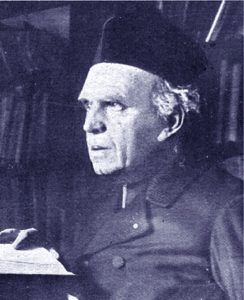
In the last quarter of the nineteenth century, Joseph Turmel, a French priest born in Brittany in 1859, embarked on what would be a lifelong and intense study of biblical literature and church history. By the age of 26, this course of study had converted him to rationalism. But unlike his near contemporary, Joseph McCabe, he decided to conceal his apostasy and remain a priest.
He began to write articles and books that disputed orthodox Catholicism and for a while this work went unchallenged by Church authorities, thanks to the contemporary climate of ‘modernism’, a revisionist Catholic movement, particularly strong in France, that attempted to incorporate into the faith contemporary scholarship in areas such as biblical analysis and doctrinal history.
But in 1907 the modernist movement was condemned by Pope Pius X, first through the issuing of a ‘syllabus’ of sixty-five condemned propositions and then by the handing-down of an encyclical, Pascendi dominici gregis, that condemned modernism as ‘poisonous doctrines taught by the enemies of the church… the synthesis of all heresies’. Imposing a strict code of censorship, designed to suppress modernist publications, the Pope declared, ‘It is not enough to hinder the reading and the sale of bad books—it is also necessary to prevent them from being printed’. Each diocese was directed to set up a local vigilance committee with the purpose of seeking out any writing that contradicted traditional dogma and acting against any clerics who expressed such heretical views.
Turmel was accordingly ordered to desist from further writing. He appeared to submit, but privately he had no intention of either revising his views or ceasing to publish them. He continued to write but now concealed his authorship under a pseudonym. Confident that his identity was now safely hidden, he began to write works much more explicitly critical than had been his earlier publications.
Turmel’s special interest was in tracing out the origin of elements of doctrine and ritual, and in doing so he uncovered an alternative history to the conventional Catholic story of divine revelation and patristic inspiration. Turmel showed, in study after study, that the beliefs, liturgy, and rites of Catholicism were not supernaturally inspired but instead the outcome of an all-too-human process, over centuries, of borrowing, manipulation, and invention.
Time and again the Catholic authorities suspected Turmel to be the author of these damaging books, but whenever challenged, he denied it. He later excused his dissimulation by saying that promises obtained under duress cannot place any obligation on the victim. In order to keep the Church confused about the authorship of his books, he repeatedly switched pseudonyms, to the point where he ended up published under sixteen different names.
But eventually the Church obtained conclusive proof that Turmel was the author of these devastating attacks on Catholicism and, in 1930, he was confronted and summarily excommunicated. His expulsion from the Church finally released him from his enforced anonymity and from that point on he was able to publish under his own name. That once unmasked he was excommunicated is hardly surprising. What is startling is that Turmel, the convinced rationalist, continued to serve his little community as its parish priest, saying mass and hearing their confessions. This is, to say the least, curious, and it is unsurprising that Felix Sartiaux, an admirer of Turmel and his contemporary biographer, characterised him as ‘the most surprising, fascinating example of ecclesiastical psychology that I have encountered’.
His new situation, as an excommunicated priest who nevertheless continued to carry out some, though not all, of his priestly duties, was clearly ambiguous, but there was no ambivalence about his theological position, as he made clear in his Catechisme Pour Adultes:
Genesis tells us that God made man in his own image. On the contrary it is terrified humanity that made the gods in its own image, and made them violent, fantastic, sensual. Then came the philosophers, who undertook to clarify the dreams of humanity and adopt them for better or worse to the laws of logic. God is a frightful nightmare produced by reasoning in the service of a delirious imagination.
After his excommunication, Turmel started work on his magnum opus, a six-volume study entitled Histoire des Dogmes. Over its nearly three thousand pages, he systematically scrutinised the core teachings of the Church and their historical roots. His blunt conclusion was that the biblical basis of the faith was an ‘imposture’ and that its doctrines were ‘products of the human imagination’.
Very few of Turmel’s many books have been translated into English. Two of them, both published by the Rationalist Press Association, were his Catechisme Pour Adultes, clumsily retitled for the English-speaking market as Religious Inventions and Frauds, and his La Messe, retitled as The Evolution of the Mass. Both these books were translated by Charles Bradlaugh’s grandson, Charles Bradlaugh-Bonner.
The great rationalist scholar J. M. Robertson described Turmel as the ‘incomparably learned priest who by sheer study of the literary history of his own church grew to the knowledge that its claims are incredible’. F. A. Ridley, a former editor of the Freethinker and one-time President of the National Secular Society, judged Turmel to be ‘perhaps the greatest scholar of whom the modern international freethought movement can boast’. The English rationalist A. D. Howell Smith (author of a number of very good books published by the Rationalist Press Association) declared that ‘no historian of dogma before Turmel was a pronounced disbeliever in every form of supernaturalism or covered such an immense field, displaying an amazingly vast erudition in tracing the complete evolution of the tenets that are supposed to constitute “the faith once delivered to the saints”… The boasted semper eadem of the Church is shown to be a lie.’
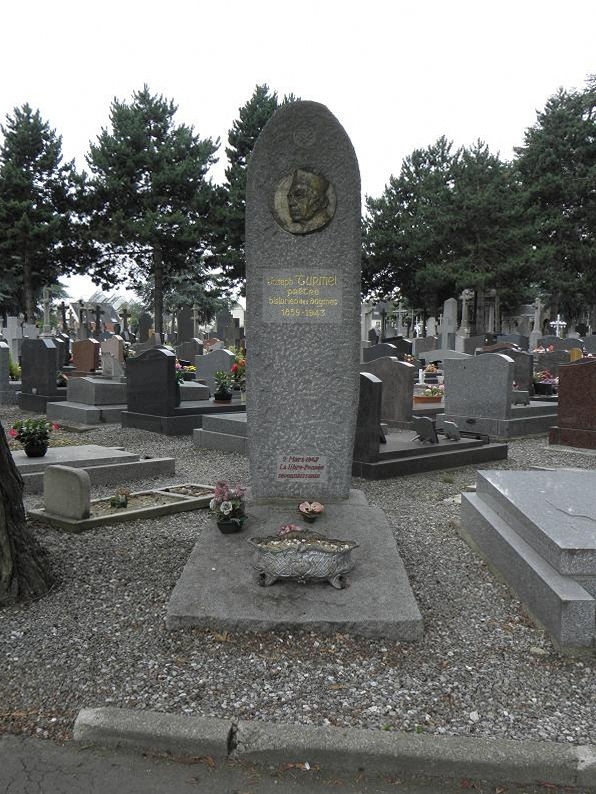
Turmel died in 1941 in Rennes, where he had spent almost his entire life. One of the town’s streets is now named after him and his grave is marked by an impressive monument paid for and maintained by the local freethinkers’ group—the Libre Pensée Rennaise. A translation of an inscription on the monument provides a fitting epitaph:
A freethinker. He laboured in the service of truth and the struggle against obscurantism.

Your email address will not be published. Comments are subject to our Community Guidelines. Required fields are marked *
Donate