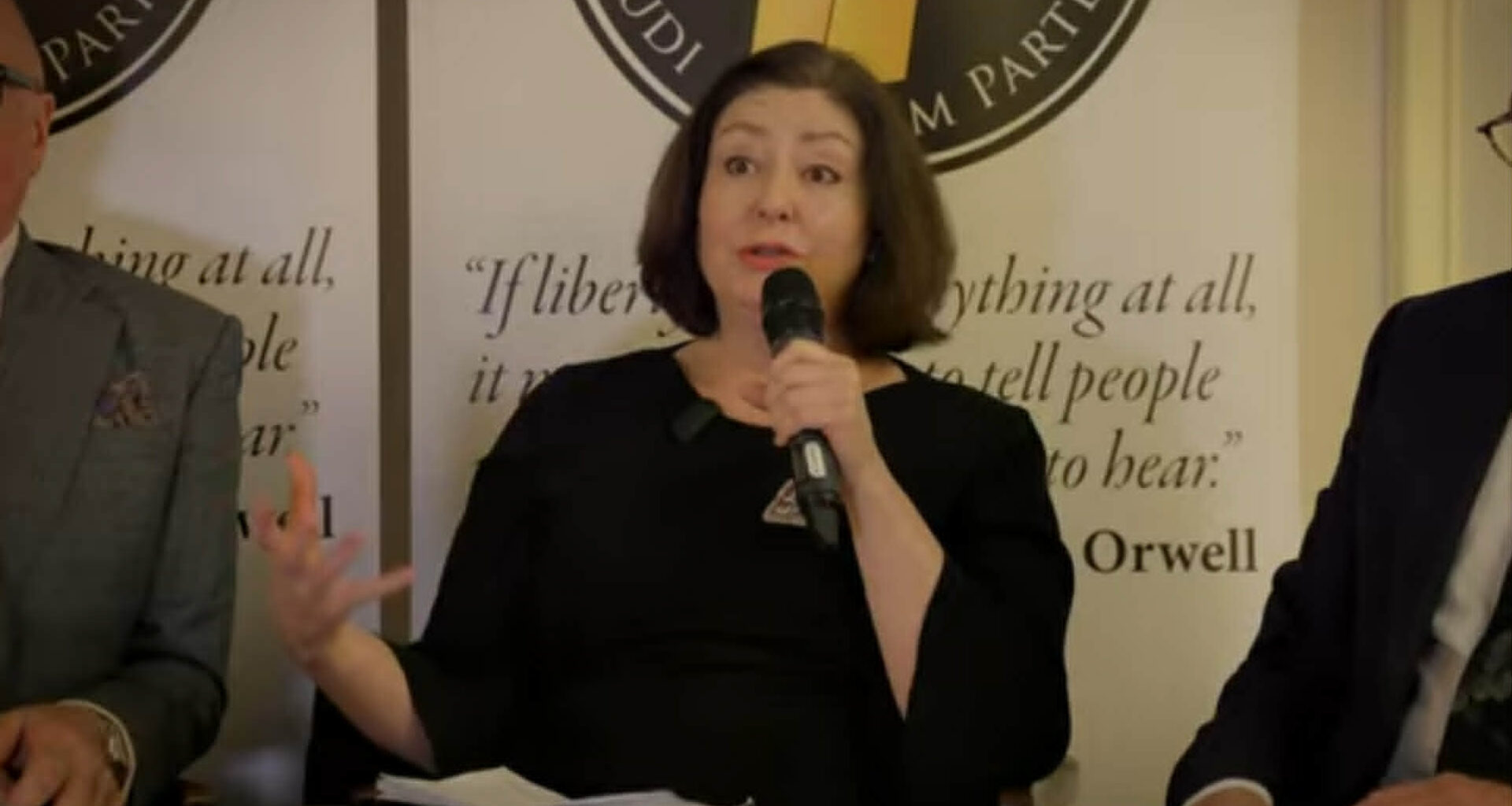
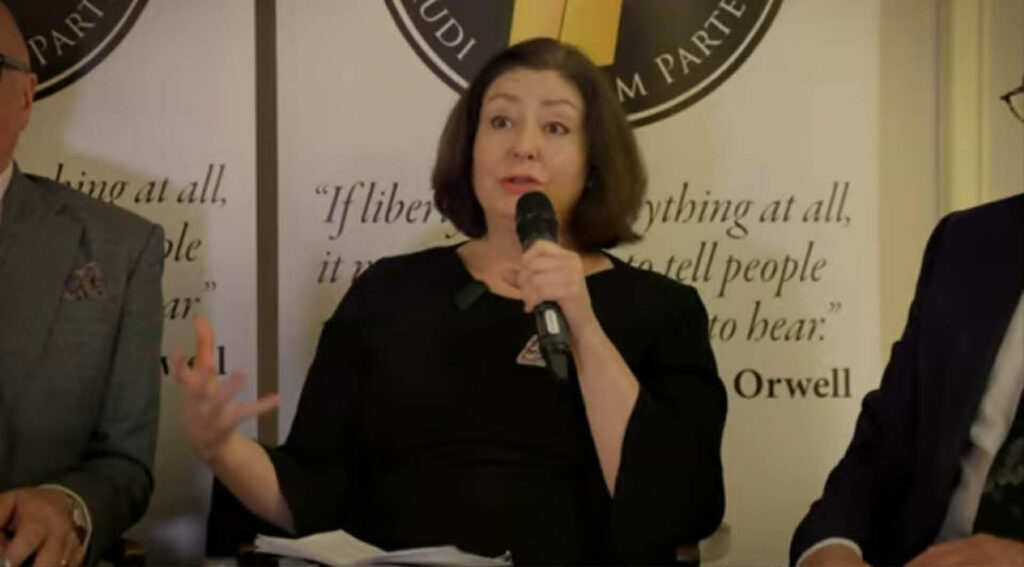
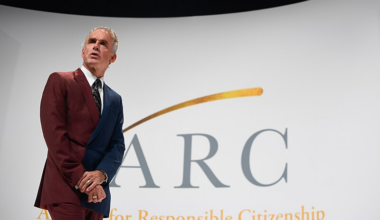
The following is an expanded and updated essay based on Maryam Namazie’s remarks at the launch of Steven Greer’s book, Islamophobia and Free Speech, on 15 April 2026, hosted by the Free Speech Union. Greer is Professor of Law at the University of Bristol. He was accused of ‘Islamophobia’ in 2021, a charge that was not upheld following a university investigation. (See here and here for an interview with Greer and a review of an earlier book of his, respectively.) The discussion included Sir John Jenkins, a former British diplomat, and was chaired by Free Speech Union’s David Rose. You can watch the discussion here.
Accusations of ‘Islamophobia’ and the like control dissent. I know this from experience. I have been labelled an ‘Islamophobe’ for criticising Islam, Hamas, and the Islamic regime of Iran; an ‘antisemite’ for criticising the Israeli state; and an ‘undercover jihadi’ for defending Muslims and migrants. The aim is always to silence dissent.
It is important to state at the outset that anti-Muslim racism is real. Whether or not Muslims are a ‘race’ is beside the point. Anti-Muslim hostility operates like racism, through name, appearance, and background, not merely belief. This reflects a broader shift in how racism operates. Biological racism has largely been discredited, but it is often rearticulated through culture and religion. Muslims are racialised not as a biological group but as a cultural one. This shift has been reinforced by a cultural relativism that treats Muslims as a homogeneous population defined by fixed ‘authentic’ beliefs and behaviours.
It is precisely because anti-Muslim racism is real that the language of Islamophobia is used to conflate the distinctions between Islam, Islamism, and Muslims. Islam is a body of ideas, subject to criticism and contestation. Islamism is a far-right political project. Muslims are diverse individuals.
‘Islamophobia’ is mobilised by authority to deflect criticism, determining what can be said, who can speak, and which forms of dissent are permissible. It protects authority by repackaging criticism of an idea or a religious-right political project as racism. In doing so, it disciplines dissent, stabilises authority, and shifts attention away from the structures of power being criticised. That is the crux of the matter: obfuscation in the service of power.
Of course, Muslims may be influenced by Islam, just as Italians may be influenced by Catholicism. But religion, even as a reactionary set of ideas, is also a lived experience. People are mainly born into it due to a lottery of birth. As Kenan Malik has consistently argued, sharia is not stitched into the DNA of every person from a Muslim background. People are not collectively good or bad.
Despite this, the default is to conflate people with the belief. The implication is that Islam is uniquely hateful and misogynistic, and this results in an inevitable ‘clash of civilisations’ narrative. But you can find similar forms of hate and misogyny in the Bible and Torah. And the same political project in other religious-right movements.
A recent example illustrates this conflation. I was misquoted on the back cover of Islamophobia and Free Speech as stating: ‘Greer’s book offers a compelling repost [sic] to the current campaign to denounce any criticism of Muslims and Islam as “Islamophobic”.’ The original statement was reduced to a sentence about ‘Muslims and Islam’, collapsing the distinction I had made.1 This is analogous to conflating criticism of Judaism into hostility toward Jews, and labelling both as ‘antisemitism’.
It is true that the failure to distinguish between criticism of Islam and Muslims is being politically weaponised to restrict free speech. But it is also true that the conflation between Islam and Muslims is used to promote hatred against people, to homogenise and place collective blame.
For me, any criticism of an idea is legitimate. It does not have to be measured, evidence-based, or polite. Free expression is an individual right, not a group right. Its limits cannot be determined by authority or claims of offence. It doesn’t even have to conform to existing law. Otherwise, how would women in Iran oppose the hijab? Expression is legitimate as long as there is no incitement to violence. Free expression is not an abstract principle; it is a precondition for all rights—a demand from those without power against authority.
Yet the institutions that claim to defend free expression do not apply this principle consistently. Organisations such as the Free Speech Union present themselves as defenders of free expression, yet their most visible interventions are in cases framed around Islam and ‘cancel culture’, even though restrictions on speech are not limited to accusations of ‘Islamophobia’. Academics face exclusion when accused of ‘antisemitism’ for criticism of Israeli state policy, and those supporting Palestine Action have been arrested under expansive public order and counter-terror frameworks. In each case, a similar mechanism operates: criticism of power is reframed as harm to a people or a nation, not to protect people, but to protect authority and manage dissent.
This is why the focus of the debate is often misdirected toward an ‘unholy alliance’ between Islamism, sections of the left, and liberal institutions, while the primary role of the state is disappeared.
The language of ‘Islamophobia’ is useful to authority. It allows the state to appear protective while controlling dissent. On the one hand, the state imposes surveillance frameworks such as Prevent, counter-terror powers, and protest restrictions, producing a chilling effect on speech. On the other hand, it co-opts and selectively recognises and funds particular ‘community representatives’, marginalising dissenting voices and managing ‘the Muslim community’ through established authority structures. Disruptive feminist dissent, which cuts across family, religion, community, and state, is consistently marginalised.
Authority benefits in multiple ways. The state manages minoritised populations through its recognised representatives. Religion is shielded from criticism. And religious-right political movements are insulated from challenge.
Moreover, the focus on the left obscures the fact that Islamism did not emerge in isolation. It was significantly shaped by Cold War geopolitics, including US support for Islamist groups to create an Islamic belt around the Soviet Union, alongside the suppression of left and secular alternatives.
Identity politics, particularly in the form of state-led multi-faith policy, reframes conflict horizontally, as communities set against each other, rather than vertically, as citizens against power. It fragments opposition and redirects anger. It obscures class and material conditions. In doing so, it displaces conflicts rooted in labour and inequality into the language of culture, where they can be managed rather than addressed.
Economic insecurity, austerity, housing inequality, lack of local resources, and low wages are recast as problems of culture or demography. The result is that structural issues are left untouched while the most vulnerable are made the focus of political ‘solutions’. We see this clearly in anti-immigration and anti-Muslim narratives. When structural inequality is reframed as a problem of demography or culture, the solution becomes exclusion, deportation, community management, or surveillance rather than redistribution, housing, wages, and democratic rights.
The most powerful restrictions on speech come from the state, through law, surveillance, and protest controls, but the focus of this debate is only on the left and ‘cancel culture’. State controls are rarely described as censorship, precisely because they are embedded in law and governance rather than framed as cultural conflict.
This has material consequences for how harm itself is understood.
Take the example of the ‘grooming gang’ scandals. Of course, fear of being labelled Islamophobic could have played a role. But official inquiries document decades of institutional failure rooted in victim blaming, contempt for working-class girls, and systematic failures of safeguarding. The same report that documented ethnic patterns in certain regions also concluded that the ethnicity data across the UK was not sufficient to support statements about the ethnicity of group-based child sexual exploitation offenders at the national level.
Data on child sexual abuse shows that most identified perpetrators in the UK are white and that abuse is not confined to any one ethnic or religious group. Most violence against women and girls is committed by someone known to the victim, often a partner or former partner. The focus on ethnicity has been used to externalise male violence, treating it as something that arrives with particular communities rather than something structural that cuts across all sections of society.
When abuse is committed by white men, whether by the likes of Jeffrey Epstein and Jimmy Savile or within the Catholic Church and elite institutions, it isn’t treated as a problem of ‘Christian culture’ or ‘Western culture’. A Guardian investigation found that 41% of those arrested during the Southport riots had prior domestic abuse reports. In these circumstances, it is analysed in terms of male violence, power, misogyny, and institutional failure. But when perpetrators are racialised minorities, violence against women and girls is instrumentalised and the frame shifts to culture, religion, and ‘community’.
During the panel discussion, a member of the audience associated with the Restore Britain party responded to the fact that most perpetrators are white men by stating that Britain is a ‘white country’. If demographic majority explains why most perpetrators are white, then it cannot also explain the disproportionate focus on minorities. Violence is analysed structurally when it is associated with white men, but culturally when it is associated with minoritised men. Her remark made explicit what often remains implicit in debates on Muslims and migrants: that the purpose is not safeguarding women or protecting free expression, but reinforcing the false assumption that violence is inherent in minority populations and to defend whiteness and the Christian right. Britain is, as I said then, not a ‘white country’, but a country with a diverse and plural population.
Misdiagnosing violence as ‘Muslim culture’ is politically useful. It externalises the problem, shifting responsibility away from institutions and toward communities, while reinforcing narratives that justify exclusion and control. It provides cover for racist movements that promote white nationalism by presenting minorities as inherently criminal. At the same time, it obscures a feminist analysis: that violence against women is not a cultural aberration imported from elsewhere, but a structural feature of society. This fails victims and survivors. Addressing it requires investment in services, legal reform, and accountability.
The same dynamic operates in debates on migration. The right to asylum is recognised under national and international law, and those fleeing persecution often have no choice but to travel without documentation. Yet they are increasingly labelled ‘illegal’, transforming vulnerability into criminality.
In each of these cases, social and political problems are reframed through identity, allowing power to present itself as protective while exercising control.
Religion is central to this process. It is not just belief, but a system of authority, one of the oldest and most effective in human history. It organises social reproduction, regulating women’s bodies, labour, and sexuality in ways that sustain existing social and economic hierarchies. It shapes law and governs dissent. And this is not unique to Islam. When religion is fused with state power, whether in Christian, Jewish, Hindu or other contexts, it shapes society in similar ways.
What we see today is not new but a modernised form of older mechanisms of blasphemy, heresy, and sedition, translated into the language of identity and harm. The term ‘Islamophobia’ is a case in point. Like older mechanisms, it does not protect people but religion and, through it, the structures of power. The issue, then, is not simply speech, but the organisation of power itself: how criticism is reframed, how populations are managed, and how structural problems are disappeared.
Any serious position must insist that no belief system is beyond criticism and that no people are subject to collective blame. Where that distinction is erased, criticism is not merely discouraged; it is made structurally impossible. That is how power reproduces itself, and it is why the demand for free expression must be, at its root, a demand against power.
- This is the original quote I sent to Greer:
Steven Greer’s book is of special relevance to those of us who have faced accusations of ‘Islamophobia.’ Islam, like all religions or beliefs, must be open to criticism. The right to blasphemy is a cornerstone of free expression. It is not limited to or dependant [sic] on one’s ‘identity’ or lottery of birth. In fact, it matters most to those living under or fleeing from totalitarian and theocratic states where it can be punishable by death. In countries like Iran and Afghanistan, being a woman in and of itself is an act of blasphemy—her hair, voice and body; being an atheist, gay, apostate or ex-Muslim and opposing a religious state or the rule of clerics are all blasphemies. The struggle to blaspheme is a struggle for the right to be fully human. Conflating blasphemy with bigotry only serves the fundamentalists in imposing de facto blasphemy laws and further vilifies dissenters whilst doing nothing to combat racism, xenophobia and anti-Muslim bigotry.
Greer told me that he sent me the edited version of the endorsement and, not having received a reply, assumed I was content with the changes. This is not the case. I did not respond because I did not agree to the revised wording. I had already provided a quote reflecting my position and did not want one written for me that departed from it. The edited version alters the meaning of my original statement by collapsing a distinction I consider essential. Greer responded that the distinction between criticising Muslims and criticising Islam is ‘subtle and not well understood’. ↩︎


1 comment
For the record, nearly all the pre-publication endorsements of my book, ‘Islamophobia and Free Speech’, required editing, mostly because they were either too long and/or strayed from commenting upon the book itself. Both were the case with Maryam’s. Proposed edits, including that attributed to her, were referred back to each contributor for approval. Most expressly confirmed. But having received no reply from Maryam, I assumed she assented. With the benefit of hindsight it might have been wiser to have chased her up. This aside, I’m puzzled by Maryam’s apparent willingness to criticize Islam but not Muslims, particularly as she admits having criticized Hamas. While a distinction can and should be drawn between criticizing Islam and criticizing its adherents, another is also required. This is between, on the one hand, expressing prejudice or bigotry towards Muslims on the basis of lies, distortion and misrepresentation, and, on the other, criticizing them for having acted upon elements of the faith which are difficult, if not impossible, to reconcile with western values, for example, husbands ‘striking’ their wives for disobedience in accordance with the permission given by the Qur’an. The expression of prejudice or bigotry against anybody should not be tolerated. But criticism of unlawful conduct, whether supported by a religious injunction or not, should be supported.
Your email address will not be published. Comments are subject to our Community Guidelines. Required fields are marked *
Donate