

It seems to me that freethinkers and secularists are bad at recording, sharing, and promoting their own history. I have heard it said that past struggles and campaigns are irrelevant to today, and that dwelling on the past is a distraction and a waste of limited resources. If that is so, is it not odd that churches and other promoters of revealed religion take the opposite approach, constantly retelling stories of often fictionalised martyrs and heroic deeds? Unless we understand what we have been, we cannot know what we are and can become.
Too often, freethought history has been left to academics who regard it as an intellectual curiosity and write up their theses in near-impenetrable language. Their purpose may be to impress fellow academics, but they do little to enlighten the general public. The public square has been left largely clear for those who wish to denigrate, or rather elide, freethinkers’ achievements and legacy. Their strongest weapon has been used to great effect and with inadequate pushback: they simply ignore us. No organisation is guiltier than the BBC, whose policy of presenting balanced political views has never extended to religious belief (or lack thereof).
Those who rightly draw attention to the decline in religious belief amongst the population too often fail to notice the enduring and sometimes increasing influence of religion within our political, cultural, and educational institutions. This is best shown by the inability of many to take the resurgence of an aggressive, conservative Christianity seriously. So far, I have mostly spoken about the UK, but the point pertains even more strongly to the USA, whose freethought legacy is under direct assault by an authoritarian, Christian nationalist administration.
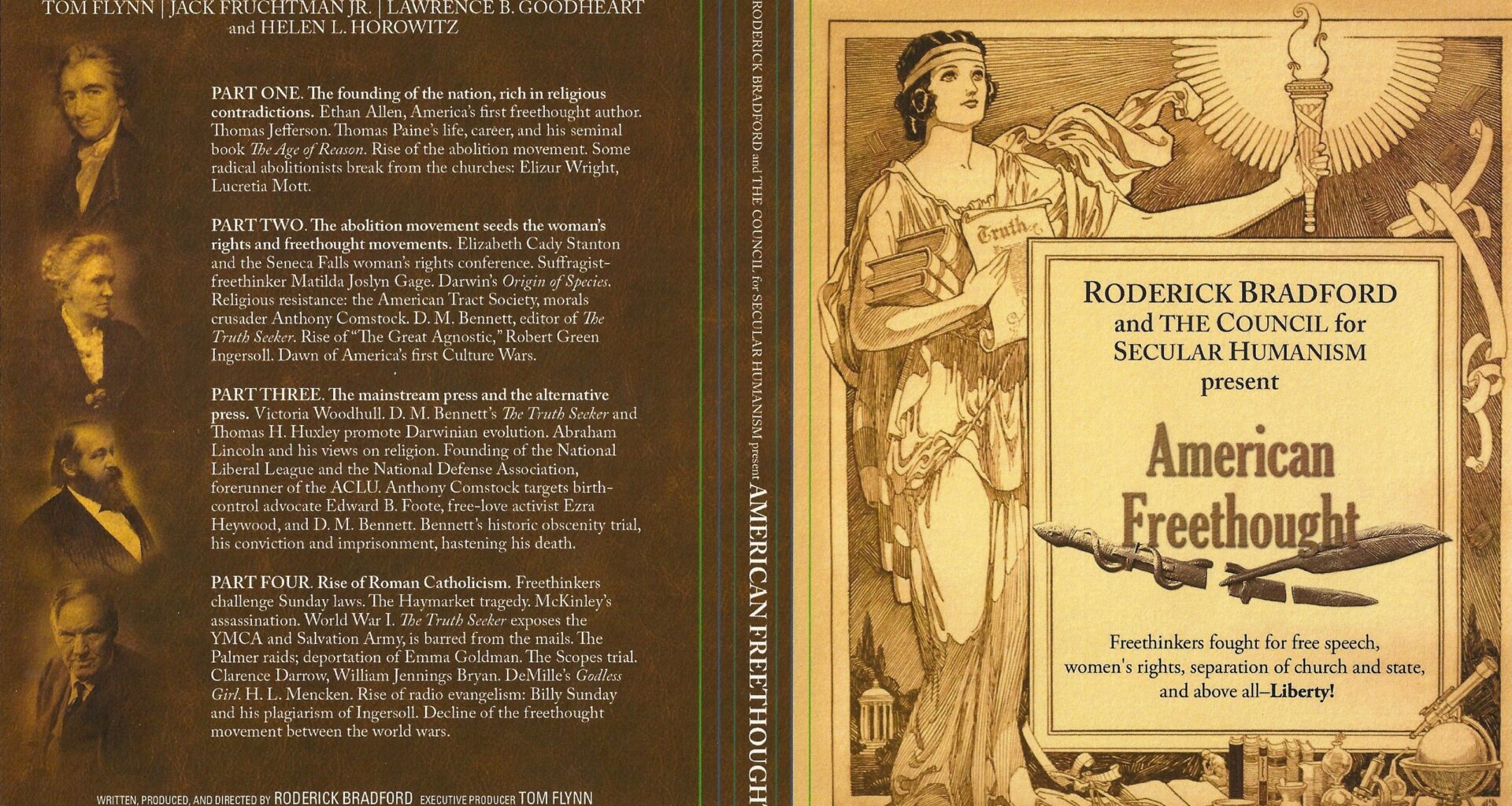
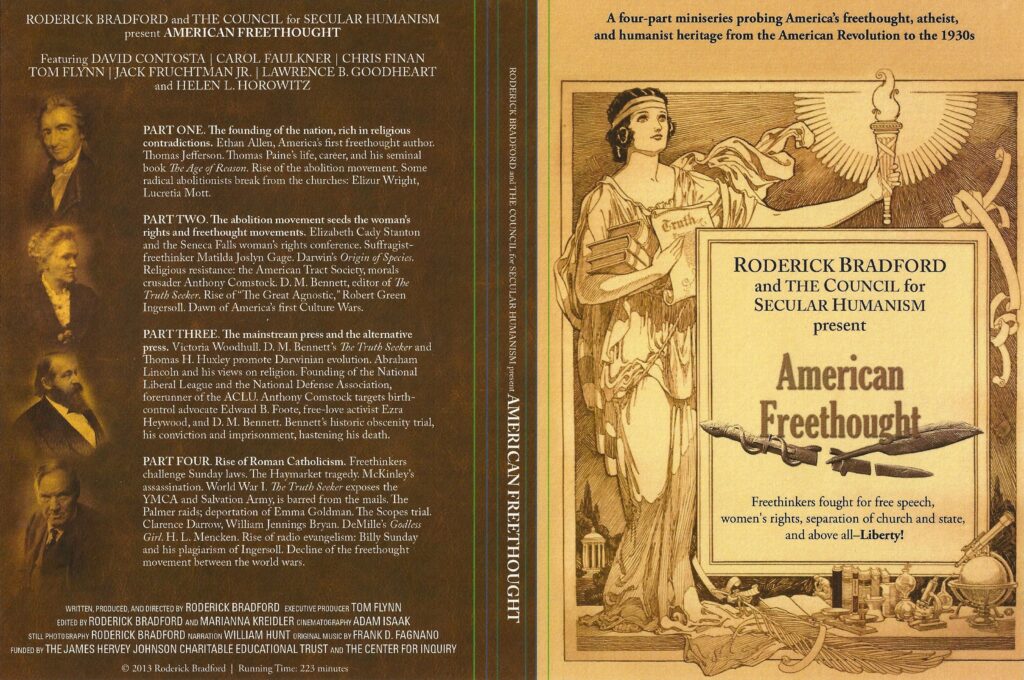
It has always been the mission of the Freethinker to write about freethought issues in accessible terms, so I consider it appropriate to recognise and celebrate the four-part, nearly four-hour American Freethought film series, largely the work of Rod Bradford, editor of The Truth Seeker and author of D.M. Bennett: The Truth Seeker. The series was originally published in 2013 as a DVD and is a serious and polished attempt to tell the story of freethought in the USA and examine its important influence on the way that nation has developed.
The approach is chronological, although with frequent explanatory references back and forth. Thomas Paine and the American Revolution are taken as the starting point, as they surely must be, and the series finishes with Clarence Darrow and the Scopes ‘Monkey’ Trial and the decline of the freethought movement between the wars. The story is told through a series of interviews with leading authorities, including Jack Fruchtman, David Contosta, Helen Horowitz, Chris Finan, Carol Faulkner, Lawrence Goodheart, and Tom Flynn. Each was interviewed at length, and the footage was divided into easily digestible, ‘bite-sized’ chunks. Of the contributors, Tom Flynn plays a leading, anchor role, spelling out the significance of events and personalities.
Tom was an American author, journalist, novelist, and executive director of the Council for Secular Humanism and editor of its journal Free Inquiry (both under the aegis of the Center for Inquiry, the leading American freethought organisation) until his death in 2021. He was also director of the Robert Green Ingersoll Birthplace Museum and the Freethought Trail. His concluding comment in the series is very telling: that you cannot understand America today unless you understand the contribution of freethinkers.
To supplement and highlight points within the narrative, a wealth of illustrations is used. The main sources are the Library of Congress and the Library at the Center for Inquiry, which probably has the world’s largest collection of freethought publications. The illustrations include several cartoons by the extraordinary Heston Watson, which originally appeared in the late nineteenth-century Truth Seeker. Watson’s cartoons do what we often fail to do today: they spell out the freethinker’s cause in a way all those with an open mind can relate to. There is also use of photo animations created by Alper Nakri, whose work can also be seen in History Channel programmes in the US, and some archival film footage, including from the Scopes Trial and of the bizarre, conservative, evangelist ‘Billy Sunday’, who was to find this occupation rather more financially rewarding than his former career as a baseball player. Sound familiar? Accompanying original background music was composed by Frank D. Fagnano.
An aspect which repeatedly struck me is the parallels between British and American freethought history. Here are just a few. Both take Thomas Paine and his Age of Reason, in which he eviscerated revealed religion, as seminal. Both reached their peak towards the end of the nineteenth century (Americans refer to the ‘Golden Age of Freethought’) when both benefited from the services of outstanding orators: Charles Bradlaugh in Britain and Robert G. Ingersoll in the USA. In both countries there was the emergence of a journal of record: in Britain, the Freethinker, and in the USA, The Truth Seeker. Both journals have made it their business to champion the memory and works of Thomas Paine, and both survive to this day.
Referring specifically to The Truth Seeker, Tom Flynn goes as far as to suggest that without its efforts, Paine’s memory and work would have fallen even further into obscurity. Further, the first editors of both journals, G.W. Foote (Freethinker) and D.M. Bennett (Truth Seeker), served terms of imprisonment of similar lengths (12 and 11 months) as a reward for their endeavours. These editors exchanged information and each frequently reprinted articles that appeared in the other’s newspaper. Freethinkers in both countries were important in disseminating knowledge of birth control techniques and campaigning for free expression. Most importantly, in both countries there were honest individuals of extraordinary courage prepared to face the opprobrium of their fellow citizens and fight for what they thought was right. There are many other parallels that could be noted.
If the series has a weakness, it is its density: it contains a great deal of detail and analysis. At times, this makes it challenging to follow, and I had to watch it twice to feel I had fully absorbed it. Yet depth is essential if the subject is to be treated seriously, and I would hesitate to suggest cutting anything. What is needed instead is the energy, commitment, and funding to produce separate episodes on the many major events and issues it raises. In the meantime, Rod Bradford has made effective use of the footage by creating two- or three-minute clips that highlight specific themes, some released to coincide with issues as they become topical. As Mark Twain, himself a Truth Seeker subscriber, once observed, ‘History never repeats itself, but it does often rhyme.’
In any case, it is hard for a Briton to be critical. In the UK, we have yet to produce anything to rival American Freethought. Like the American story, our own is compelling and significant, and well worth telling. After all, the American freethought movement drew heavily on the work of two of the greatest Britons in history—Charles Darwin and Thomas Paine. For now, we can only watch American Freethought—and admire it.
Those wishing to follow my recommendation should use the following link to find the four episodes, plus a range of other film material of interest to Brits. I am very grateful to Rod Bradford for organising this feast: https://vimeo.com/roderickbradford.
Those who desire something more permanent can purchase the series on DVD from the Center for Inquiry store: https://centerforinquiry.org/store/product/american-freethought-blu-ray-and-dvd/.
Related reading
Books from Bob’s Library #8: our friend ‘The Truth Seeker’, by Bob Forder
Image of the week: The Freethought Road, by Bob Forder
A reading list against the ‘New Theism’ (and an offer to debate), by Daniel James Sharp
Is all publicity good publicity? How the first editor of the Freethinker attracted the public’s attention, by Clare Stainthorp
Secularism and the struggle for free speech, by Stephen Evans





1 comment
Excellent review. For myself, I choose to imagine that somewhere, perhaps in another world far from our own and considerably more intelligent, the four-part film series ‘American Freethought’ is being viewed on a vastly superior global streaming service, free and on continuous loop, by hundreds of millions of subscribers, especially during election cycles.
Your email address will not be published. Comments are subject to our Community Guidelines. Required fields are marked *
Donate