

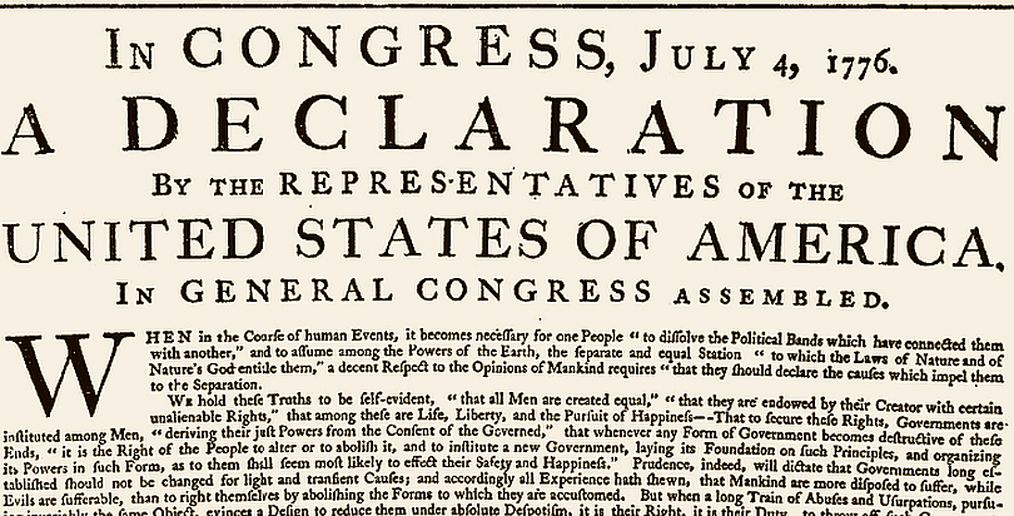
On 4 July, the United States celebrated the 250th anniversary of its Declaration of Independence from Great Britain. Although independence wasn’t actually achieved until Britain accepted defeat with the 1783 Peace of Paris, the Fourth of July is usually celebrated as the ‘birthday’ of the United States. As John Adams wrote,
I am apt to believe that it will be celebrated, by succeeding Generations, as the great anniversary Festival. It ought to be commemorated, as the Day of Deliverance by solemn Acts of Devotion to God Almighty. It ought to be solemnized with Pomp and Parade, with Shews, Games, Sports, Guns, Bells, Bonfires and Illuminations from one End of this Continent to the other from this Time forward forever more.
(Adams, incorrectly, predicted that 2 July—the day that Congress voted in favour of independence—would be remembered as the nation’s birthday, rather than 4 July, the day when Congress formally adopted the Declaration of Independence.) In keeping with the spirit of Adams’s remarks, back in May, Chevrolet used a specially designed Corvette to blow out 250 candles at the Indianapolis Motor Speedway.
If the Fourth of July is America’s birthday, then the Declaration of Independence is its birth certificate. The Declaration is the foundational document for the nation, its creedal statement, establishing that the United States will be a republic premised on equality. ‘We hold these truths to be self-evident’, its most famous sentence asserts, ‘that all men are created equal, that they are endowed by their Creator with certain unalienable Rights, that among these are Life, Liberty and the pursuit of Happiness.’
In the 250 years since 1776, Americans have interpreted the Declaration of Independence as the nation’s birth certificate, embracing its language to make claims for greater rights and equality. When women’s rights advocates gathered at Seneca Falls, New York in 1848, Elizabeth Cady Stanton reworked the language of the Declaration of Independence when she drafted the Declaration of Sentiments to claim equal rights for American women. In his speech at the Lincoln Memorial in 1963, Martin Luther King described the Declaration of Independence as ‘a promissory note to which every American was to fall heir. This note was a promise that all men, yes, Black men as well as White men, would be guaranteed the unalienable rights of life, liberty, and the pursuit of happiness.’
While the revolutionaries of 1776 did intend the Declaration of Independence to be a justification of their rebellion, and an assertion of their rights, it was not only a birth notice but an obituary as well. For the revolutionaries, the Declaration of Independence signalled the failure of the British Empire. During the previous decade, since Parliament adopted the Stamp Act in 1765, through the series of subsequent laws aimed at taxing the colonies (and asserting greater control over them), self-styled ‘Patriots’ in the colonies sought to find a solution that would allow them to exercise their rights within the British Empire. They believed that they were British subjects who had the same rights and liberties as Britons who resided in Britain. They sought to reform and remake the empire to ensure that the British constitution applied to them. When George III declared the colonies to be in rebellion and waged war against them, he asserted that the vaunted ‘rights of Englishmen’ that the constitution guaranteed did not apply in the colonies. That was when, as a last resort, the colonies declared independence. The Declaration of Independence was a declaration of failure.
Thomas Jefferson adopted an elegiac, emotional tone when writing about ‘our British brethren’ in his draft of the Declaration.
We must endeavor to forget our former love for them, and to hold them as we hold the rest of mankind, enemies in war, in peace friends. We might have been a free & great people together; but a communication of grandeur & of freedom it seems is below their dignity. Be it so, since they will have it: the road to glory & happiness is open to us too; we will climb it in a separate state, and acquiesce in the necessity which pronounces our everlasting Adieu!
Jefferson’s language suggests less a celebration of what Lincoln would later term a ‘new birth of freedom’ than regret and sorrow over what might have been. To his way of thinking, independence had been forced on the Americans by a brutish, tyrannical, and unfeeling king and his ministers who lacked the vision to find a constitutional solution that would secure the rights of his subjects in America. He is saying, ‘We might have been great together, but we will have to be great without you.’ Congress tempered and cut Jefferson’s emotive language in its final draft of the Declaration, concluding simply, ‘We must, therefore, acquiesce in the necessity, which denounces our Separation, and hold them, as we hold the rest of mankind, Enemies in War, in Peace Friends.’
It struck some commentators as somewhat incongruous that King Charles III made a state visit to the United States in April to mark the Semiquincentennial of a republican revolution (his mother, Queen Elizabeth II, made a similar visit during the Bicentennial in 1976). However, when he addressed a joint session of Congress on 28 April, the king said,
With the spirit of 1776 in our minds, we can perhaps agree that we do not always agree—at least in the first instance. Indeed, the very principle on which your Congress was founded—no taxation without representation—was at once a fundamental disagreement between us, and at the same time a shared democratic value which you inherited from us. Ours is a partnership born out of dispute, but no less strong for it, so perhaps, in this example, we can discern that our nations are in fact instinctively like-minded—a product of the common democratic, legal and social traditions in which our governance is rooted to this day.
Thomas Jefferson would have agreed.
Related reading
America the Radical: Some Fifth of July Reflections, by Daniel James Sharp
The Fourth of July and the Battle for America’s Soul, by Daniel James Sharp
Review: Jonathan Rauch, ‘Cross Purposes: Christianity’s Broken Bargain With Democracy’, by Patrick Seamus McGhee
US feeling cross: a review of ‘Cross Purposes’ by Jonathan Rauch, by Nicholas E. Meyer
What Would Hitchens Think? by Zwan Mahmod
A Republic on Fire: ICE’s Reign of Terror, by Ron Fischer
Donald Trump, Christianity, and the need to write better stories, by Adam Davidson-Harden
The White House’s ‘Banger Memes’ Are Damaging Democracy, by Matilda Gladwell
The Conspiracy Zone, by Paul Fitzgerald
The assassination of Charlie Kirk, by Fariborz Pooya
How Trump will reshape America’s global role in his image, by Matt Johnson
The end of American idealism, by Matt Johnson
American democracy will soon turn 250. Freethought can reinvigorate it. By Patrick Seamus McGhee
The radical atheism of the American revolutions: interview with Matthew Stewart, by Daniel James Sharp
Donald Trump is an existential threat to American democracy, by Jonathan Church
Donald Trump, political violence, and the future of America, by Daniel James Sharp
White Christian Nationalism is rising in America. Separation of church and state is the antidote. By Rachel Laser
The Left-Liberal Tradition: Or, How Liberalism and Socialism Can be Allies, by Matt McManus
Robert G. Ingersoll: The Great Forgotten Orator of Reason and Liberty, by Tom Malone
US Election 2024: Yet Another Farcical and Costly Contest, by Zwan Mahmod
US Election 2024: On ‘Lesser Evilism’, by Ralph Leonard
‘Project 2025 is about accelerating the demise of a functioning democracy’: interview with US Representative Jared Huffman, by Daniel James Sharp
Books From Bob’s Library #1: Introduction and Thomas Paine’s ‘The Age of Reason’, by Bob Forder
Books from Bob’s Library #2: Thomas Paine’s ‘Rights of Man’, by Bob Forder
The rhythm of Tom Paine’s bones, by Eoin Carter
Faith Watch, February 2024, by Daniel James Sharp
Faith Watch, March 2024, by Daniel James Sharp
Christopher Hitchens and the long afterlife of Thomas Paine, by Daniel James Sharp
Introducing ‘Paine: A Fantastical Visual Biography’, by Polyp, by Paul Fitzgerald
Reproductive freedom is religious freedom, by Andrew Seidel and Rachel Laser
Secular conservatives? If only…, by Jacques Berlinerblau
Image of the week: ‘The world is my country, to do good my religion!’, by Bob Forder
The Antisemitism Awareness Act will mean the demise of free speech in America, by Kunwar Khuldune Shahid
Satan Will See You in Court: A Florida Battle for Religious Freedom, by T. ‘Chaz’ Stevens
Is Democracy Overrated? The Vacuity of Curtis Yarvin and His ‘Dark Elves’, by Jonathan Church
Against the ‘New Theism’, by Daniel James Sharp
Can the ‘New Theists’ save the West? by Matt Johnson
Two types of ‘assimilation’: the US and China, by Grayson Slover
What has Christianity to do with Western values? by Nick Cohen
Image of the week: ‘Trumpburster’, by Paul Fitzgerald
Image of the week: ‘Top Trumps’, by Paul Fitzgerald
Can Christianity Save Atheism? On Žižek’s Christian Atheism Cringe, by Ralph Leonard
Escaping Ideology with Jonathan Church: Freethinker editor Daniel James Sharp in conversation
Image of the week: The Scopes Monkey Trial of 1925, by Daniel James Sharp








Your email address will not be published. Comments are subject to our Community Guidelines. Required fields are marked *
Donate