

Jeunes mères et grandes soeurs aux regards pleins de pèlerinages, sultanes, princesses de démarche et de costumes tyranniques…
—Arthur Rimbaud, Illuminations
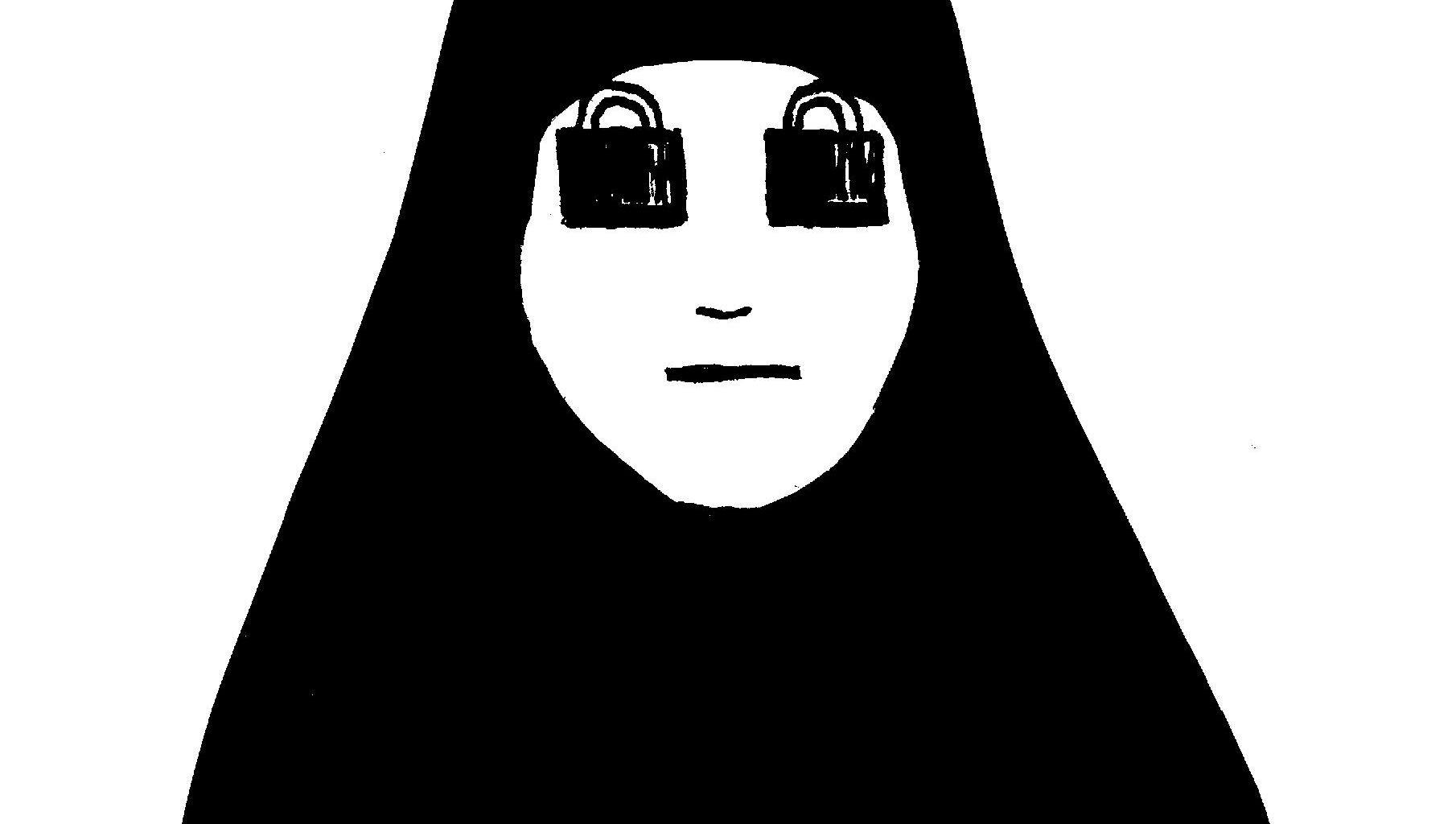
The female veil provides a rich illustration of religion acting in something other than its primary and most obvious role—that of supplying comforting fantasies and pseudo-explanations for whatever cannot be understood about the world. Though that main role usually draws most attention, religion obviously exercises plenty of others. To cite one example among the ancillary roles, it generates employment for armies of people. The veil—in its diverse types, including hijabs, niqabs, abayas, chadors, burqas, burkinis—furnishes another case in point. Namely, religion is a heaven-sent instrument (for its believers, very literally so) for keeping specific groups of people under the thumb of others. Say, the descendants of a conquered people permanently in lower social ranks than the descendants of the conquerors. Or women subservient to men.
With any luck, religion will brainwash many people in the group at the losing end of the bargain into defending it themselves. No bondage is harder to break than a self-imposed one.
The veil says this: women are chattel. Its supporters can argue themselves blue in the face, but there really are no two ways about it. (Female supporters, unless they are lucky enough to get off with ‘only’ a compulsory headscarf to hide the hair, need not worry, of course, as their blue faces will not be perceived in public.) That rock-bottom message of the veil is all the clearer the more cloth the women are encased in, but it is always the same message. The veil is worn to hide part or all of the wearers, but in the process discloses something else: that the females wearing it are to such an extent possessions, that the men who lord it over them either do not want others to even get a look at them—or make them wear something that is as clear a mark of ownership as if they were branded. ‘I am the one who rules on what my womenfolk may wear.’ The rest of any pro-veil position is superstructure—arguments brought in to disguise that true essence of the matter.
Consider the contention, ‘women should dress modestly’. In the first place, what is ‘immodest’ about hair, or about a face? Or a throat? Or, for that matter, an arm? Or, if one comes down to it, a leg or much of the rest of the body? And in the second place, why should men have the right to dictate that rule to women anyway? Or be the ones who decide for women what is and what is not immodest?
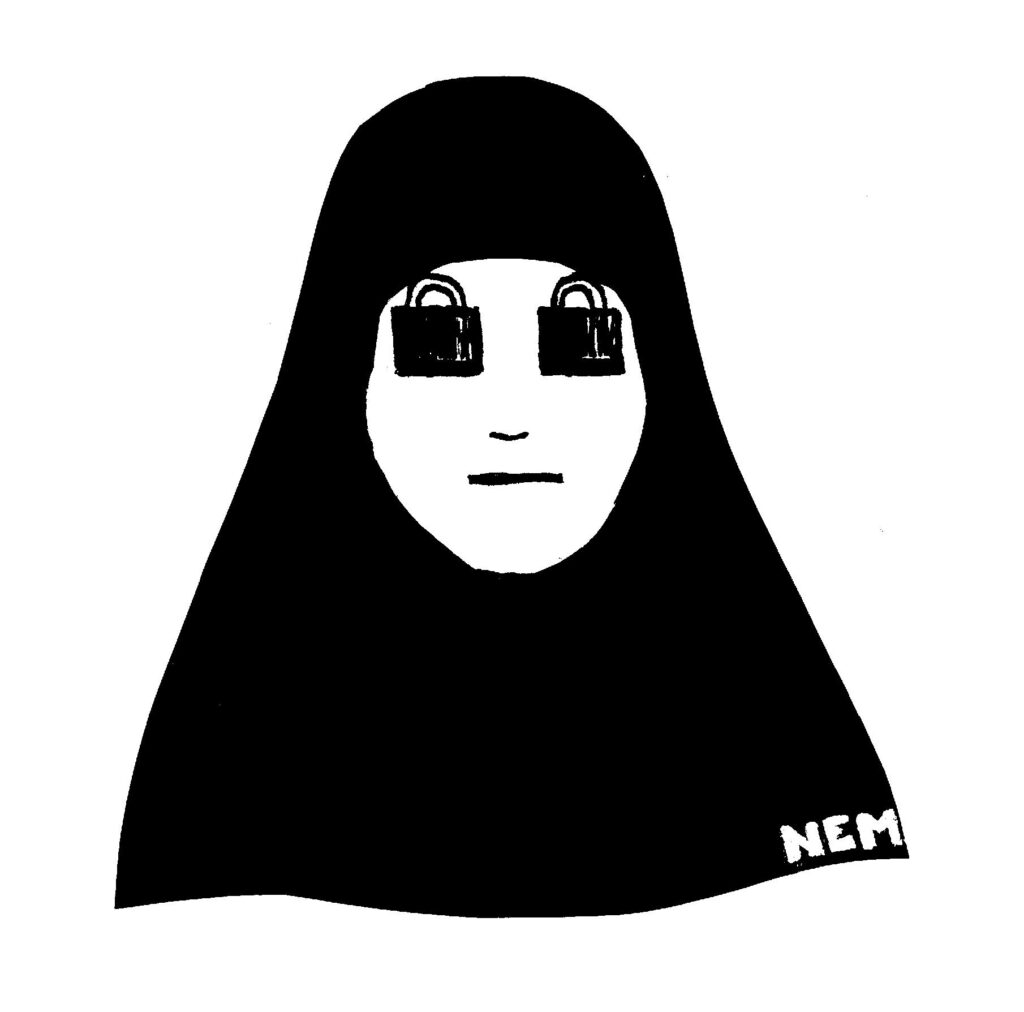
Saying all this should by rights feel like belabouring the obvious. It is not, in a world rife with hypocrisy about the issue, as in the case of the otherwise vocal feminists who give their good cause a bad name by their comparative silence about the vile subjugation of women in Afghanistan and Iran. Or about the relatively less brutal but still barbarous secondary status of women in Saudi Arabia and other family fiefdoms, as in the Middle Ages, around the Persian Gulf.
Special mention is merited, on the subject of absurd concepts of ‘modesty’ being foisted on women, by the question of hair. It would definitely appear that ancient Semitic people (maybe some of their neighbours as well?) had a ‘thing’ about hair—as crystallised in the tale of Samson and Delilah. A kind of fetish, conceivably with magical connotations, at least in its origins. That might account for the surviving obligation by the wives of Orthodox Jewish men to conceal their hair under wigs or kerchiefs, and for the hijabs (or worse) of the women, whether single or married, of Arabs and peoples once conquered by Arabs.
Comparative statistics are naturally unavailable, but from the evidence it is reasonable to conclude that since ancient times, fetishes have tended to drift downwards, by varying distances. Thus, covering the hair, or even everything save the eyes (in the worst cases, even that), the hands, and feet, to avoid ‘exciting the lust of other men’ (what are the ‘other men’ supposed to be, unbridled animals?), forgets that nowadays foot fetishes are likely to be far more the norm than hair fetishes. Hidebound prudes imposing their Bronze Age mores on women are hoist by their own petard. Some seem to have cottoned on to this and make ‘their’ women wear gloves even in the most sweltering heat.
One argument wielded by defenders of the use of the veil is that it and other restrictions on women pre-existed Islam. They stress that upper-class women were kept secluded in ancient Athens and Persia—and that the practice among Muslims is mainly not Koranic but customary (the Koran and the Hadith, Mohammed’s reported sayings, are considered to be ambiguous with regard to the veil). Correct. The veil is a generalised macho thing… and religion is what is enlisted to keep it in place. Precisely the point with which this article began.
Further, independently of origins, religion, once brought in, takes over, and the veil unquestionably became religiously-connected long ago. And even further: if an institution is to be untouchable because it existed in the faraway past, or because it is of a customary nature, that would be a justification for, respectively, slavery (not just the de facto slavery, this very day, of the women in purdah in Afghanistan, but de jure, openly declared slavery as well), and graft.
(This is a bit of a sidetrack, but as recently as the aftermath of the killer quake in Afghanistan in September 2025, rescuers often helped men trapped in the rubble but not women, because of the prohibition to touch them. Where were the incensed demonstrations and declarations against this outrage?)
There is an irony about the veil, the importance of which often goes underappreciated. Among Muslim women themselves, the attitude towards veiling tends to be diametrically split—depending on where they live. It is one thing in countries where rigid enforcement is the official policy. It is another both in Western countries and in nations with majority or large Muslim populations but governments that largely operate secularly, even if they are wavering on the issue.
The circumstance is in fact quite reminiscent of how easy, as did get remarked on at the time, it was for people like Picasso or Shaw or Sartre to come out in support of communism, when it was tantamount to supporting the Soviet Union—if they didn’t actually have to live in Stalinland. In mandatory-veil countries, by available accounts, women generally either react as rebelliously as they dare—and run the risk of being viciously punished for it—or sullenly go along with it, as does anyone who is under some form of involuntary servitude or imposition, has no hope of evading it, and doesn’t happen to be a hero.
Very much the opposite is the situation in the West, and to some degree in those other secularly-run nations alluded to above. Particularly in the West, the veil frequently is less worn than flaunted—as a way to cock a snoot at the rest of the population, however strongly they may deny it with religion-furnished rationales.
This use of the veil, in short, is pour épater les infidèles.
Muslims may certainly feel less than warmly embraced by societies that often were xenophobic to start with; that in many cases rose up to their prosperity thanks, in considerable measure, to the skimming of the riches of colonised territories, and don’t often recall it; and that became extra suspicious or hostile towards Muslims in general when Islamist zealots laid bombs, called for jihads, issued murder fatwas, hijacked planes and used them as missiles, carried out mass kidnappings of schoolgirls (Muslim schoolgirls!) to serve inter alia as sex slaves, banned the women in their grasp from getting an education, and so on. So… if they don’t actually have to live in Ayatollaland, Talibanland, or other lands of cover-up-or-else (or do not have a husband, father, or brothers who anyway force the veil on them), women may find it easy to see the veil as an instrument to show the majority inhabitants that yes, we’re here, we do things that you don’t like, and there’s nothing you can do about it.
Again, religion—by saying or implying, in effect, that the custom is heavenly mandated—provides the cover. The underlying situation of bondage to men is either imagined as something to be borne proudly or not even perceived as bondage. The very fact of wanting to rub the visible sign of their tutelage to men in the rest of society’s face is an unknowing demonstration of their own psychological enslavement.
One result of the latter can be seen when they denounce regulations that ban or restrict the use of the veil in public, as in France’s efforts to enforce its hard-won laïcité—often using feminist turns of phrase like ‘attempts to colonise the bodies of Muslim women’. This, in defence of a practice that in the lands where it is instead statutory, can result in women who ignore it—or merely fail it by an inch or two—receiving ferocious physical punishment, on the spot, if not being beaten to death in police detention. Now that is real ‘colonisation of women’s bodies’, and very often ‘the bodies of Muslim women’ at that.
It takes hypocrisy of a very high order to condemn bans while in effect ignoring lashings and murder by clubbing.
Any curtailment of the veil is also seen by veiling apologists as ultimately grounded not in concern for the civil rights of downtrodden women, but in ‘Islamophobia’ (a deliberately slippery term in itself; ‘anti-Muslim bigotry’ is better). No doubt that exists too. But if it is to be seen as the very topmost ingredient in actions taken about the veil, with other facts not taken into consideration, then again, in the lands where the Islamic morality police report or flail away at Muslim women, the Islamic governments must, by that logic, be motivated by Islamophobia too.
Another pro-veil tack. ‘Women should be free to decide whether to use it.’ We all agree that women should be free (unless, of course, we’re the Taliban, Islamic State, Boko Haram, and the like). However, the only way women can make a decision truly freely is if they are in a relationship of legal, actual, and psychological gender equality at home and out on the street. Not the case.
Mention was made earlier to a big irony possibly going underappreciated; here comes another that all too often slips under the radar—and it is huge. In many, if not most cases, it is women themselves, the victims of a machista system, who play a key part in passing those lopsided gender ‘values’ on to the next generation. What has been thoroughly drilled into them by the previous one, they pass on, as they educate their children. It is not a vicious circle—more like a vicious, endless chain.
Turning to another question: what about the male veil, or litham, of the Tuareg in Africa? No, none of the above analysis applies—because among the Tuareg the men are most definitely the upper-hand gender. Among men the veil is a custom not related to gender subordination.
A further question: what is there to say about definite markers of religiosity other than the female veil—like, say, crosses or Stars of David worn on chains around the neck? The idea of bans, where enacted, as in several Western European nations and others from Cameroon to Sri Lanka, Tunisia to Kyrgyzstan, usually is to restrict ‘conspicuous’ religious signs in public. This goes for both objects and behaviours. Naturally, ‘conspicuousness’ is open to an enormous range of graduations, interpretations, and exceptions.
Opponents anyway see such rules as tantamount to forced assimilation, refusing to believe that they could really only be meant to keep religion private, a matter for the home and the place of worship, not the street. But they have a point in that the application of the system can be arbitrary. It could scarcely be otherwise with something as complex and entwined with custom as religion. How big a cross or Star of David is acceptable?
Are very exact rules to be issued, as if legislators did not have weightier matters to tend to, and are police to be issued with rulers to measure compliance, as if they did not have more serious tasks? Apart from that being preposterous, it would paradoxically liken them to Islamic morality police, only for the reverse purpose and hopefully without resort to corporal punishment. In essence, a veil, from a hijab on up, is regarded as inadmissibly conspicuous, while the equivalent level of conspicuousness for a cross would not be a pendant but an item, say a metre or more in length, carried over the shoulder. Meanwhile, a smallish Muslim marker, like maybe a crescent worn as a pendant (for those who take it as a Muslim symbol, which not all Muslims do), would be acceptable.
There are so many things over which it has to be decided if they are kosher or not, if a small joke be allowed. It is very tied up with what has a long tradition in a given setting and what has not, which is not a criterion acceptable to all. Normally it could be expected that no ban applies to the skullcap worn by many Jews (yarmulke/kippah) and likewise by the pope and other Catholic hierarchs (for them, a zucchetto). Nor to Orthodox Jews’ sidelocks (payot/payes). Or to the outwardly worn threads they consider holy (tzitzit)—so that the same should go for the curiously rather comparable threads held sacred and exhibited by Brahmins (yajñopavīta). Or to the full robes of monks of any religion, or of nuns, priests, bishops, and higher-ups who have not changed into street clothes.
It should have something to do with the fact that these personages cannot credibly be believed to wear their garments as visible signs of subservience to the opposite gender (assuming there are no more forcible confinements to nunneries, as was for so long a common practice). Ditto for the beards which some Islamic countries make men wear compulsorily. On the other hand, a couple of years ago, the French police were reported to refuse to accept a Muslim applicant for the force who had the mark on his forehead that results from many years of tapping it against the ground five times a day (this dark callus seen on foreheads has its own name/s, zeiba/zabiba/tabâa). That is unfair.
Contrariwise, take this other reported and decried incident, from 2024: a refusal to permit Muslim members of the French national soccer team to fast during Ramadan. That one seems a reasonable rather than discriminatory workplace decision. On empty stomachs, they can hardly be expected to perform the way they are handsomely paid to. I, the writer of this, have had occasion to see people during the day as they fasted in the course of Ramadan, in Jordan and in Egypt. All in all, the men were a distracted and irritable lot. (Apparently the worst of it for them was that cigarettes, too, were out of bounds.) Then, when evening came, they sat down festively at long communal tables, set up on the streets, for the big dinners that break the daytime fasts. And the women, who, unless pregnant or breastfeeding, fast equally, and had spent the day not moping but scurrying to prepare the dinners, were not allowed to join their lords and masters at those tables, and ate separately inside their houses. Colonised bodies, indeed.
All of which leads to two deep-down questions.
Can something like the veil be suppressed? And supposing it is, is attempting it the wise thing to do anyway? First, the issue of feasibility. History indicates that the veil and even worse embodiments of male dominion over women, whether religiously backed or not, can in fact be done away with—if the party doing the doing away is in a position of overwhelming power. Thus the British were able to abolish suttee (widow suicide by burning alive) in India. In China, the binding of feet, which the first republican government tried without great success to eradicate, was virtually ended under the immensely stronger and implacable Communist rule.
With regard to the veil specifically, an example is that Reza Shah Pahlavi abolished it in Iran in 1935. It is also, of course, an example of how thunderously such steps can be reversed when power shifts. In Afghanistan, weaker royal governments than Iran’s had only ‘encouraged’ women to abandon the veil. But even if they had been more energetic about it, we can well guess how little chance any de-regimentation achieved by women stood against the Taliban’s ruthlessness towards them.
The next query was about the wisdom of progressive governments engaging in strong action in these areas—considering that it can sometimes involve them in more trouble than they thought, or even be counter-productive. (For instance, bans on veils, in particular, could cause some especially retrograde parents to forbid girls to go to school altogether, and to keep them imprisoned in the house.) The answer to this question cannot be more definite than this: it depends both on the circumstances and on what is at stake. When the subject is misogynistic practices as abominable as female genital mutilation or the ‘honour’ killings of adulterous—or raped—women, there is no question at all: for any non-medieval state, quashing them is an obligation.
Otherwise, governments may perhaps find that if they want to get any results at all, they are required to be more forceful than they would like to be. And/or that they become bogged down in petty details of definitions and exceptions, and similar problems. The veil is a form of domestic violence; the goal of manumission is laudable; its implementation is fraught.
So, here is a fresh suggestion for countering the veil in modern-minded nations where minority women still have it imposed on them, or even, for the reasons discussed earlier, purposely wield it as a propaganda symbol against the majority. This proposal is cheeky. Then again, it is totally noncoercive. It is something to be carried out not by governments, but by people. The idea is to co-opt the veil—and have it lose its point.
The inspiration? Baseball caps worn backwards. That practice was reasonable when initiated by baseball catchers so they could fit on their face masks. It was taken out of that context by hip-hop bands and other youths, knowing that the ridiculousness of putting the visor on the neck would irritate the squares. But then, to their great chagrin, it began to be adopted as a sign of hopeful coolness by some members of the despised bourgeoisie itself. Purpose deflated.
Comparable processes have been undergone by other customs that originally were signs of rebelliousness, or assertions of minority individuality, or of distinctive jazziness, or combinations thereof—like zoot suits, and hoodies, and the shaving of one or both temples or even more of the side of the head (a trend launched in this century by North Korean dictator Kim Jong-un, which few of his emulators are aware of). Nothing could let the wind out of them better than being copied by all and sundry. Thus, the path is laid out for the veil. If women in general begin to wear it as a chic fashion (as, let’s face it, very strange things have been), it will be more effective against the veil than any ban.
Of course, there will be a storm—but then, storms often greet measures that are progressive. The makers, sellers, and wearers of the veils strictly for fashion purposes must be prepared to keep repeating that far be it from their intention to desecrate a symbol or practice, or show disrespect for it: on the contrary, they are rendering homage to it! If charges of cultural appropriation are raised—and they will be—there is something to point out in addition to the argument of simply paying homage. The people protesting the wearing of the veil by others (others than those they feel should wear it) are themselves guilty of cultural appropriation. The custom they have appropriated is the freedom to protest itself, which is not found in the countries whose mores they hanker for.
The bottom line is that women should be exactly as free as men to do as they please. In the long run, since religion is the buttress that holds up the veil system, women will not be fully liberated from this particular chain before they and men, both, free themselves from religion altogether.
Related reading
No Hijab Day, 1 February: Confronting Misogyny, by Maryam Namazie
The hijab is the wrong symbol to represent women, by Khadija Khan
Women’s Blasphemy and the State, by Maryam Namazie
Iran: On Power, Inheritance, and the Disciplining of Women’s Bodies, by Maryam Namazie
The Ayatollah, Theocratic Fragility, and the Rebellion of Iranian Women, by Yamin Mohammad
Verses of Life: A Review of ‘Woman Life Freedom: Poems for the Iranian Revolution’, edited by Bänoo Zan and Cy Strom, by Daniel James Sharp
The Silent Revolution Against Religious Oppression in Iran, by Siavash Shahabi
The Taliban’s unceasing war on Afghan women, by Khadija Khan
A Small Light: Acts of Resistance in Afghanistan, by Zwan Mahmod
The ‘Women’s Revolution’: from two activists in Iran, by Rastine Mortad and Sadaf Sepiddasht






1 comment
You’re just an up tight jew…..
Your email address will not be published. Comments are subject to our Community Guidelines. Required fields are marked *
Donate